

any elements of the WPI plan have changed since 1970; others way well change in the future," the Strategic Planning and Steering Committee noted in its April 1997 draft report. "What we seek is to reinvigorate the spirit of the Plan, not recapture all its mechanisms. Values endure; their expression may change. It is thus important to recognize that several of the principal ambitions expressed in the Plan have not been realized."
One of those ambitions, the committee noted, was to coordinate learning and doing throughout the curriculum. Thanks to a two-year, $200,000 grant from the National Science Foundation, that ambition is beginning to be realized. The award is funding an innovative program aimed at extending the benefits of integrative, project based learning, the hallmark of the Plan, into the first two years of a typical undergraduate career.
Students typically spend much of their first two years learning fundamental concepts in math, science and engineering. According to Judith Miller, professor of biology and biotechnology and director of WPI's Center for Educational Development, they often fail to see how the principles of one discipline relate to the concepts they're learning in other courses, or why those concepts will be importnant in later course and project work. "They might know how to solve an equation in calculus, but they can't see how it applies to a problem in chemistry or physics," she says.
The first two years also offer students few opportunities to engage in the kind of project work that will characterize their junior and senior years. Project work enables students to put what they learn in the classroom to practical use by solving complex problems. By working in groups on projects, they also learn about teamwork, managing complex assignments and communicating professionally - skills that will be vital in their careers.
![]()
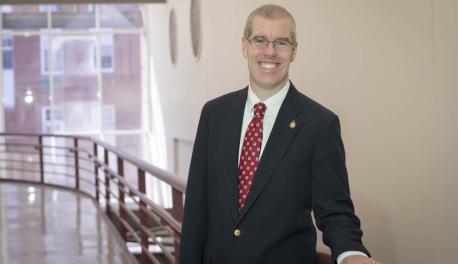
Art Heinricher and Judith Miller are extending the benefits of project work throughout the curriculum and helping students see the links between concepts in math and science.
"The NSF grant will help us address both the lack of project experience and the lack of integration in the first two years, and also help students acquire skills that will be critical to the successful completion of their required projects and later, to their professional careers," says Arthur Heinricher, associate professor of mathematics and the author of the NSF proposal. "The vehicle for accomplishing this is what we're calling bridge projects."
Heinricher says the idea behind the projects is that freshmen and sophomores taking introductory classes in fundamental subjects must see how the concepts in those subjects relate to one another. Each project will build curricular and conceptual bridges between a pair of introductory courses - for example, biology and chemistry, or calculus and physics. The instructors for both courses will work together to develop examples, assignments and projects that require students to use aspects of both disciplines.
The bridge project program will take advantage of the concept of the peer learning assistant (PLA), an innovation developed by Miller and others with support from the Davis Educational Foundation. PLAs are students who help instructors of introductory courses work more efficiently by assisting student groups with projects and assigned tasks. "PLAs must have taken the courses before and have good academic records and good interpersonal skills," Miller says. "For their efforts, they will receive a stipend, along with valuable experience in teamwork and project management.
"The NSF award will have many positive outcomes for WPI," Miller adds. "It will bring faculty members from different disciplines together to think about education. Just as important, it will help WPI continue to build its reputation as a center for curricular innovation and as a model for engineering educators across the country."
Michael Dorsey