WPI
Journal

Summer 1997

Hispanic Culture in the Movie Lab

T he Nutty Professor" and "Grumpy Old Men," read the signs on the walls. They're not descriptions of instructors left by disgruntled students; they're movie posters that decorate WPI's newest multimedia computer lab. But the first class to make use of the Movie Lab took students far from Tinseltown.

Students who took "Topics in Latin American Culture" in the fall of 1997 met in the Movie Lab on a regular basis to access audio and video clips, review World Wide Web sites, and make presentations relying on student-created Web pages. The class also met in a traditional classroom to work on Spanish conversational skills and to discuss course material.


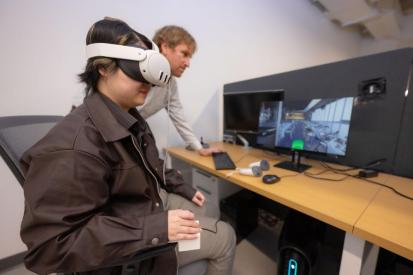
Angel Rivera, left, with the help of Mike O'Neil, used the high-tech tools in a new multimedia lab to bring Latin American culture alive for his students.


"The technology is an enhancement for education, not a replacement," says course instructor Angel Rivera, assistant professor of Spanish, whose foray into the technological world of the Movie Lab was an education in itself. Beginning with only basic computer skills, he received a tutorial from Mike O'Neil, instructional designer in WPI's Instructional Media Center (IMC), and then spent many hours learning to set up a web site for his course, which includes maps, images, video clips, lecture summaries, concept and vocabulary reviews, and study questions.

In addition to serving as an aid in class discussions, Rivera says, the Web "gives students some power. They come to the lab on their own to review course material and create their own web pages - in Spanish - for their final presentation. I was tired of receiving traditional papers. When a student submits a Web page, suddenly it's not flat paper anymore. It branches out in many directions."

Students in the class worked in teams of three or four to create two Web pages: one presenting historical, political, geographical and cultural background on a selected Latin American country, and a second exploring a topic such as economic and political problems in Puerto Rico or racial questions in the Hispanic Caribbean.

The results were impressive, Rivera says. One presentation on Puerto Rico included a link to audio clips of Puerto Rican music. Other links introduced sources in both Spanish and English, including daily newspapers. Students really "soaked up information," Rivera says. "They had to write, listen, talk and respond in Spanish. And they fielded some tough questions from their peers."

O'Neil has seen this magic work before. "The process of building interactive Web pages encourages you to come up with new ideas and perspectives, and to dig deeper into a subject than you might otherwise."

Located on the ground floor of Fuller Labs, the Movie Lab is the product of a collaboration of Lee Fontanella, head of the Humanities and Arts Department, David Cyganski, professor of electrical and computer engineering, Pennie Turgeon, director of the IMC, and Helen Shuster, director of the Gordon Library. It was made possibly by a $200,000 contribution from the Class of 1956, part of its 40th anniversary gift to WPI that also made possible a new library computer system. The Hollywood theme was selected to foster a more creative environment, O'Neil says.

Seating 28, the lab is equipped with 14 powerful multimedia PCs loaded with a large assortment of graphics, word processing, 3-D animation and Web authoring software. On top of each computer sits a small video camera that, in concert with special software, can enable people to see and talk to people around the world. "This is an exciting application for language instruction," says O'Neil.

Other innovative applications will be added as new courses in the humanities, arts, and electrical and computer engineering are taught using the lab's facilities. Notes O'Neil, the Movie Lab's potential, like the imagination of Hollywood itself, is virtually limitless.


[WPI] [Contents] [Top]

webmaster@wpi.edu
Last Modified: Thu June 10 11:48:56 EDT 1999