

Secured: A Special
  Focus

Jay Gainsboro

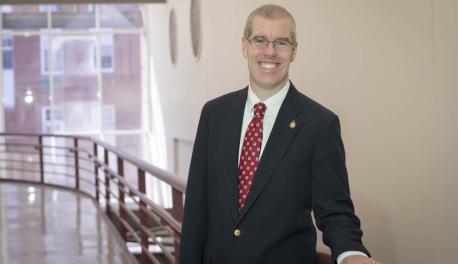
Name a person, place and thing that link deposed hotel queen Leona Helmsley, drug-dealing despot Manuel Noriega and convicted killer James Earl Ray. Try Jay Gainsboro '75, prison and the telephone.

When Helmsley, Noriega and Ray phoned home-or anywhere else-during their incarcerations, they shared a vital connection to this entrepreneurial WPI alum and they all paid for it-prepaid in fact. This infamous trio, whose collective rap sheet includes tax evasion, drug dealing and murder, has been counted among the "captive" client base of prisoners worldwide who use The Enforcer, an inmate telephone control and billing system developed by Opus Telecom Inc., Gainsboro's privately held company. Not long ago, Framingham-based Opus put its technology and Gainsboro's nerves to the test by focusing all its energy on a new customer. It was that attention to detail for which the company is widely known that helped convict Oklahoma City bomber Timothy McVeigh.

Opus Telecom, founded in 1979, specializes in applications of what is known as computer telephony integration or CTI. Opus makes CTI products primarily for two markets: prepaid telecommunications systems (such as prepaid phone cards) for the "teledebit" market and inmate telephone systems for the corrections market. Gainsboro, president and sole owner, says the company's two current strengths are prison calling and control systems and prepaid wireless communications, though it also has the burgeoning international telecommunications market in its scope.

Gainsboro, who holds several telecommunications patents, estimates Opus' combined sales at about $30 million. He says the company's 50 employees process 30 million calls a year at more than 80 sites in the United States and Europe. The company's major partners include AT&T, MCI, British Telecom and Lucent.

Among the many other functions they perform, Opus' busy computers track and store information on prepaid phone card use nationwide. It was a 17-month trail back in 1995 of a system to store debit card calls that helped convict Timothy McVeigh, whose bomb killed 168 people-including many children-and injured 500 others as it destroyed the Alfred P. Murrah Federal Building on April 19, 1995.

Using and recharging a phone debit card issued in the name of Darryl Bridges, McVeigh made nearly 700 calls, including some to former Army buddy Terry Nichols, to military surplus stores, to munitions and chemical companies, and to a Ryder truck rental outlet. Gainsboro and his team used their system to sift through eight billion bytes of stored data to identify the origin and destination of each call. The hundreds of non-reimbursed hours they invested helped federal prosecutors prove that "Darryl Bridges" was really Timothy McVeigh. "What I learned from this experience," says Gainsboro, "is that the government will find you if they put the resources in place to do it."

Opus' involvement in the McVeigh case began two days after the bombing, when Gainsboro got a call from an Opus client, West Coast Telecom (WCT). The caller, John Kane, was working with the FBI and the Secret Service to retrieve phone records concerning a suspect. Gainsboro and his team were asked to determine who made a 57-second call from the Dreamland Motel in Junction City, Kan., between 9 a.m. and 11 a.m. on April 17, 1995. The call, to an 800 number, went into WCT's switch, then into Opus' calling card platform. It was one call among 7.8 million calls tracked by Opus nationwide during that two-hour period. After identifying the call, the Opus system determined that the PIN and account number were for a phone card purchased from Spotlight, a magazine published by the Liberty Lobby in Washington, D.C. The Liberty Lobby provided the cardholder's name-Darryl Bridges. The FBI found a phone card in that name in the home of Terry Nichols and obtained other evidence linking the alias to McVeigh and Nichols.

The information was what federal prosecutors needed to start building their cases against the two suspects. After pinpointing that call, Opus was able to trace hundreds of other calls made with the card to people and businesses that figured in the preparations for the bombing. Gainsboro was slated to testify at McVeigh's trial in Denver, but was given an 11th-hour reprieve by a change in witnesses. "I was in the 'on-deck' room and was anxious," Gainsboro says. "I knew that the defense would try to undermine my credibility. I felt a tremendous responsibility to do a good job. I had met the families of the people who died. I got very close to the horrendous loss of life."

Supporting the government's efforts to convict McVeigh cost Opus about $100,000, but Gainsboro does not regret the time and resources he and his team invested. He cites those who claim that the phone records constituted 80 percent of the case against McVeigh. The records provided a kind of timeline-one that allowed the prosecutors and jury to watch, in retrospect, McVeigh's movements in the months, days and minutes leading up to the bombing.

Involvement in the high-profile Oklahoma City bombing was a sharp detour for Gainsboro, who never sought the limelight, just success. Growing up, he was surrounded by entrepreneurs. His father and uncles all owned their own businesses. After deciding at 14 that someday he would start a high-tech company, Gainsboro turned to a successful family friend for guidance. The friend's formula included a degree from a good technological university. That advice brought Gainsboro to WPI.

"My education at WPI was excellent," he says. "I majored in management and took some basic engineering courses. When I look back at the value of my years at WPI, I think of one professor in particular, Joe Mancuso. He was quite entrepreneurial and took me under his wing. He had a strong influence on helping me understand business issues. It was at WPI that I met my future business partners, Russ Vickery, Jeff Birkner and Dave Erickson. They helped me get started."

Path of McVeigh call through Telecom systems

Prior to founding Opus in 1979, Gainsboro helped his father start a new consumer products business in Chicago. While there, he became aware of new long-distance carriers, such as MCI and Sprint, that billed themselves as alternatives to AT&T. He estimated that using Sprint could save his father's new company 30 percent on long distance charges. Though touch-tone service was not available through the local phone company's outdated central office, he still managed to save $1.50 on his first call. Using a screw-in keypad that attached to his rotary-dial telephone, he was able to punch in the 23-digit access code Sprint and MCI users had to enter before dialing every number. Gainsboro immediately saw a tremendous money-saving opportunity for millions of businesses; his father saw an inconvenience.

"My father wouldn't use the keypad," Gainsboro says. "He had no patience with the 23-digit access code. His refusal was the impetus that drove me to find a solution to the problem. I went out and bought an auto-dialer, so all he had to do was dial five digits plus an authorization code, but my dad was still frustrated by all the numbers and wouldn't use it."

His father's second refusal spurred Gainsboro to turn to Vickery, Birkner and Erickson, who designed and developed a "store and forward" dialer. The new dialer made gaining access to alternative long-distance carriers virtually transparent to the caller. The business user would dial calls in the usual fashion, and the unit would analyze the digits, check the telephone network, and forward the calls to the appropriate carrier. That was the birth of Opus Telecom. Not surprisingly, Sprint was excited about the dialers, the first of which were sold to hotels and motels.

Sales of the new dialers reached $3 million by 1983, the year AT&T settled its antitrust case and U.S. District Court Judge Harold Greene decreed that consumers should have equal access to all long-distance carriers. The ruling marked the end of the dialer business. But Gainsboro, fascinated since childhood with the possibilities and potential of the telephone, went on to invent several other telecommunications products.

"We got into the real-time rating of phone calls, building call accounting systems that rated and tracked calls," Gainsboro says. "We started selling these to law firms, country clubs and the like. Until 1987 all the features we offered were contained in a small box. The Army forced us out of our box."

It was the scale of the U.S. Army's telephone tracking and rating needs that forced Opus to rethink its technology. Moving from methods for controlling a 3,000-caller database to a database with an unlimited number of callers not only took the technology out of the box, but marked a critical shift in the company's focus, technology and market.

"AT&T came to us because one of its customers, the New York Department of Corrections, wanted to know what numbers were being called from prison phones and who was making the calls," Gainsboro says. "Until that time, 80 to 90 percent of the calls prisoners made were collect calls. The Federal Bureau of Prisons had a new idea-let prisoners pay for their own calls through a prepaid system."

Opus, with GTE, won the contract to develop the new prepaid calling system, which quickly accounted for 80 percent of the market for prepaid and collect calling systems. In fact, prepaid calling technology was developed first for prisons. The idea for the popular prepaid phone card emerged in 1992 at the suggestion of WCT's John Kane. Opus developed the technology and sold it back to WCT. Organizations, such as the Liberty Lobby, were offered their own prepaid calling cards to sell to customers, clients or subscribers.

After Spotlight subscriber Timothy McVeigh bought his phone debit card under the alias Darryl Bridges, he became, as Gainsboro puts it, "an Opus customer for life." Because of its experience with prison phone systems, Opus maintains detailed records on all calls made with the cards it tracks. Had McVeigh bought his card in a retail store, it would have been more difficult to identify the card's owner, Gainsboro says. With McVeigh now behind bars, Gainsboro says he can expect the same high standard in customer service and attention to detail that helped land him there. Today, any calls McVeigh makes are tracked and stored in the Opus network database.

-Walker is a freelance writer whose last article for the Journal was a profile of the late David Todd in the Spring 1998 issue.


webmaster@wpi.edu
Last Updated: 11/20/98 11:18:35 EST


WPI Journal Home Contents Top