Larry Raymond activates a walk signal with the Crosswalk Button Locator.
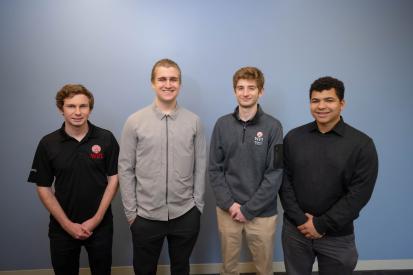
From left, Raymond, Polizzotto, Geiger, Lynch, Tamang, Laplume.The sighted can hardly imagine the terror the blind experience negotiating a busy street. An intersection may have a pole with a crosswalk button, but how does a visually impaired individual find the pole--let alone the button that makes the sign light up? Completing a required project, Matthew Geiger ’02, Brian Laplume ’03, Jeremy Lynch ’01 and Robin Tamang ’02 worked with Lawrence M. Raymond, Worcester’s assistant director of human resources, to develop a device that would allow a blind person to locate the crosswalk button.
"The walk light only goes on when the button is pushed," says Raymond, who is blind. "If I come to an intersection and no one else is standing there, I may miss a couple of cycles before I can cross." Knowing of WPI’s experience with community-oriented projects, Raymond called the University in search of an inexpensive, effective solution to the problem. His request was passed on to Leonard Polizzotto, professor of practice and director of WPI’s Center for the Globalization of Technology, who assembled the project team and served as its advisor.
The "Crosswalk Button Locator" uses a transmitter installed in a cane or attached to a guide dog’s collar to signal a receiver (an antenna and a beeper) mounted on a light pole and connected to the signal button. When the transmitter is activated, a beep guides the user to the button. Estimated cost is only $100 per pole ($400 per intersection). The device was designed to augment the current crosswalk system used in Worcester and other cities: a flashing lighted sign that may "chirp" when it is on.
"The students did an outstanding job," says Polizzotto. "They surveyed blind people to determine what they needed, then used what they learned to come up with this product. Its simplicity and cost-effectiveness will make it attractive for cities to install. The result should be a significant improvement in the safety and independent mobility of the visually impaired."
Raymond demonstrated the students’ invention in front of Worcester’s City Hall. Polizzotto says they plan to market the device to cities across the country and are currently applying for a patent and researching manufacturing options. The project may also be the start of a new WPI/Worcester connection. Raymond has come up with yet another idea: in the Worcester Public Library at Salem Square (which is currently being renovated and expanded), "talking" signs will help the blind find their way around, making it easier to locate services and special equipment. Polizzotto is recruiting a new student team to work on this project.
"I strive to be as independent as possible," says Raymond, who uses a guide dog. "To have my independence and be able to cross the street safely is one more way I can empower myself." He adds that while the city manager has expressed an interest in the project, no commitment has been made to purchase any of them.