Leonard White '41
Investing in Students
Leonard White ’41, a WPI trustee emeritus, has made a $1 million bequest to his alma mater to support student financial aid. The Leonard and Ann White Endowed Scholarship Fund honors White’s late wife and represents his gratitude for her support during their life together.
“Ann did half the work, she should get half the praise,” says White, who wanted to remember her in a special way. “She worked very hard for WPI.”
The scholarship fund is an especially fitting tribute, since White proposed to his wife on Earle Bridge. Ever since then, WPI has remained an integral part of their lives, with Leonard and Ann working together to advance the university. White’s generous gift also supports a critical priority for the university—student financial aid.
White understands firsthand the financial demands of a top quality higher education. Growing up just a few miles away in Auburn, Mass., White says WPI was the obvious choice for his college education. His father, a contractor, lost much of his business during the Depression, making WPI all the more attractive—White could live at home and work part-time for a local water company to pay his way through an excellent engineering program. White clearly recalls his earning power—50 cents an hour—which paid his annual tuition bill of $320. After graduating with a bachelor’s degree in mechanical engineering, White took a position with the Public Service Electric and Gas Company of New Jersey for a 44 percent pay increase to 72 cents per hour.
In 1943, with World War II enveloping the United States, White enlisted in the Navy as an engineer officer and served in the Pacific Theater, eventually as an executive officer and navigator. At the close of his service, White returned home and began working for the family business, R.H. White Construction Co. When his son, David White ’75, enrolled at WPI, White became more involved with the life of his alma mater once again. Among his many activities, he has served on reunion committees
and as a class agent, participated in fundraising initiatives, and has attended many WPI events over the years. During his time on the Annual Fund Board, White established the President’s Advisory Council. This group of leadership donors to WPI started with 30 members. Today this group, known as the President’s Circle, is several hundred strong. White served as a WPI trustee from 1977 to 1992, contributing his time and expertise to many campus initiatives.
In addition to the Leonard and Ann White Scholarship Fund and Ralph H. White Scholarship Fund, the Whites, with their son, David, also established the Ralph H. White Professorship in Civil Engineering in 1987. The White Professorship is currently held by Rajib Mallick.
“I’m pleased to be able to do this for WPI,” says White. “I’ve enjoyed my relationship with the university, and I hope it will continue. It’s a pleasure to have my name associated with WPI.”
Students give the new facility high marks.
“As a double major in chemistry and biochemistry, I know firsthand the transformation that has taken place in Goddard Hall to create the new George I. Alden Center. And I can say with confidence that this is a facility of which we can all be proud, a facility that matches the outstanding instruction we receive from our professors,” said Roseann Gammal ’10, vice president of the Student Government Association.
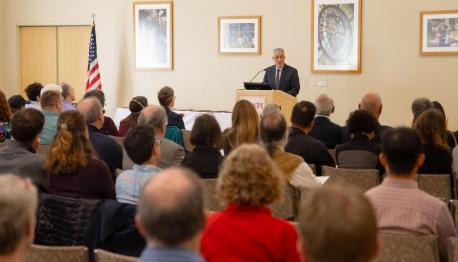
Please note picture on right: Professor Jill Rulfs (left), associate department head for biology and biotechnology, shows features of the new undergraduate life sciences labs to guests at the Alden Center dedication.
Gammal noted her family’s long history with WPI—her grandfather, Charles Gammal ’20, was the first of several family members to graduate from the university. He was at WPI at the same time as Robert H. Goddard, the father of modern rocketry, and George I. Alden, who was a university trustee by then. Her grandfather, also a chemistry major and later an organic chemistry lab instructor at WPI, would be impressed by the new Alden Center and proud of the WPI of today, Gammal said.
“Although the campus has undergone many physical changes, my grandfather and I have both experienced something that has remained constant over the years: a quality WPI education, grounded in a long history of excellence, devoted to the Two Towers concept of theory and practice, and dedicated to producing graduates ready to tackle some of the world’s most challenging problems.”
One change since her grandfather’s days at WPI is the recent emphasis on the life sciences and bioengineering. In recent years, WPI has invested approximately $75 million in faculty, facilities, equipment, and staff in life sciences and bioengineering, most notably at the graduate Life Sciences and Bioengineering Center at Gateway Park. The opening of that facility in 2007 made significant academic space available on WPI’s main campus, thus paving the way for the creation of the George I. Alden Center.
The Gateway Park facility is also considered a catalyst for the development of biotech and life sciences industries in Central Massachusetts. With Governor Deval Patrick’s focus on growing the life sciences industry in the state through the $1 billion Massachusetts Life Sciences bill signed in 2008, President Berkey said, “the timing of the Alden Trust’s investment in undergraduate life sciences education at WPI just couldn’t be better.”
“Many of the students who will work and learn in these laboratories will make important contributions as scientists, entrepreneurs, business leaders, and other professionals in the life sciences industry, on pressing problems in health and medicine and related opportunities in commerce,” he said. “It is indeed exciting to see how well our academic aspirations align with the national and global needs in health, medicine, and economic development.”
Roseann Gammal, like her grandfather and other family members, believes in this promise of a WPI education.
“As a student, I believe in a WPI education. I’m living it, and I’m grateful for those like George I. Alden and the trustees of the Alden Trust who share that belief with me,” Gammal said. “With the George I. Alden Center supporting our work, WPI life sciences students will graduate prepared to live up to the WPI ideal of using engineering, science, and technology to create positive change in the world.
George I. Alden and his legacy
A man of the Industrial Revolution, George I. Alden taught mechanical engineering at WPI for 28 years. Alden, an innovator and pioneering faculty member, was a driving force behind combining theory with practice in engineering education, an approach that continues to be a cornerstone of the WPI experience. WPI graduates, able to lead in the burgeoning Industrial Age, will be the future leaders in the Biotech Age, thanks to Alden’s philanthropic vision.
The George I. Alden Life Sciences and Bioengineering Educational Center was created with an $11.5 million commitment from the George I. Alden Trust. Alden established the trust in 1912 for the general purpose of “the maintenance of some charitable or philanthropic enterprises” with particular expressed interest in “the promotion of education in schools, colleges, or other educational institutions,” as well as particular interest in WPI and two other named organizations.
The trustees of the Alden Trust have given priority to higher education, predominately in support of independent undergraduate education, in smaller institutions with fulltime traditional undergraduate enrollments of 1,000 to 3,000 students. The trustees focus their grant making on capital needs. They support institutions that demonstrate a combination of educational excellence, exciting programming, and efficient and effective administration. The trustees primarily support proposals that they feel will contribute significantly to the intellectual growth of students and will enhance an institution’s mission, with particular emphasis on Alden’s expressed desire to “do the greatest good to the greatest number of beneficiaries.”
The Alden Trust is WPI’s most generous benefactor, committing a total of $19,577,085 over the past 80 years to help advance the university’s mission of preparing the next generation of leaders in engineering and science. In 1929, the Alden Trust made its first gift to WPI of $181,085 to establish the George I. Alden Fund. In 1970, the Alden Trust established the George I. Alden Chair in Engineering with a gift of $500,000. Since then, the Trust’s commitment to WPI has supported many capital projects aimed at advancing undergraduate teaching and learning. In addition to the Alden Life Sciences and Bioengineering Educational Center ($11.5 million), these include: Salisbury Hall renovations (1973-76, $750,000); Atwater Kent renovations (1979-82, $1 million); Fuller Labs construction and campus computerization (1985-87, $1.2 million); Alden Memorial renovations (1988-90, $1.64 million); Higgins Laboratories renovations (1993-96, $2.4 million); and Little Theatre funding (2004, $400,000).