
Worcester Polytechnic Institute’s annual Undergraduate Research Projects Showcase transformed campus into a vibrant celebration of innovation, discovery, and student achievement as seniors presented the culmination of their academic journeys through Major Qualifying Projects (MQPs). Highlighting the breadth and depth of WPI’s signature project-based education, the event brought together students, faculty, project sponsors, and the broader community to experience how undergraduate research is tackling real-world challenges with the potential to shape industries, improve lives, and change the world. From groundbreaking engineering solutions to interdisciplinary advancements, these capstone projects not only mark a defining milestone for students but often lead to peer-reviewed research, patents, startup ventures, and career-launching opportunities.
From sustainable transportation and life-saving robotics to quantum computing and accessible AI, the following projects represent just a sample of the creativity, technical excellence, and real-world impact on display at this year’s showcase.
Comparing the Stress Reduction Impact of Social Media Use with Restful Activity

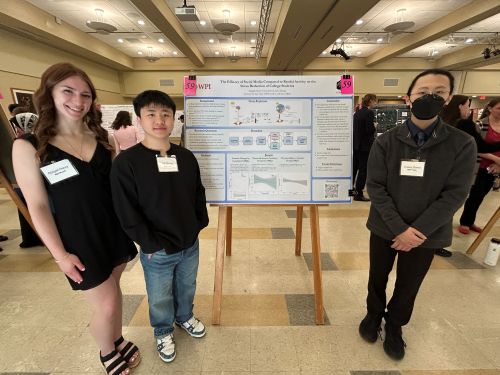
Students: Abigail Henry, Casey Dowd, and Eric Zhong
Advisors: Stacy Shaw and Louis Roberts
The team studied whether deliberate self-chosen restful activities like puzzles or building with LEGOs reduced physiological stress more or less than social media use, which is a common quick coping mechanism students may use for stress relief. The study involved collecting saliva samples and conducting student surveys from 45 student participants. The study found no statistical differences in cortisol level reduction between the strategies tested. The team suggests future research use more study participants and more specific survey questions.
Q: What inspired you to take on this project?
A: Abigail Henry: “I am super interested in social media. I use it all the time. So, I thought it would be interesting to see how we could juxtapose that with intentional rest to try to help out college students.”

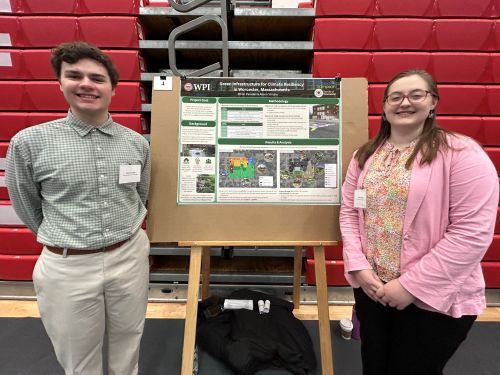
Designing Green Infrastructure in Worcester
Students: Ethan Paredes and Alison Strojny
Advisors: Suzanne LePage and Stephen McCauley
The team developed a green infrastructure design plan to mitigate stormwater runoff and the heat island effect in a neighborhood in Worcester. The students suggested a design with natural solutions, including rain gardens and bioswales, to handle runoff around a school. Through mapping data analysis, site visits, and collaboration with project sponsors—the City of Worcester and Weston & Sampson, an engineering and environmental consulting firm—the team proposed solutions to address storms that drop more rain than current infrastructure can handle.
Q: How does it feel to know that you’ve got a concrete proposal that could potentially help the City of Worcester?
A: Ethan Paredes: “We put a lot of effort into this project. It feels good to see that effort actually materialize into something that is going to make the change that we hoped it would.”
Developing a Scanning Device for Integration into Drones for Medical Emergency Rescues

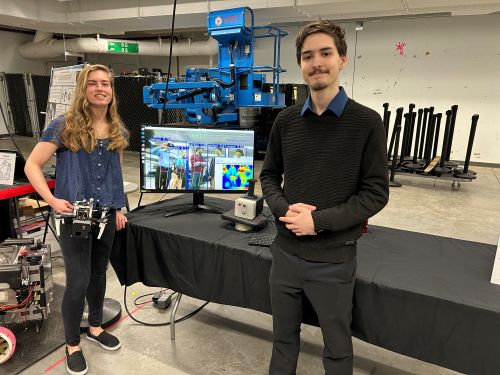
Students: Ian Hagglund and Caitlin Murphy
Advisors: Guanrui Li and Giovanni Pittiglio
The students created a handheld device, which could be carried by a drone, that utilizes two types of cameras and radar to scan a body, measure a person’s vital signs, and detect signs of trauma or bleeding. The goal is to assist first responders in disaster zones by empowering them with technology to locate injured people and assess their physical condition.
Q: What motivates you or interests you in this problem?
A: Ian Hagglund: “Being able to find a robot to be able to better perceive the world around it and to better perceive people so that it can help people that are in need is really important to me. And it’s also really important to be able to help people at the same time. So that’s really what motivates me.”

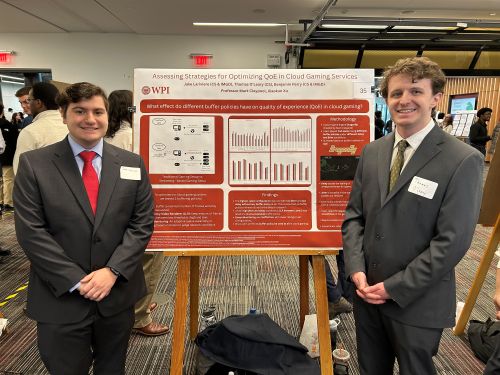
Analyzing Strategies to Optimize Cloud Gaming User Experience
Students: Thomas O’Leary, Jake Lariviere, and Benjamin Perry
Advisors: Mark Claypool and Xiaokun Xu
The team created a computer game to be played over a network and tested network buffer policies under varying network conditions to study the impact on input delay and smoothness of game imagery. The team identified a no-buffer policy as the best option for this particular game for maintaining a user experience closest to a traditional gaming system in which games are not played over a network.
Q: What are you most proud of about this project?
A: Thomas O’Leary: “I play a lot of video games. So, being able to make a game was definitely something that I really found enjoyable. And then being able to bring in my computer science knowledge to test all these buffer policies and network delays and the effect they have on the user. It was really interesting working with a team. That feeling of having a project that you can definitely own is incomparable.”
Reducing Vibration in Baby Carriages

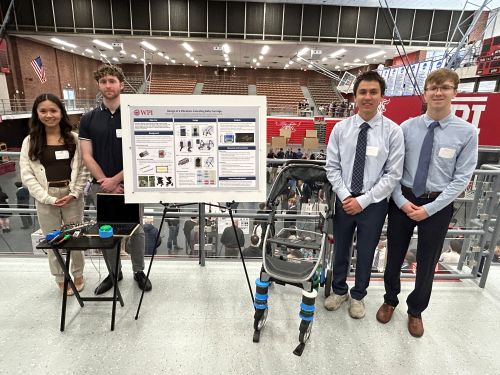
Students James Hoagland, Andrew Pugh, Rachel Tsang, Nikita Zuev, and Michael Collins
Advisor: Joe Stabile
The team developed a suspension system for baby carriages to improve child safety and comfort during transportation and enhance the caregiver’s experience. The design relies on a combination of voice coil motors and moving magnets, with the goal of improving on current approaches to suspension for baby carriages.
Q: Where could this project go from here?
A: Rachel Tsang: “We’re hoping another group of students can build off this research. By just blending active suspension and passive suspension systems in a stroller, this is definitely a really good starting point. We have that proof of concept, and I think that future work could definitely improve it and continue to develop this.”

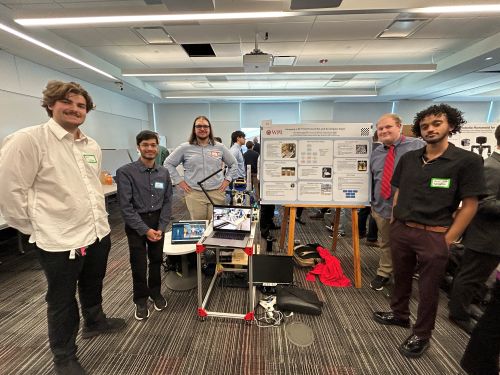
Implementing Artificial Intelligence Computer Vision into a Chess-Playing 3D-Printed Robot
Students: Ethan Ford, Max Williams, Aziel Habtemichael, Nicolas Graham, Nate Caughron, and Arjun Vyavaharkar
Advisors: Taylor Andrews and Pradeep Radhakrishnan
Students created an app to allow a robot to play chess. Through work on computer vision, simulation, and the device at the end of the robotic arm, the team trained and allowed for arm motion control so the robot could recognize chess pieces, pick them up, and place them as designed. The robot is also designed to be able to pick and place a variety of objects in a tabletop setting, including pill bottles.
Q: How did you benefit from working on this project as a team?
A: Max Williams: “We had a large group. In general, I think the best part of working in a group is having a bunch of different ideas and being able to rely on other groups of people to help while still being focused.”
Advancing the Development of a Sleep Health Game

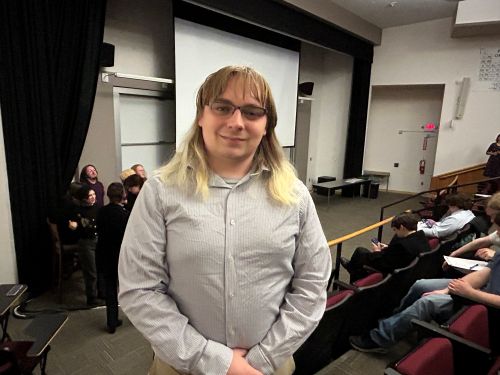
Student: Trey Bowen
Advisor: Gillian Smith (Project Center: Kyoto, Japan)
Bowen helped further the development of a smartwatch-based game, “Sleep Tamagotchi,” by implementing new elements and updates and conducting a user study of the game prototype that has been developed by students at Kyoto University of Advanced Science (KUAS) in Japan. The game is designed to promote better sleep health. Bowen conducted the user study while abroad at WPI’s major qualifying project center in Kyoto, Japan, and through collaboration with KUAS students.
Q: What was the most impactful part of this project for you?
A: Trey Bowen: “I think the most impactful experience for me was being able to work with people from other majors who were not as familiar with making games and to help them overcome some of the challenges as they found there’s more to the development process than they originally thought.”

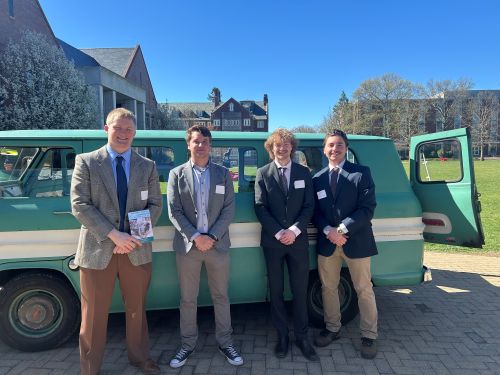
Electric Conversion of a 1962 Corvair Van
Students: Trevor Bowen, Jacques Blashka, Colin Cotton, and Iain Spearance
Advisors: Lee Moradi and Hunter Zhang
The team transformed a vintage 1962 Corvair van into a fully electric vehicle using salvaged components from a 2015 Nissan Leaf. The project combined mechanical redesign, battery integration, and electrical engineering to create a replicable platform for sustainable vehicle restoration. Beyond the building itself, the team developed a detailed guidebook to help others safely convert older vehicles to electric power.
Q: What is the possible outcome of this project?
A: Team members, "We designed it so it can be replicated. Part of our project was creating a guidebook so others can safely follow the right engineering steps and potentially convert and preserve their own older vehicles."
Flarebot: Unmanned Firefighting Reconnaissance Robot

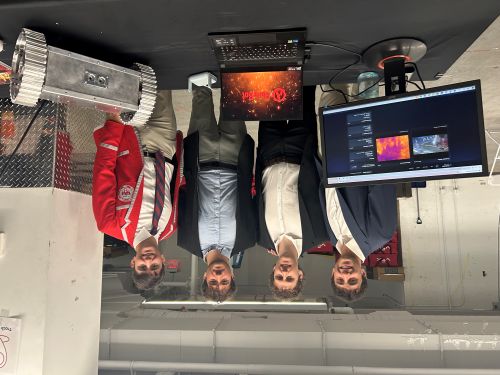
Students: Nicholas Carignan, Aidan Carter-Frem, Max Gosselin, Trajen Masner, Henry Wagg, TJ Weeden
Advisors: Mustapha Fofana, Griffin Tabor, and Jacob Whitehall
Inspired by Worcester’s 1999 Cold Storage Warehouse tragedy, students developed Flarebot, a robotic platform designed to enter burning structures before firefighters, conduct initial searches, and detect trapped occupants. Equipped with sensors and search capabilities, the system aims to improve survival rates while reducing unnecessary risks to first responders.
Q: How does this project have the potential to create meaningful real-world impact?
A: Henry Wagg: “If we can deploy a robot immediately into dangerous fires, we can increase survival chances for victims, while also protecting firefighters from risking their lives unnecessarily."

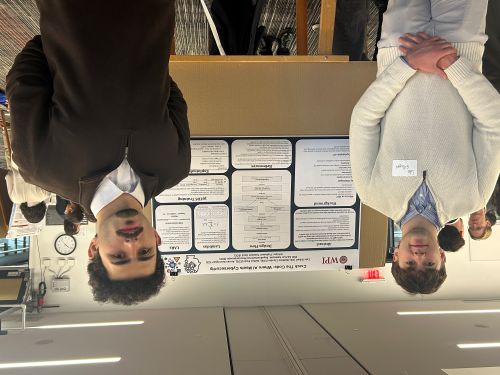
Crack the Code: Where AI Meets Cybersecurity
Students: Matthew Cloutier, Arman Gevorgyan, Cole Gilbert, Nathan Ewell
Advisor: Fatemeh Ganji
This project advanced cybersecurity defenses by integrating explainable AI into existing security systems, producing human-readable analyses of threats. The system helps analysts more efficiently identify malicious activity, including emerging zero-day attacks, while improving transparency and trust in AI-assisted security operations,” said Gevorgyan.
Q: How critical is this research today?
A: Arman Gevorgyan: “As modern computing grows more complex, explainable AI becomes essential for helping security analysts defend systems more effectively and identify threats faster.”
Distributed Quantum Computing Research

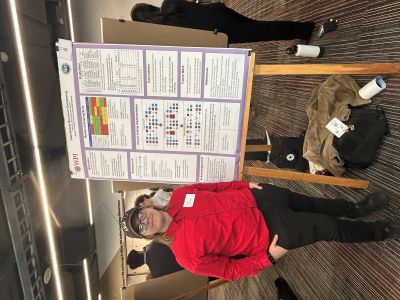
Student: Peter Cancilla
Adivsor: Tian Guo
Supported by the National Science Foundation, this research explored how multiple smaller quantum processors can work together to achieve the computational power of larger quantum systems. The project leveraged WPI’s advanced computing resources and cloud infrastructure to address one of quantum computing’s major scalability challenges.
Q: How did the NSF funding assist this project?
A: Cancilla: “NSF support was critical because it provided access to the significant computational resources needed to advance this research,” said Cancilla.

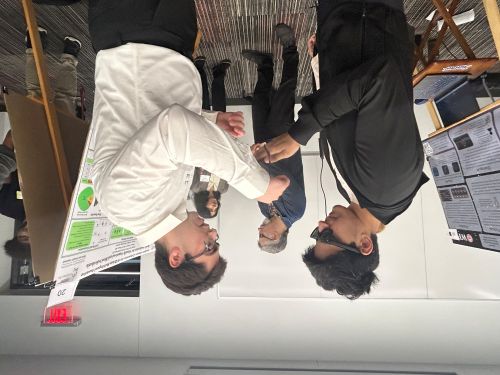
InnoSpire Glasses Companion: An AI-Driven Multilingual Assistive Mobile Application for Visually Impaired and Blind Individuals
Students: Zachary Gluck and Samruddhi Naik
Advisor: Chun-Kit Ngan
Students developed software for AI-enabled smart glasses that assist blind and visually impaired users through real-time text-to-speech, object recognition, and remote volunteer support. The mobile app enhances independence by converting visual information into accessible audio guidance.
Q: What inspired your passion for pursuing this research?
A: Gluck: “Meeting visually impaired users and seeing their excitement about how this technology could directly improve their daily lives was more valuable than any technical achievement.”
Performance Analysis of the North American Aviation P-51 Mustang

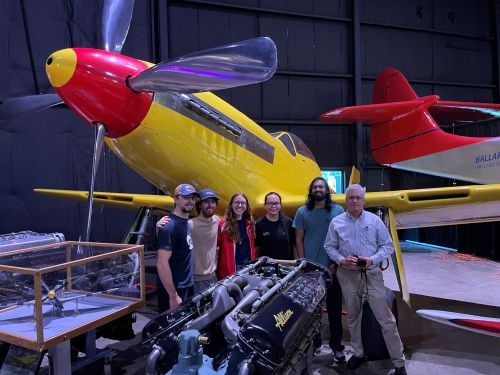
Students: Dylan Wagner, Zachary Roethlein, Henry Wright, Grace Cink, Anastasia Siryk, Jaden Gitlow, Arjun Ramakrishnan, Caitlin Veltrup
Advisor: John Blandino
This MQP team investigated the long-debated speed record of a modified North American Aviation P-51 Mustang, a famed World War II fighter later adapted for competitive air racing. Using advanced simulation models, historical performance data, and virtual measurement tools, students analyzed whether one racer could truly have averaged more than 500 mph over an entire race.
Q: What was your conclusion?
A: Wright: “If this was on the show MythBusters, the determination would be ‘Plausible,’” That means under specific, extreme, conditions that speed may have been achieved. Coincidentally, Wright landed a job after graduation at Fluid Power Products, where the hiring manager is a WWII buff.
Medical School Collaborations:
Several MQP teams worked in UMass Chan Medical School labs this year collaborating on projects in the life sciences/biomedicine to explore drug discovery and immunology. Those included: Tracing the Embryonic Origins of Innate like T Cells |Kaelie Newell

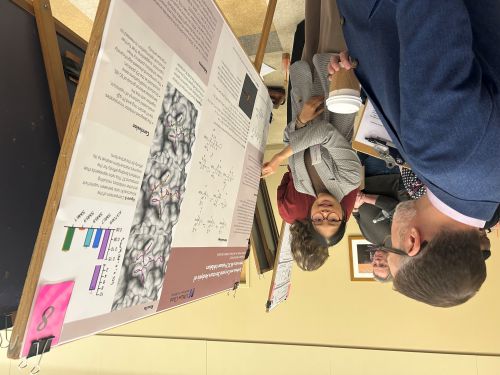
Synthesis and Biochemical Evaluation of Enterovirus 68 3C Protease Inhibitors |Thi Nguyen
Structure-Based Design, Synthesis, and Biochemical Evaluation of Enterovirus D68 3C Protease Inhibitors| Julia Murphy

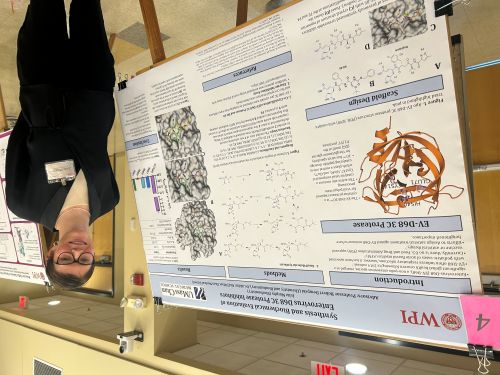
Robert Dempski, WPI professor of chemistry and biochemistry, served as the advisor on these projects and said, “This work not only strengthens students’ technical knowledge, but also expands their professional networks, opens doors to future research and employment opportunities, and creates a springboard for continued success in highly competitive biomedical fields. Our strong partnership with UMass Chan, right up the street from WPI, also reflects the power of collaborating with our neighbors to create meaningful educational and research opportunities that benefit students and advance innovation.”


