Man in a lab coat stands in lab with blurred figures in the background.

Kristen Billiar

Uncovering the Path to Heart Valve Failure

WPI researcher Kristen Billiar leads part of multicenter project funded by American Heart Association to determine causes of heart disease
April 23, 2026

For researchers, the path to understanding aortic heart valve disease is littered with clues.

Chronic high blood pressure, or hypertension, is a risk factor. So is inflammation. And then there is lipoprotein (a), also known as Lp(a), a sticky cholesterol-carrying particle that circulates in the blood. 

Kristen Billiar, a professor in the Department of Biomedical Engineering, will try to determine what turns those risk factors into disease as part of a $15 million multicenter initiative that is funded by the American Heart Association and focused on early detection and prevention of heart valve disorders.

Billiar has been awarded $1,278,213 for a four-year project aimed at determining the connection between circulating Lp(a), the biomechanical forces at work in the aortic valve, and development of calcific aortic valve disease (CAVD). CAVD is the most common heart valve disease, causing an estimated 248,256 deaths in the United States in 2019. The disease thickens, calcifies, and narrows the thin, flexible flaps of tissue that open and close in valves as blood moves through a beating heart.

Billiar’s project is one of three taking place under the Center for Aortic Valve Disease Prediction and Integrated Research at the University of Pittsburgh. Cynthia St. Hilaire, associate professor of medicine at the University of Pittsburgh, is the center director and also will lead a project with collaborators at Creighton University. A third team will be led by Satoshi Okawa, University of Pittsburgh assistant professor of medicine. Together, the three teams will focus on early detection, disease progression, and treatment of aortic stenosis, which is a narrowing of the heart valve that allows oxygen-rich blood to flow out to the body. 

“The project at WPI will focus on biomechanics, but we will also collaborate with researchers at other institutions who are concentrating on cell biology and using artificial intelligence (AI) to examine genetic risk factors,” Billiar says. “The goal is to identify targets for potential therapies to treat heart valve disorders.”

Beginning Quote Icon of beginning quote
Bringing my work together with the work of other researchers has the potential to make great advances in our understanding of heart valve disease and lay the groundwork for new therapeutic approaches. Beginning Quote Icon of beginning quote
  • Kristen Billiar
  • Professor, Department of Biomedical Engineering
Preview

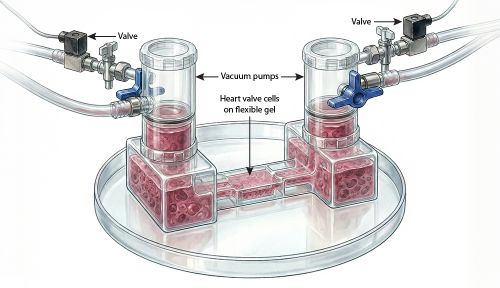
An AI-generated illustration shows a machine that pushes and pulls cells on a gel to mimic the mechanical forces on heart valves.

To study the impact of mechanical forces on heart valve cells, researchers in the lab of Kristen Billiar seed heart valve cells on a gel that is subjected to the forces of fluids pushed by pumps.

High levels of Lp(a), an inherited condition, seem to play a role in hardening the aortic valve. Yet not all people with high levels of Lp(a) develop valve disease, which suggests that other factors such as inflammation and abnormal mechanics may predispose valves to disease.

Billiar will focus on whether disordered blood flow and stretching of valve tissue prime heart valve cells to be sensitive to circulating Lp(a) and inflammation, leading to calcification. He and researchers in his lab will conduct experiments with valve-on-a-chip technology—human valve cells seeded onto a flexible gel that can be stretched and exposed to disturbed fluid flow. 

Undergraduate and graduate students at WPI will participate in the research. Undergraduates will have opportunities to work as laboratory assistants and undertake capstone projects, which all WPI students must complete to graduate.

Billiar’s research focuses on the field of mechanobiology, which involves understanding how mechanical forces regulate health and disease in connective tissues. He has received funding from the National Institutes of Health to research how stretching and blood flow can inhibit or encourage cardiovascular cells to populate and grow in tissue-engineered heart valves. He has received American Heart Association funding to examine how cell death leads to calcium deposits that cause aortic valves to fail.

“This new project builds on years of research and the development of tools that can reveal the role that mechanical forces play in disease,” Billiar says. “Bringing my work together with the work of other researchers has the potential to make great advances in our understanding of heart valve disease and lay the groundwork for new therapeutic approaches.”

Keep Up With WPI Research News

Want to learn more about Research at WPI? Subscribe to the monthly newsletter.


Offices and Departments

Profiles