

Seminar
“Scaling the Goat Path: Translating Human Biomechanics, Wearable/Implantable Sensors, and ML/AI into High-Value Medical Devices”

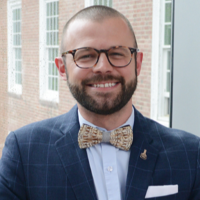
Ryan Chapman, PhD
Assistant Professor, Department of Kinesiology
University of Rhode Island
Abstract: Biomechanics research often stops at understanding how humans move. Yet many of the most impactful insights emerge when those measurements reach the clinic. Navigating the multitude of potential pitfalls of commercializing medical devices from biomechanics research requires innovative science, thoughtful collaborations, and perhaps more importantly, perseverance. In order to "scale the goat path" of medical device development, this seminar will highlight how wearable and implantable sensors, paired with data-driven modeling, can move from basic biomechanics studies, to clinical trials, to translation. Examples will span orthopaedics, surgical alignment, and pregnancy, illustrating how lab-based motion capture and first-principles modeling evolve into free-living sensing, clinical trials, and ultimately licensed technologies and startups that improve patient care. Throughout, we will discuss critical translation hurdles including validation, clinical integration, and improving healthcare value. This work demonstrates how biomechanics, sensors, and ML/AI can create real-world healthcare impact through interdisciplinary collaboration and ultimately commercialization.
Bio: Dr. Ryan Chapman is currently the lab director of the Biomechanics and Wearables Laboratory (BWL) at the University of Rhode Island. Prior to his current role, he earned a BS in Electrical Engineering from the University of St. Thomas (2010), a MS in Biomedical Engineering from the University of Iowa (2013), a PhD in Biomedical Engineering from Dartmouth College (2018), and was a postdoctoral research associate in the Dartmouth Biomedical Engineering Center at Dartmouth College. He has a diversity of engineering and clinical experiences that drive his lab’s work including expertise in human biomechanics, sensor development, and translation/commercialization of technology. By combining his training in electrical engineering and data science principles (sensor design/implementation, ML/AI) with deep clinical needs, his lab has had repeated success developing high value, engineering-driven solutions for challenging healthcare problems. Currently, his research focus is on improving pathologic musculoskeletal biomechanics spanning several populations including orthopaedics, obstetrics, athletics, and soldiers. Outside of research, Dr. Chapman is passionate about developing new biomechanics curricula, increasing access to STEM disciplines for historically marginalized populations, and spending time with his family.
For a zoom link please contact Kate Harrison at kharrison@wpi.edu