
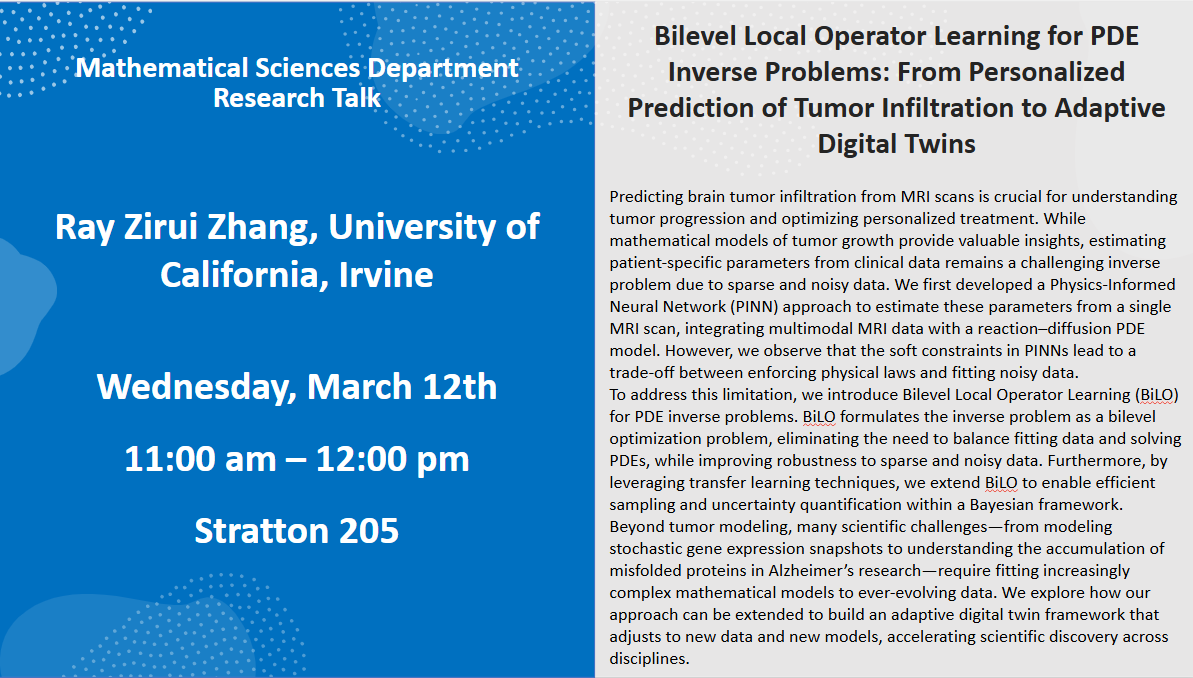
Mathematical Sciences Department Colloquium
Ray Zirui Zhang, University of California, Irvine
Tuesday, March 12th
11:00 am - 12:00 pm
Stratton Hall 205
Title: Bilevel Local Operator Learning for PDE Inverse Problems: From Personalized Prediction of Tumor Infiltration to Adaptive Digital Twins
Abstract: Predicting brain tumor infiltration from MRI scans is crucial for understanding tumor progression and optimizing personalized treatment. While mathematical models of tumor growth provide valuable insights, estimating patient-specific parameters from clinical data remains a challenging inverse problem due to sparse and noisy data. We first developed a Physics-Informed Neural Network (PINN) approach to estimate these parameters from a single MRI scan, integrating multimodal MRI data with a reaction–diffusion PDE model. However, we observe that the soft constraints in PINNs lead to a trade-off between enforcing physical laws and fitting noisy data.
To address this limitation, we introduce Bilevel Local Operator Learning (BiLO) for PDE inverse problems. BiLO formulates the inverse problem as a bilevel optimization problem, eliminating the need to balance fitting data and solving PDEs, while improving robustness to sparse and noisy data. Furthermore, by leveraging transfer learning techniques, we extend BiLO to enable efficient sampling and uncertainty quantification within a Bayesian framework.
Beyond tumor modeling, many scientific challenges—from modeling stochastic gene expression snapshots to understanding the accumulation of misfolded proteins in Alzheimer’s research—require fitting increasingly complex mathematical models to ever-evolving data. We explore how our approach can be extended to build an adaptive digital twin framework that adjusts to new data and new models, accelerating scientific discovery across disciplines.