Active fluids are materials composed of energy-consuming microscopic components that can spontaneously generate flows and complex dynamics without external forcing. A well-studied example is the microtubule–kinesin active fluid, in which kinesin molecular motors drive chaotic, turbulence-like motion at micron scales. While such systems are intrinsically active, a central question remains: How do active fluids respond when subjected to external mechanical forcing?

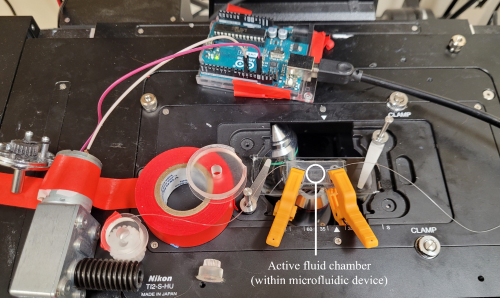
Active fluid was confined within a square chamber of a 3D-printed microfluidic device. A motor-driven thread placed across the chamber opening served as a moving boundary, allowing controlled shear to be applied to the system.
In a recent article in the journal Soft Matter, a team that included WPI researchers in the lab of Kun-Ta Wu, associate professor of physics, identified a common stress threshold (about 1.5 millipascals) that must be exceeded for a microtubule–kinesin active fluid to respond appreciably when confined under different geometries and subjected to externally imposed shear influences. The team also found that once the threshold is crossed, the nature of the response depends on the geometry of confinement.
The researchers reported that in slab-like cavity geometries, externally imposed shear penetrates the bulk and competes directly with internally generated active stresses, producing a kinematic transition from activity-dominated chaotic flow to externally shear-dominated ordered cavity flow.
In contrast, in ring-like (toroidal) confinement, shear remains localized near the boundary and does not directly entrain the entire system. Instead, the global flow response emerges through a cooperative interaction between localized external shear and internally generated active stress.
This mechanism was further demonstrated using a two-connected-toroid experiment and comparison with passive water, revealing that active stresses enable the transmission of localized mechanical perturbations across the system.
Together, the results establish that both stress magnitude and confinement topology determine how active matter responds to external forcing. The research provides new design principles for controlling active fluids in microfluidic systems and may offer insight into how cytoskeletal active materials respond to mechanical cues in biological systems.


Joshua Dickie
WPI PhD student Joshua Dickie was the lead author of the article. Co-authors at WPI were Wu; graduate student Tianxing Weng; undergraduate Haoran Wang ’27; and Yen-Chen Chen ’21, MS ’21, who is a research associate in Wu’s lab. Other co-authors were Yutian He, a graduate student at the University of Massachusetts Amherst; Professor Robert A. Pelcovits and Professor Thomas R. Powers of Brown University; and Saloni Saxena, previously a postdoctoral researcher at Brown and now a researcher at the University of Pittsburgh.
The research was selected by Soft Matter as a 2026 Open Access Spotlight article. The research was supported by the National Science Foundation (NSF-CBET-2045621, NSF-CBET-2227361, NSF-MRSEC-DMR-2011846, NSF-PHY-2309135).
Topics

People