Man in white jacket stands in laboratory.

Jiawei Yang

Researchers Develop System to Customize Hydrogel Implants

Jiawei Yang leads work to improve long-term performance of materials in the body
June 25, 2026

Researchers led by Worcester Polytechnic Institute (WPI) Assistant Professor Jiawei Yang have designed a modular system that could potentially improve hydrogel implants in the body by customizing the materials for stiffness and functionality.

Preview

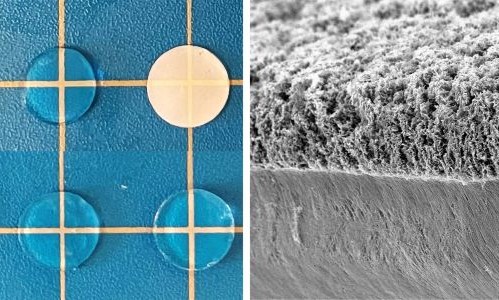
Two side-by-side images of materials developed by researchers.

At left, hydrogels developed by Jiawei Yang and a team of researchers exhibit different colors according to their coatings. At left, a microscopic image of a hydrogel surface. Photos courtesy of Jiawei Yang.

The system, described in the peer-reviewed journal Science Advances, uses coatings to treat the surface of hydrogels, which are flexible, water-loaded polymers. The researchers reported that by customizing different types of hydrogels with unique coatings, they were able to create two distinct hydrogel implants that maintained adhesion in living tissue and resisted an immune system response. 

“It is difficult for a material with a single chemical composition to play two distinct roles in an implant,” says Yang, a faculty member in the WPI Department of Mechanical and Materials Engineering. “We addressed that by developing a way to customize hydrogel implants with two sets of chemical compositions that can be tailored to address specific needs and achieve better results.”

The research addresses two critical challenges in the design of hydrogel implants—functionality and immune rejection. In the body, hydrogel implants need to adhere to tissues that may have different levels of stiffness, ranging from soft tissues in the brain to stiffer tissues in muscles and cartilage. Hydrogel implants also need to function, perhaps by delivering medicine to tissue or holding a device in place. 

Increasing the stiffness of a hydrogel implant to meet the needs of stiffer tissues, however, can alert the immune system to a foreign body. One particularly challenging immune system response is fibrosis, in which the body produces collagen to encapsulate an implant with a thick, dense covering. Once encapsulated, an implant can stop functioning.

Beginning Quote Icon of beginning quote
It is difficult for a material with a single chemical composition to play two distinct roles in an implant. We addressed that by developing a way to customize hydrogel implants with two sets of chemical compositions that can be tailored to address specific needs and achieve better results. Beginning Quote Icon of beginning quote
  • Jiawei Yang
  • Assistant Professor, Department of Mechanical and Materials Engineering

To address the challenges in hydrogel implant design, the researchers grafted two types of ultrathin polymer coatings, ranging from a few nanometers to a few micrometers thick, onto two hydrogels with different structures. Then they tested the materials for adhesion, fibrosis, and stiffness. 

Yang says that the modular system allowed researchers to overcome the traditional trade-off between stiffness and functionality in implant design. The underlying hydrogels could be adjusted to meet stiffness needs, while the coatings could be adjusted to make sure the implant could continue to function in living tissue without triggering an immune response. The thickness of coatings proved to be a critical factor in design, Yang says. 

“By dialing up the thickness of coatings to micrometers, we strengthened adhesion,” he says. “When we dialed down the thickness to nanometers, we saw no fibrosis.”

The research concentrated on work Yang mostly did while he was a research fellow at Massachusetts Institute of Technology and Boston Children’s Hospital. To characterize the materials that were created, Yang used photonics resources at WPI’s Lab for Education and Application Prototypes (LEAP).

Yang, who focuses his research on innovating polymer materials for health and sustainability, joined the WPI faculty in 2024. He received a CAREER Award in 2025 to support work on developing hydrogel bioadhesives for long-term implantation.

Offices and Departments

Profiles