When Professor Nitin Sanket watches birds dart through dense forests or bats spiral effortlessly in complete darkness, he doesn’t just marvel at their flight — he sees blueprints for the future of robotics.
That fascination has now earned him a significant milestone: his first National Science Foundation (NSF) grant, awarded through the highly competitive Foundational Research in Robotics (FRR) program. Beginning September 1, 2025, Professor Sanket’s project titled “Sound Navigation: Enabling Tiny Robots to Find Their Way Through Smoke, Dust, and Darkness,” will be supported with $704,908 over three years.
This is one of NSF’s toughest programs, with high scrutiny and very high standards. Professor Sanket said. “Generally this is approached as a team. I was determined to go for this grant alone since the fit seemed perfect. Receiving this grant, I feel very accomplished and re-energized to push the boundaries of bio-inspired robot perception forward.”
Professor Sanket’s inspiration traces back to a simple but powerful question: How do natural flyers succeed where machines fail?
“I have always been fascinated by how nature’s expert flyers like insects and birds are able to effortlessly weave through tough obstacle courses while hunting prey.” he said. “Our robots, though very complex are no match for these biological flyers. This led me to ponder how we can draw inspiration from nature to build better autonomous aerial robots.”
For more than a decade, Professor Sanket worked with vision-based systems, the standard in aerial autonomy. However, vision has its limits. Darkness, fog, smoke, snow, or dust render cameras nearly useless. “Light’s penetration power is extremely limited — you see this every day when driving through fog or at night,” Professor Sanket explained. Sound, on the other hand, doesn’t suffer from these problems. Bats use ultrasound to navigate complex environments, and that inspired Professor Sanket to explore how robots might do the same.
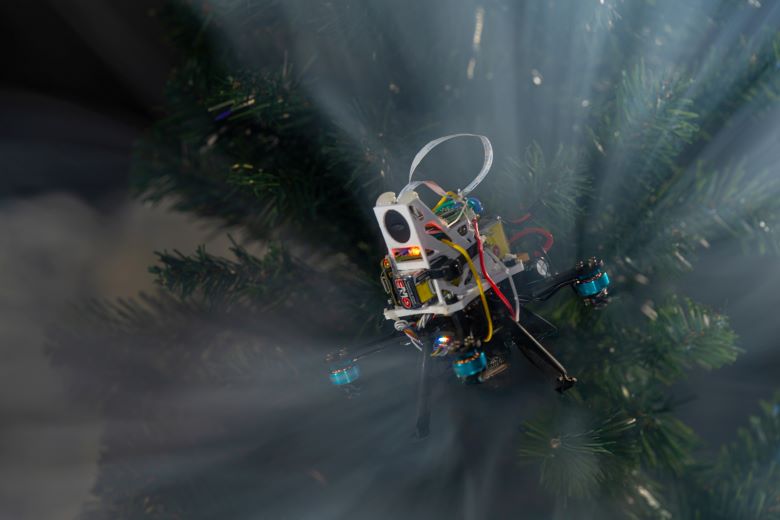
The project focuses on enabling tiny aerial robots, smaller than 100 millimeters and weighing less than 100 grams, to navigate without relying on vision. Instead, Professor Sanket’s team will develop sound-based sensing systems which essentially gives drones a form of bat-inspired echolocation.
However, using ultrasound in air is far from simple. The whir of robot propellers produces significant noise, and ultrasound struggles to distinguish small features. Professor Sanket’s approach tackles these challenges on multiple fronts:
- Hardware design: using metamaterials to reduce noise interference.
- Software innovation: applying physics-informed deep learning to filter and interpret ultrasonic signals.
- Sensor fusion: combining sound with other modalities like inertial data to improve reliability.
- Learning systems: implementing a hierarchical reinforcement learning navigation stack that teaches robots how to move toward goals while avoiding obstacles.
Through this combination of robot perception, bio-inspired AI, and robot learning, Professor Sanket aims to build inexpensive, power-efficient drones that can succeed where vision-based systems fail.
The implications reach far beyond the lab. “This work will enable real-world in-the-wild fast deployment of robots in disaster zones, search and rescue, or hazardous environment monitoring with harsh conditions not possible today,” Professor Sanket said. “This will help in protection, prevention and preservation efforts though a cost-effective, scalable and easily-deployable manner.”

The broader principles of sound-based navigation could also impact fields as diverse as self-driving cars, coral reef preservation, and volcano exploration. “The collaboration opportunities are endless,” Professor Sanket said.
For Professor Sanket, the excitement isn’t only about technology. It’s about people. He says the most rewarding part of his research journey is, “working with students, finding things no one has done before and solving hard problems in a creative way.”
His advice to early-career researchers echoes his own path: “Go for a grant that you really believe in. That will show in your writing. Do not let anyone tell you something is not possible.”
As he looks ahead, Professor Sanket envisions a future where aerial robots become everyday partners in human life — tools that can save lives, protect the environment, and expand our reach into places too dangerous or inaccessible for people.
“I’m excited to keep learning from nature,” Professor Sanket reflects. The more we understand how the natural world solves problems, the more we can build robots that aren’t just machines, but partners in making life safer and better.
Topics


People