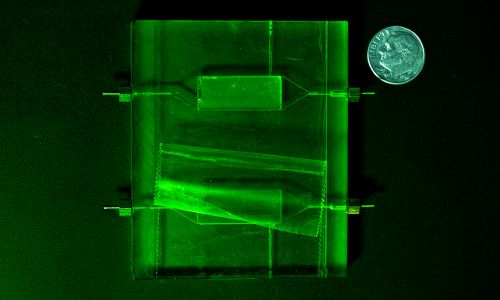
Researchers at Worcester Polytechnic Institute (WPI) have developed a solid polymer coated with harmless viruses to detect the bacteria Salmonella enterica (S. enterica), an advance that could lead to new ways of finding contamination in the food supply.
The group, led by Yuxiang “Shawn” Liu, an associate professor in the Department of Mechanical and Materials Engineering, reports that the technology can rapidly capture and visualize foodborne bacterial contaminants in tiny fluid samples. With no need for incubation or complicated equipment in research centers, the technology has the potential to be used as a rapid biosensor in field applications and in areas with few resources.
“We have a solid surface that can be used anywhere in the food supply chain, from farm to fridge, to detect foodborne bacteria with minimum human intervention,” Liu says.
Foodborne diseases cause millions of illnesses and an estimated 420,000 deaths worldwide annually. S. enterica, a leading cause of foodborne illness, can spread through fecal matter and has been found in raw and undercooked foods, such as eggs, meat, milk, and fresh produce. The bacterium infects the intestines, causing diarrhea, fever, and abdominal cramps.
Conventional tests for foodborne bacteria typically involve lab techniques that require special equipment and training. Samples may need to be incubated to allow bacteria to grow so they can be counted, and tests at research centers can take 24 to 48 hours. Other approaches involve amplifying segments of genetic material in samples or detecting antibacterial antibodies in a sample, but those tests may not differentiate live pathogens from dead pathogens. Testing devices with antibodies also tend to have a limited shelf life at room temperature.