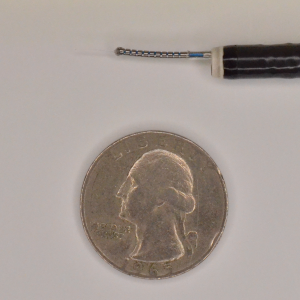
WPI researchers have developed a flexible optical fiber that can be threaded through a medical endoscope and steered into the larynx to destroy hard-to-reach tumors on the vocal folds, an advance that could expand outpatient laser treatment options for patients whose only other choice might be surgery under general anesthesia.


From left, Lucas Burstein and Loris Fichera
The researchers reported that during tests with a 3D-printed replica of a human larynx, they were able to reach about 81% of 70 targets that otherwise would be impossible to reach during outpatient treatments.
“Some people, such as patients with cardiac conditions, may not be able to undergo general anesthesia and conventional laser surgery for growths in the larynx,” says Loris Fichera, associate professor in the Department of Robotics Engineering and leader of the research team that developed the new optical fiber technology. “An improved medical device could address that problem by giving some patients an option to undergo laser treatment while under mild sedation in medical offices instead.”
The researchers’ device is a flexible optical fiber threaded through a thin-walled nickel-titanium sheath that is 1.6 millimeters in diameter and notched so it can bend. The sheath is thin enough to fit into an endoscope, a tube-like device with a light and camera on the tip. Surgeons insert endoscopes into the body to examine tissues, organs, and structures.
Once inside an endoscope, the sheath and optical fiber can be steered with hand-held controls to a site in the voice box, tissues that are also known as vocal cords, to destroy growths with pulses of light.