Robot Perception: Did we get it all wrong?

Abstract: Small birds and insects navigate complex environments using milliwatts of power. Why, then, do robots require dense 3D maps and GPUs to navigate and still fall short? Autonomous robot navigation remains dominated by compute-heavy perception pipelines that scale poorly to small, agile platforms. Biological systems take a fundamentally different approach: they leverage physics and structure in the sensing process itself to extract only task-relevant information for action. In this talk, I present a fundamentally novel view of robot perception, which I call passive computation. By leveraging optical, physical, and structural cues already present in sensory data, navigation-relevant information can be extracted before any algorithmic processing. I show for the first time that such passive perceptual cues are sufficient for reliable navigation, even in visually degraded and completely dark environments. This work argues for a shift from compute-centric perception toward sensing-driven intelligence, where physics performs the first and most efficient stage of computation.
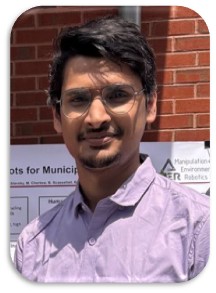
Bio: Deepak Singh is a Ph.D. student at Worcester Polytechnic Institute, working with Prof. Nitin J. Sanket in the Perception and Autonomous Robotics (PeAR) Group. Deepak’s research focuses on low-power perception and navigation for aerial robots, with an emphasis on neuromorphic sensing, embodied AI, and the intersection of optical physics with robot perception. He holds a Bachelor’s degree in Electronics and Communication Engineering from NSIT, Delhi, India. Before beginning his Ph.D., Deepak worked across academia and industry on a broad range of topics, including autonomous robots, computer vision, large language and speech models, and 3D graphics.