2026 Teaching Innovation Grant Recipients
2026 - 2027 Professional Learning Communities
Applying Learning Science to Course Design - From Research to Practice: Evidence-Based Teaching at WPI
How can insights from cognitive science and educational research transform the way we structure our courses and engage students? This professional learning community brings together educators interested in grounding their pedagogical decisions in empirical evidence about how people learn, retain, and transfer knowledge.

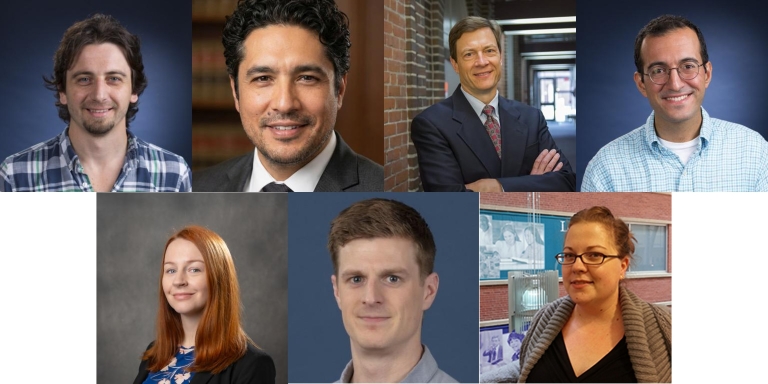
Koksal Mus, Yunus Telliel, John McNeill, Ahmet Can Sabuncu, Stacy Shaw, John-Michael Davis & Kimberly LeChasseur
Facilitator, Kimberly LeChasseur, Morgan Teaching and Learning Center
Understanding Student Learning Through AI Interaction Traces
Koksal Mus, Electrical & Computer Engineering
This project investigates how students learn in an AI-supported Project-Based Learning environment within a high-enrollment Introduction to Cryptography course. By analyzing student–LLM interaction traces alongside project outcomes, the study examines self-regulated learning, feedback-seeking behaviors, and iterative problem-solving processes. Findings will inform learning-science-grounded design strategies for scaling AI-supported PBL in large STEM courses, offering transferable guidance for integrating AI tools in ways that strengthen engagement, conceptual understanding, and responsible use of generative technologies.
Evaluating Learning Mechanisms in an AI‑Powered Interview Simulation in ID2050
John-Michael Davis, The Global School
This project evaluates how an AI‑mediated interview simulation supports students in developing dialogic interviewing skills. By analyzing changes in students’ questioning strategies, metacognitive reflections, and performance in authentic interviews, the study examines learning mechanisms such as feedback specificity, iterative practice, and persona diversity. Findings will inform learning‑science‑grounded course design and produce evidence‑based guidance for integrating AI‑supported deliberate practice into experiential, project‑based learning at WPI.
Measuring Learning and Student Outcomes In AI-Infused Classrooms
Stacy Shaw, Social Science & Policy Studies
AI can provide rich opportunities for students to engage with course material, but requires evaluation of it's impact on learning, engagement, confidence, and other important outcomes. The goal of this project is to leverage scales and measures from psychology and learning science to evaluate the impact of AI in the classroom.
The Blackboxing of Learning and the Pedagogy of Glassboxing
Yunus Telliel, Humanities & Arts
This project develops a glassboxing pedagogy for course design that makes student–AI interaction visible rather than allowing AI tools to blackbox learning. Through documented LLM histories, annotated prompts, and reflective accounts, glassboxing foregrounds epistemic labor, critical judgment, productive failures, false starts, and moments of insight, all of which are often overlooked in mainstream approaches to course design. Drawing on engineering and humanities contexts, the project operationalizes a cross-disciplinary ethos of responsible documentation while opening space for pedagogical experimentation across disciplines.
John McNeill, Electrical & Computer Engineering
Ahmet Can Sabuncu, Mechanical & Materials Engineering
Exploring Project-Based Learning (PBL)--Reimagining PBL for the Next Generation of WPI Education
Project-based learning has shaped WPI’s identity for over five decades—but how might we reimagine its possibilities to meet the needs of today’s learners and tomorrow’s disciplines? This peer learning community invites faculty and staff to collectively explore innovative approaches to PBL that expand our understanding of what project-based education can achieve in a modern educational context

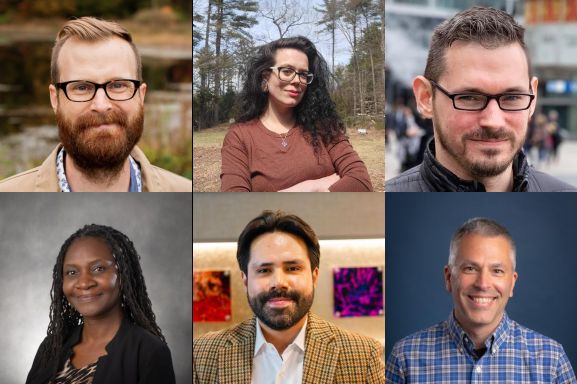
Ryan Madan, Zoe Eddy, Lane Harrison, Tsitsi Masvawure, Raul Orduna-Picon, and Lou Roberts
Mapping Students' PBL Experiences to their Growth as Communicators
Ryan Madan, Humanities and Arts, Co-PI
PBL is widely praised for improving student communication abilities, but we know little about HOW PBL fosters that growth. To fill this gap, I will create a student survey to correlate specific elements of the project experiences with students' perceptions of their writing engagement, thereby providing data to help us understand how to shape PBL dynamics to maximize communication gains. The survey will be piloted by my D’27 IQP cohort but will be flexibly designed for other project contexts.
The Role of Relationality for Project-Based Learning in the Age of AI
Lerie Gabriel, Humanities and Arts, Co-PI
Drawing on relational approaches to writing instruction, this project engages PBL to develop technical communication assignments in the context of emerging technologies, particularly generative AI. It will guide students towards analyzing and designing archival systems with attention to ethical AI use integration. More broadly, it will produce assessment strategies for evaluating students’ critical, creative, and ethical engagement with emerging technologies to be shared amongst educators at WPI.
Neurodiversity-Affirming Pedagogy for PBL
Zoe Eddy, The Global School
This project explores neurodiversity-affirming advising within WPI’s Project-Based Learning model, focusing on communication, writing, and cultural studies. It examines how implicit norms around collaboration and workflow can marginalize neurodivergent students and develops modular advising tools that make expectations explicit and expand modes of contribution. Through collegial inquiry and iterative implementation, the project will create strengths-based communication frameworks, multimodal writing and visualization options, and inclusive feedback practices that support diverse cognitive approaches and foster belonging within interdisciplinary project teams.
Improving Data Visualization in PBL Contexts
Lane Harrison, Computer Science
In many student projects at WPI, data visualizations are significant artifacts. Students use them for discovery and sensemaking, present them to stakeholders, and include polished versions in posters and final reports. This project will combine the latest knowledge, design methods, and tools from the data visualization research community into guidelines, examples, and activities to improve how projects at WPI promote data literacy and competencies.
Visualizing qualitative data: A brief "how to" guide for your IQP report
Tsitsi Masvawure, Department of Integrative and Global Studies
Students collect enormous amounts of qualitative data during their IQPs, but struggle to report on it in visually engaging ways. Consequently, IQP reports can read like a data dump or appear too “data thin” when qualitative data are being reported. I will develop a guide (i.e. booklet), that will provide concrete examples of different visuals (e.g., word clouds, network maps, heatmaps etc) that can be used to distil large amounts of text into compelling, nuanced yet easy to digest visuals.
Enhancing the Writing-Learning Bond
Raul Orduna Picon, Chemistry and Biochemistry
How might we design scientific writing experiences that students actually care about? Traditional approaches to teaching chemistry make disciplinary concepts and practices feel relevant on paper but rarely meaningful in practice. This project designs, deploys, and assesses approaches that transform the general chemistry laboratory into a welcoming space where students feel included and valued. Through contextualized storytelling, writing-to-learn activities, and writing communities of practice, I aim to make scientific writing a purposeful and empowering experience.
What’s the Story? Maximizing the Long-term Value of the MQP Report
Lou Roberts, Biology and Biotechnology
This project will leverage what students have experienced through writing in their humanities, IQP, and courses and apply that knowledge to their MQP writing process. Identifying, recalling, and revisiting their story as they write will help them shape their background, present their data effectively in their results, and guide their discussion. The goal is the students will produce a final report with a clearly stated, cohesive narrative that is reflected throughout the MQP report, thus increasing its value, potency, and readability as an open access resource.
2026 - 2027 Course and Program Projects
Strengthening Learning Through Observation
Esther Boucher-Yip, Professor of Teaching, Humanities and Arts, Dr. Ingrid Matos-Nin, Professor of Teaching, Humanities and Arts, and Michelle Borowski, Adjunct Instructor/Lecturer, Humanities and Arts
This project advances the pedagogy of observation as a teachable, transferable skill that strengthens attention, interpretation, and reflective judgment. Its goal is to develop and share structured strategies for slow looking, guided noticing, and evidence-based descriptions drawn from the humanities, social sciences, and experiential learning. By creating adaptable teaching and learning materials disseminated through Canvas Commons, the project supports multidisciplinary integration and aims to improve student learning outcomes, deepen analytical engagement, and cultivate attentiveness as a core academic skill.


Bridging Rigor and Belonging: Calculus-Based ECR Tutorials in Introductory Mechanics
Thomas Noviello, Instructor, Physics, PI, and Rudra Kafle, Associate Professor of Teaching, Physics
This project will create six story-driven mechanics tutorials that put students in the role of scientists and engineers where they will use calculus to build, test, and refine real models. The goal is to make introductory mechanics both more rigorous and more welcoming in our fast-paced 7-week terms. The impact will be stronger conceptual understanding, greater confidence with mathematical modeling, and reusable instructor guides that make student-centered teaching consistent across sections.


Designing and Evaluating an Embodied Learning Framework for Graduate Robotics Education
Agheli Mahdi, Associate Teaching Professor, Robotics Engineering, PI, and Connor McCann, Assistant Professor, Robotics Engineering
This project designs and evaluates a scalable learning framework that integrates research-grade robotic systems into theory-intensive graduate robotics courses. By pairing analytical modeling with structured physical validation, the initiative strengthens students’ ability to translate theory into real-world performance. Piloted in RBE 521, the framework will support broader adoption across the Robotics Engineering curriculum and position the department for future innovation in research-integrated graduate education.


Scaling AI-Supported Project-Based Learning in High-Enrollment Cryptography Course
Koksal Mus, Assistant Professor of Teaching, Electrical & Computer Engineering
This project scales and evaluates an AI-supported, adversarial Project-Based Learning model in a high-enrollment Cryptography course of over 100 students. The goal is to prepare graduates for industry by embedding iterative design, vulnerability discovery, and structured attack–refine cycles into course architecture. By rigorously assessing learning outcomes and AI use, the project will produce a transferable implementation toolkit and evidence-based framework for responsible AI integration in large, mathematically rigorous engineering courses.


Developing AI-Infused Modules for Responsible Research at WPI
Laura Roberts, Assistant Teaching Professor, Integrative & Global Studies, PI, Courtney Kurlanska, Assistant Professor of Teaching, Integrative & Global Studies, and Caitlin Ferranini, Assistant Teaching Professor, Integrative & Global Studies
This project develops and pilots three AI‑infused instructional modules to help WPI students and faculty integrate generative AI responsibly into undergraduate research while balancing AI use with academic integrity. Modules address AI’s benefits and limitations, AI‑supported literature reviews, and qualitative research methods and analysis. A series of workshops and the option to participate in a pilot study will be provided for faculty. The project will promote responsible AI use, transparency, and assist students and faculty in navigating emerging AI tools.


Developing a flipped format for BB3950 Molecular Biology to achieve learning outcomes in the age of AI
Scarlet Shell, Associate Professor, Biology and Biotechnology, PI
This project will develop materials to implement a flipped format for BB3950 Molecular Biology, allowing students to achieve learning objectives that are not possible with currently available materials. In a traditional course format, in-class sessions focus on content delivery, and out-of-class assignments focus on use and application of material. However, students often complete assignments by AI without developing the intended skills. We must therefore change our approach to achieving learning outcomes related to integration and application.


2026 Summer Sandbox Grants
Rejuvenating ECE 2029 with AI and Gamification
PI: Fatemeh Ganji, ECE
This project integrates AI-powered design tools, automated feedback, and gamified challenges to transform digital circuit education. By combining large language models with interactive learning platforms, it enhances student engagement, accelerates skill development, and lowers barriers to mastering hardware concepts. The redesigned course supports sophomore success and offers a scalable model for AI-driven engineering pedagogy.


Improving Student Engagement and Learning in Online Education in an AI World
PI: Gbetonmasse Somasse, SSPS; CoPI: Alexander Smith, SSPS
This project aims to improve student engagement in online, asynchronous classes in an AI world. The ubiquitous availability of generative AI tools can be detrimental to student engagement and learning. This proposal will identify and experiment with alternative AIresilient formative and summative assessments, including participation, learning activities, assignments, and tests. The tools developed may also improve face-to-face student interactions.


Leveraging AI in Aerospace Design: From Seeking Answers to Questioning AI
PI: Jielong Cai, Aerospace Engineering
The goal for the project is to integrate AI into the initial aerospace engineering design process, aiming to speed up this process which would allow students to have more time to refine their design towards the end of the term. The project involves training a specific generative AI model for aerospace design, and the development of a class module to help students develop mindsets to interact with AI, questioning its decisions, and working towards more realistic initial design solutions.


Creating community in an online, asynchronous course by integrating students’ local experiences and contexts
PI: Lauren Mathews, Biology & Biotechnology; CoPI: Michael Buckholt, Biology & Biotechnology
The goal of this project is to create community in an asynchronous online course in environmental biology by leveraging students’ local geographic and environmental contexts. Students will investigate local environmental projects or problems that are meaningful to them and will share what they learn with other students, contributing to a whole-class community learning experience. This generalizable model will be useful to accomplish similar goals in other online asynchronous courses.


Interactive AI-Augmented Learning Module for Undergraduate Online Teaching
PI: Mahdi Agheli, Robotics Engineering
This project will pilot an interactive, AI-augmented learning module that enhances engagement and understanding in undergraduate online courses. Integrating runnable simulations, visualizations, and a built-in generative-AI assistant, the module allows students to experiment with concepts and receive guided feedback in real time. Initially implemented in an online Control Engineering course during summer term, this approach aims to improve active learning and provide a scalable model for AI-supported instruction across disciplines.


A Framework for Interactive projects in calculus and ode's using large language models
PI: Michael Smith, Mathematical Sciences; CoPi: William Sanguinet, Mathematical Sciences
Design a framework and collection of projects for integrating AI into student learning. The objective of these projects will be to challenge students to “teach” creative math problems to a locally-run large language model. This will provide an environment within which students can experiment with and practice communicating mathematical ideas to others, and it will familiarize students with artificial intelligence and communicating mathematically with large language models in a professionally relevant way. Along with this a strong framework will be developed to facilitate continued efforts in developing and integrating these kinds of projects, with attention to the fast-paced evolution of artificial intelligence.
Targeted linear algebra projects to engage students across disciplines
PI: Samuel Tripp, Mathematical Sciences
The linear algebra courses at WPI are taken by more than 1,100 students annually across almost every major. Students learn best when the material is connected to their interests and career fields. I will build a repository of ten final projects for MA 2071 aligned with the majors at WPI, so that students are sure to have an option of interest to them, and so future faculty can both use and contribute to this store of projects.


AI-Augmented Supply Chain Management Education: A Modular Methodology and Toolset for Operations and Supply Chain Management
PI: Sara Saberi, Business School
This project establishes a low to no-code, AI-augmented framework for Operations and Supply Chain Management (OSCM) courses at WPI. By integrating resources from AI-backed platforms, it develops modular units for various topics in OSCM courses. This initiative is vital for the upcoming WPI's SCM degree programs, transforming business and engineering students into technology-enabled leaders. Through free, intuitive tools, the project democratizes AI literacy, ensuring students graduate as "Citizen Data Scientists" ready to build resilient, sustainable global networks


Deep Learning or Shallow Gains? Evaluating Generative AI’s Impact on Student Learning in Software Engineering
PI: Shubbhi Taneja, Computer Science; CoPI: Wilson Wong, Computer Science; CoPI: Sakire Arslan Ay, Computer Science
As generative AI reshapes education, this project explores how AI-generated instructional videos can improve learning in upper-level computer science courses. Leveraging insights from video engagement research and AI-supported problem-based learning, we deploy Knowlify, an AI-driven video generation tool, across two core CS content modules. This structured intervention examines impacts on student engagement, retention, and comprehension, offering evidence-based guidance for integrating AI-powered media into advanced CS instruction.


AI-Powered Debugging Tutor for Foundational Biomedical Engineering Courses
PI: Taimoor Afzal, Biomedical Engineering
This proposal aims to create an AI Debugging Tutor that helps students in BME 1004 and BME 2211 learn MATLAB and biomedical data analysis skills more effectively. The system will identify common mistakes, offer step-by-step conceptual hints, and reinforce algorithmic thinking without giving away answers. By reducing repetitive troubleshooting demands on instructors and providing personalized guidance, the AI tool will significantly enhance student engagement, confidence, and mastery while supporting more equitable learning across diverse student backgrounds
Experimentation and Data Science Course Development and Training
PI: Zachary Taillefer, Aerospace Engineering
This project will develop and validate new hands-on experimental modules for an undergraduate aerospace engineering experimentation and data science course. The effort will integrate physical experiments with data science workflows, enabling students to acquire, analyze, and interpret experimental data using modern computational tools. Activities include hardware testing, experimental design refinement, and development of instructional materials and data analysis pipelines. The project will accelerate implementation of a scalable, student-centered experimentation course for deployment in the upcoming academic year, strengthening experiential learning and data literacy


Structured AI Tutoring for Applied Statistics
PI: Zheyang Wu, Mathematical Sciences
This project develops an AI-assisted practice tool for MA2611 Applied Statistics I, a course serving 700+ students annually. Building on a working prototype, the tool delivers curated problems with adaptive difficulty and AI-generated feedback aligned to course pedagogy. Unlike unstructured ChatGPT use -- which often undermines conceptual understanding -- this system provides teacher-guided AI interactions through carefully engineered prompts and instructor-curated content. The tool addresses gaps in existing support by providing personalized, on-demand practice at near-zero marginal cost per student.