Follow The WPI Podcast on your favorite audio platform
E37: Hurricane Preparedness | Sarah Molinari | Integrative and Global Studies
In this episode of The WPI Podcast, we explore how communities can better prepare for hurricanes and their long-term effects. Sarah Molinari, assistant teaching professor in the Department of Integrative and Global Studies, discusses lessons learned from damaging storms in modern Caribbean history.
The conversation highlights examples of grassroots preparedness and response strategies, the challenges of scaling community-led solutions, and the importance of centering relationships, collaboration, and community voices in research and planning related to storm resilience.
As one of several Worcester Polytechnic Institute faculty members in the Caribbean Collaborative Action Network, Molinari conducts research on climate adaptation and collaborates with communities in the region. She discusses this work and her role at the university’s Puerto Rico Project Center advising student projects, which have included the co-creation of a disaster response management tool.
Related links:
“Building Equitable Climate Adaptation Partnerships in the US Caribbean”
Caribbean Collaborative Action Network
Department of Integrative and Global Studies
San Juan, Puerto Rico, Project Center
Interactive Qualifying Project
National Oceanic and Atmospheric Administration Regional Integrated Sciences and
Assessments Program
Transcript
Cain: Hurricanes are an annual threat to lives and livelihoods, so what can communities do to prepare themselves and respond if they're impacted? Some of the worst tropical cyclone seasons in US history have caused hundreds, even thousands of deaths, and the most impactful hurricanes to hit the US have caused tens of billions of dollars in ensured losses. And the threat exists in countries and territories around the world. Today on The WPI Podcast, we're discussing community hurricane preparedness. Hi, I'm Jon Cain, and this is your home for news and expertise from the classrooms and labs of Worcester Polytechnic Institute. I'm happy to be joined for this episode by Sarah Molinari. She's an assistant teaching professor in the Department of Integrative and Global Studies at WPI. She's a cultural anthropologist and one of several WPI faculty members who are part of the Caribbean Collaborative Action Network. It's a network funded by the National Oceanographic and Atmospheric Administration that works to build regional knowledge, connections, and capacity to adapt to climate threats. Sarah conducts research on climate adaptation, collaborates with communities in the Caribbean, and teaches and advises WPI students on related issues and projects. Sarah's joining us from WPI's Puerto Rico Project Center in San Juan. Sarah, thanks for being on The WPI podcast.
Molinari: Thanks, Jon. Happy to be here.
Cain: Well, Sarah, we're talking just ahead of the Atlantic hurricane season. It runs from June to the end of November, And those are the months when tropical cyclones like hurricanes and tropical storms typically develop. Now, whenever the season comes around, emergency management officials often encourage people to determine their storm risk and to prepare in advance of the possibility of a storm. A lot of those are things that individuals can do, But broader community preparation for hurricanes is important too, right?
Molinari: Yes, and I think maybe now more so than ever. So in the United States and the US Caribbean territories, where I'm currently speaking from Puerto Rico now, but we're also talking about the US Virgin Islands, I think we're facing a very fragile institutional context and a reduced overall response capacity heading into this 2026 hurricane season. And by this, I'm referring to a lot of staffing losses, uh, various cuts to the agencies that are tasked with actually forecasting storms, developing the science to understand storms, the agencies that are supposed to coordinate response and manage recovery. So for example, we have FEMA, the Federal Emergency Management Agency, who has lost several thousand employees had they been laid off or they've left the agency over the last couple of years, and this is really gonna mean less capacity at the federal level for disaster response logistics and recovery coordination. Another example is NOAA, the National Oceanic and Atmospheric Administration, and this is the agency that also has the National Weather Service, and those are the folks that are really the frontline weather warning system, So we're talking about weaker warning infrastructures and public messaging capacity around emergency communication heading into this hurricane season. So I think the central risk in 2026 is not necessarily that the US has no disaster response system, but it just has a thinner one. It's more uneven and perhaps less able to absorb major shocks. So this all means that if federal infrastructures are thinning out, the burdens of response we're going to see are likely to fall more on states, on local governments, on local communities, and even on individual households, and this could bring a set of further risks for uneven recoveries from disasters.
Cain: And that community level preparedness and response is really something that you've spent a lot of time looking into. So I'm wondering if you can tell us, what are some examples from the Caribbean that show just how disruptive hurricanes can be to entire communities and regions?
Molinari: So I think we have to look back to the 2017 Atlantic hurricane season and the impacts that we saw in the Caribbean region. And I think here, it's, it's really a key moment that provides several lessons and, and particularly stark lessons for thinking about this question. So as we might remember, hurricanes, Irma, and Maria moved across the Caribbean region just within weeks of one another in 2017, causing particularly catastrophic damage. So first, Hurricane Irma devastated islands in the Northeastern Caribbean, particularly impacting Barbuda and the US Virgin Islands. And then just a few days later, Hurricane Maria followed hitting Dominica as a category five storm. Um, in that island, about 90% of the housing stock was destroyed by Maria, and then the storm continued onto Puerto Rico as a category four hurricane. And so I think to talk about this question of regional disruptions caused by the 2017 hurricanes, we have to actually think beyond these events themselves. And by the event, I mean, the named hurricane, right? Hurricane Irma and Maria. And we need to consider how structural climate vulnerabilities were produced before the storms, long before 2017. And I'm referring to the legacies of colonialism, plantation economies, extracted industries, environmental racism, labor migrations, all these things that actually shaped the kind of devastation and uneven recoveries in the storms aftermath. And what we saw here in the Caribbean included supply chain disruptions, major agricultural losses to a sector that has for many decades been, uh, slowly dismantled. We saw excess and premature deaths, thousands of deaths. We saw mass displacement and outmigration. In Puerto Rico's case, it's been since the years following Hurricane Maria, the largest outmigration since the great migration of the 1950s. And of course in Hurricane Maria, in Puerto Rico, after Maria, we also saw the longest blackout in modern US history. And so I think that this hurricane in Puerto Rico showed us also how the deadliest and most severe impacts are not necessarily caused by the storm itself, but by the systemic infrastructural failures that we see in the aftermath, the electricity grid going out, water disruption, disruption to people's mobilities and roads, disruption to communication systems. And I think this is very important because Maria is still discussed here in Puerto Rico as an ongoing disaster, even almost a decade later. And it's discussed as an uneven and incomplete recovery that should really give us lessons to keep thinking about in the years to come.
Cain: I'm wondering what are some of the important aspects of how communities can address storm risk and storm aftermath and, and not just the regional or state or city leaders, but communities.
Molinari: Sure. So in Puerto Rico, there's a saying solo el pueblo salva al pueblo. And this means in English, only the people can save the people. And here in Puerto Rico, we saw how people and communities themselves were actually acting as the first responders after the 2017 hurricanes. And for instance, we saw after Hurricane Maria, the emergence of the Centro de Apoyo Mutuo across the entire archipelago of Puerto Rico, and in English, the translation is mutual aid centers, and these were really examples of neighborhoods and communities coming together to develop their own emergency response social hubs that organized things like food distribution, elderly care, solar powered charging stations, holistic healing spaces like acupuncture circles, and these Centro de Apoyo Mutuos they weren't waiting for the government to respond, or for the territorial government or the federal government. They were actually organizing themselves through the resources that they had through an ethos of mutual aid or apoyo mutuo. And they were occupying spaces. They were occupying and repurposing abandoned private buildings and schools, and this is something I call in my work infrastructures of care. And this is so central to understanding how communities are addressing risk, how they're thinking about preparation and recovery, because infrastructures of care are about the relational practices that sustain people and build local capacities. And what they're really showing us is that they're taking this question of emergency response from an individual level really to a community level and building the relationships that are helping people to survive. And interestingly, several of these mutual aid centers still exist and operate today in Puerto Rico almost 10 years after Hurricane Maria. And they're responsible and they're kind of taking up this task of addressing local climate risk and disaster preparation. Several, for example, have developed their own emergency response plans and protocols, identifying where people in need live and how they're going to go about reaching them in the event of a blackout or a communications blackout, let's say. Many have designed local food delivery networks, they're stockpiling donated supplies in preparation for a future emergency, and some have even developed things like community gardens to address kind of this ongoing sense of food insecurity and really helping us to think about preparation as an ongoing task that needs to happen way before a potential disaster event, and helping us to understand the relationships that need to go into that work.
Cain: I think you've laid out some really good examples about how many of the great ideas come from the ground up. And I wanna mention here also that WPI is a partner in climate resilience. The university is one of several universities and community organizations that co-created the Caribbean Collaborative Action Network. It's a network funded by the National Oceanographic and Atmospheric Administration bringing together researchers, residents, and government officials to build knowledge and connections and capacity to adapt to climate threats. And Sarah, you're one of several WPI faculty members involved in this research and in this effort, and WPI students are also involved. I'm wondering if you can tell us some examples of the things WPI has been doing as part of this network.
Molinari: Sure. So our network, functions as a kind of multidisciplinary regional knowledge action network that integrates both the physical and the social sciences, um, integrates academics, but also government officials and community stakeholders and graduate students across several different universities with the main basis being in the University of Puerto Rico and the University of the Virgin Islands. And we all work together in different ways to document, to build collaborations and to shape action around climate adaptation in the US Caribbean. And it's very important to note that this is the first NOAA RISA program that is for the US Caribbean.
Cain: And you mentioned NOAA's RISA program, and that stands for the Regional Integrated Sciences and Assessments Program.
Molinari: Correct. So we're trying to also set a precedent of focusing the idea of climate adaptation in some of the most climate vulnerable sites, part of the US kind of larger sphere. And we focus on multiple different hazards. Extreme heat is one of the main centers of, of focus for various researchers within the network, and we've so far held three US-Caribbean extreme heat summits that have been both in Puerto Rico and in St. Thomas in the US Virgin Islands. And as part of this work about extreme heat, which is a really interesting topic to think about in the Caribbean, where it is kind of by nature a hot tropical environment, it's, you know, extreme heat is not necessarily something new for Caribbean people. They've lived with heat, for a very long time, but we're seeing new patterns of extreme heat and changes in weather due to extreme heat and health and social impacts of extreme heat. So we're trying to push this conversation around extreme heat, and one thing we've done in particular is focus on how extreme heat is impacting learning environments or schools. And so in Puerto Rico, we've collaborated with the Department of Education to develop ways to measure and excess extreme heat in public schools, as well as to develop recommendations for the Department of Education to address extreme heat through different adaptive capacities and very practical things that they could do in learning environments. And we're very proud that, you know, not only has this work been published in academic journals, but several of the recommendations from the group working around extreme heat and learning environments were actually adopted as official policy by the Puerto Rico Department of Education. And I think this is an example of how we see, real world impacts of our research and collaborative efforts in a multi-scaler way. I wanted to also mention that the Caribbean Collaborative Action Network integrates WPI's Puerto Rico Project Center, which has been working in Puerto Rico for over 30 years now and receives IQP students two times per year, so for two academic quarters. Uh, right now I'm in Puerto Rico working with a group of 23 students, 23 juniors, and this has been a kind of a, a really important place to continue building this knowledge at action network around different topics in Puerto Rico and helping students to support the climate adaptation work we're doing. So one particular example is from 2024, a project I was co-advising with Professor John Michael Davis, who's the co-director of the Puerto Rico Project Center. We were working with students at the Centro de Apoyo Mutuo, Las Carolinas in Caguas, Puerto Rico, and, and that's one of the many mutual aid centers that emerged in Puerto Rico after Hurricane Maria. And we worked with the students to develop what we ended up calling the Disaster Response Management System,. And this was a tool, a digital tool that brought together all kinds of local knowledge, local mappings and understandings of space, divisions of homes and different kind of notions of property and resident needs. The tool is meant to support the local preparation and recovery efforts that are led by the leaders of the mutual aid center in Las Carolinas, and it was really important to center the local knowledge, local needs, and understandings of space, because this was a community that in FEMA's housing repair assistance after Hurricane Maria, many residents and households experienced denials, for example, because FEMA couldn't find where their homes were, or their properties were not, did not appear correctly on maps, right? There, there's a different kind of address system here in Puerto Rico and also different relations of, of property. So, so coming up with a very local disaster response tool that documents the household needs, any medical conditions that people should be aware of, but also assets, what the household can share with others, whether it's extra supplies of canned food or an electric generator, it ended up being a kind of relational mapping that is now with the CAM for future emergency events. And this was a, a tool developed in collaboration with the students and the group of us, the co-advisor and the students, we published a journal article in the journal called Disasters on the results and this particular model. So I think that was a really good example of bringing STEM capacities and experience and knowledge to Puerto Rico to develop a very practical tool to help build adaptive capacity here on the ground.
Cain: Sarah, I'm so impressed by the breadth of this important work that WPI is doing as part of this network in collaboration with the community. You mentioned the Puerto Rico Project Center, and that is one of more than 50 project centers that WPI has on six continents where students can complete their required academic projects for graduation. And, uh, you mentioned the IQP, that's one of those three required projects for graduation, the interactive qualifying project. It's typically done junior year, and it's a project done at the intersection of science, technology, and societal need, and a large number of our students complete their IQP at WPI's project centers. Sarah, I wanna dive in on this a little bit further and ask you, how do university partnerships like this one help ensure that community voices are heard and that strong preparedness or response ideas to hurricanes or other climate threats can be replicated elsewhere beyond the immediate community?
Molinari: Sure. So first, I think it's about having a lens of accompaniment and reparative relations rather than extractive relations, which might characterize a lot of the way especially post-disaster research takes place in frontline communities and marginalized communities, certainly what Puerto Ricans experienced after Hurricane Maria, a kind of flood of, uh, researchers from the global north who might not have had any Caribbean or Puerto Rico experience kind of coming to extract knowledge from a disaster situation. So I, I think that the first thing is to really try to do that differently, right? Try to center relationships, center research as a form of accompaniment. And for example, our network, the Caribbean Collaborative Action Network, takes a human-centered design approach. And that means that from our various disciplines as researchers and professors we approach questions of climate adaptation through a lens that centers lived experience, and this is about methodology, it's about research design, it's about the work that's needed to build ethical university community partnerships where there's an ongoing relationship. It's also about how we teach students to do the research in the IQP, and also about how we make decisions about dissemination of our work. So for myself and, and for several colleagues within the research network, it's very important to think with, but also beyond the traditional academic publication zone, so beyond the peer review journal and the book form, but also thinking with mediums like story maps, uh, multi-stakeholder summits where there's a dialogue involved, methodologies like photovoice, and of course, the practical deliverables that the students, the WPI students that come to Puerto Rico are co-producing with their community sponsor organization. And for me, this is about uplifting, documenting, and collaborating with on the ground organizations who are doing this local preparedness work that's often quite invisible. And these, they're very small acts that are built up over time. But I think what we can do as researchers is facilitate connections of knowledge and resource-sharing in this sphere and leverage the resources we have from NOAA and the university to do so. And importantly, also in the case of the Caribbean Collective Action Network, it's about visibilizing the archipelagic connections between Puerto Rico and the US Virgin Island. So these are archipelagos that are, very close together geographically have a very similar experience of climate vulnerability, but unfortunately are rarely put into conversation together. So that's what we're trying to do in the network to, to build those connections, to make them more visible, to think collaboratively across islands and also with folks that are stateside in the network and really bring that forth to support our work.
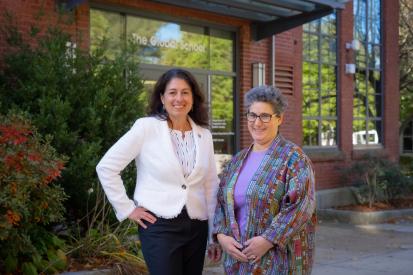
Cain: And if you wanna learn more about WPI's efforts in the network, um, I encourage you to check out the book, Building Equitable Climate Adaptation Partnerships in the US Caribbean. Sarah is a co-editor on the book with Mimi Sheller, Dean of the Global School here at WPI. The book also features writing from other WPI members of the Caribbean Collaborative Action Network about their experiences, and we'll include a link to the book in the show notes. Sarah, you've given some really great examples about how individual communities have come up with ways to address risks, whether it be hurricanes or climate challenges. What are some of the challenges to scaling those programs and ideas so that they can go beyond individual communities and maybe be implemented at a regional level?
Molinari: Yeah. So I think one of the challenges when we talk about the US-Caribbean, so Puerto Rico and the U.S. Virgin Islands, is the political context actually, and the colonial relationship with the United States really results in a bit of a siloing of the U.S. Caribbean territories from larger regional Caribbean conversations where there are folks talking about things like climate reparations and larger scale kinds of disaster planning and different kinds of conversations around climate change, but because of a certain kind of political proximity to the United States, Puerto Rico and the US Virgin Islands are often kind of on the margins of those Caribbean conversations. So I think that's one challenge. And then between the archipelagos, there's also the challenge of language, um, right? Spanish being spoken in Puerto Rico and then various languages, but also, you know, very English speaking and also Spanish speaking, but, but a kind of, a different language dynamic in the US Virgin Islands that is, I think, another challenge to this kind of larger networked sharing. And I think another big challenge is, of course, resources that the people who are doing this everyday labor of climate creativity often lack the resources to do this work of scaling up and the work of building coalitions and networks and even sharing their work to make it more visible. So I think that's where networks like the Caribbean Collaborative Action Network, university partnerships, and specifically the diasporas, right? The Caribbean diasporas and institutions in the diaspora come into play and can play a really important role in leveraging the resources that we have in these spaces to facilitate this kind of knowledge and action sharing from the ground, but also learn, right? Learn from those processes and try to make those connections that maybe we have, or me as a researcher, for example, I might have more time to do that than someone on the ground at the Centro de Apoyo Mutuo in Caguas will, um, when they're kind of in this everyday work of preparing food for their community and keeping track of the elderly residents who will need assistance in case of a hurricane. So I think it kind of um, is a question of leveraging resources from elsewhere to support those wider networks and wider scaling up projects.
Cain: Sarah, I'm wondering, what are some of the examples of what can be lost if people within communities who will be impacted by storms are not considered in the climate and hurricane preparedness planning?
Molinari: Sure. So I can use the example of some work I've been doing around flood risk in Puerto Rico and specifically, um, a chapter in this book that I co-wrote with my colleague, Seth Tuller, who's also in the Department of Integrative and Global Studies, also a co-PI on the Caribbean Collaborative Action Network. And as part of my postdoc work with CCAN, I was a postdoc in this research network working with WPI before I became a professor, we were doing some work to support a risk and vulnerability analysis component of what is called the Whole Community Resilience Planning Program in Puerto Rico. And this is a big I think $54 million effort that came out of Hurricane Maria to develop resilience plans around the archipelago between different stakeholders. And we were working with the organization that, uh, is managing this process at a, at a kind of high level scale and one of the workshops that I hosted with my colleague, Laura Cabrera from the University of Puerto Rico was about flood risk in southern coastal Puerto Rico. And we conducted a workshop in two different communities in southern, southern coastal Puerto Rico, and our understanding was that we were going to facilitate a conversation with local residents, who are part of this working group building this resilience plan, about flood risk. And we came in with a certain conceptualization of what flood risk looked like based on the geography, based on the climate and weather data we had access to, um, and really an understanding about floods as coastal flooding, as flooding after major storms and things like that. However, in both cases, when we approached the conversation, we found that the people themselves had much different understandings of flooding and also other things that they wanted to talk about besides flooding, which was the really interesting part here. So for me, it was a lesson in how people's understandings and narrations of their own environments—they are not always in the same terms that science and social science comes in with. And it's a lesson in how important those, those kind of local narrations and understandings of climate hazards are. So for instance, in one community in Playa de Ponce, in the municipality of Ponce, Seth and I wrote about in the chapter how the workshop experience and actually hearing from residents themselves unsettled our, not only our conception of flooding, but our conception of adaptation itself. These residents did not wanna talk about coastal flooding, hurricane flooding, they wanted to talk about wastewater flooding and literally how this community has been flooded with wastewater for decades because of poor infrastructure and government neglect and environmental racism. And that understanding of flooding fell completely out of the perceptions that I was coming in as a researcher with. And it, it reoriented the conversation to one that's more about addressing wastewater flooding, not necessarily as a climate risk, but as the result of government failures and abandonment and infrastructural failures that have affected this particular community for years. And so that helped us to kind of also rethink this question of adaptation itself and for me, it's a question of who is being called to adapt to what, right? And, and if we think about that question, we have to then start from understanding the local experience. And in this community, the local experience was not about coastal flooding, it was not about the flooding they experienced after the hurricanes of 2017, it was about literally the waste that's coming into their streets constantly. So that, that was one example of, I think the ways that we can think about adaptation, not just as the scientific technical project with neat solutions, but really this historical question that's steeped in social relations, in spatial relations, and in power dynamics. But we need to start with how people are understanding their lived environments.
Cain: I'm wondering if you could talk a little bit about what's next for your research efforts.
Molinari: Yeah. So this summer, I'm working with a colleague in the Caribbean Collaborative Action Network, a WPI Postdoc Bárbara López-González, and we have support from the Society for Applied Anthropology, as well as the IWell Grant out of WPI Center for Wellbeing to work on a story mapping project about climate adaptive food practices across Puerto Rico and the US Virgin Islands. And our goal is to use different multimedia tools to document and spatialize, and spatially visibilize diverse food practices from food production to distribution and consumption that we hope to show how rural and urban communities across the archipelagos are centering a certain kind of climate creativity around food. And when I say climate creativity, I'm, I'm referring to these everyday improvisational practices through which people are making life possible and navigating their changing environments under conditions of constraint. We're interested in how different organizations across the islands are bringing together resources, knowledge to respond to changing conditions that center food in some way. And again, we're hoping to support these connections of practices and knowledge across the archipelagos and these two US Caribbean territories that are often not in conversation with each other. So it's also a way that we're hoping to visibilize this work through people's own stories. And I think a, you know, a story mapping tool is, is is gonna be great for that.
Cain: I look forward to hearing more about how that turns out and, and seeing what comes out of that. There's such power in visualization and human storytelling. Sarah, thanks so much for joining us from WPI's Puerto Rico Project Center and for sharing your insight and perspective with us here on the WPI Podcast.
Molinari:
Thank you, Jon. I appreciate the conversation.
Cain: Sarah Molinari is an assistant teaching professor in the Department of Integrative and Global Studies at Worcester Polytechnic Institute. Before you press the stop button on this episode, I've got a favor to ask. Could you please follow The WPI podcast wherever you get your podcasts? We'd really appreciate it, and it'll let you get the latest episodes. And don't forget about all the other ways to keep updated about WPI. At wpi.edu/listen, you'll find this and other podcasts from across campus. There's also audio versions of news stories about our students, faculty, and staff. You can also get WPI News anytime by asking Alexa to “open WPI.” Well, that does it for this edition of The WPI Podcast. Today's episode is possible thanks to the audio engineering support from undergraduate computer science and music student, Aster Dettweiler, and PhD candidate Varun Bhat. Thanks so much to you for listening. I'm Jon Cain. Talk to you soon.