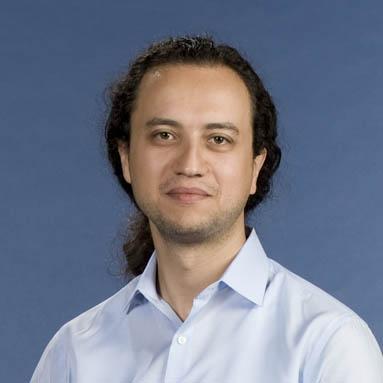
Robotics researcher Cagdas Onal is pictured in his lab with graduate students.

From left, Cagdas Onal, PhD student Gabrielle Conard, and post-doctoral researcher Shoushan Chiang

WPI Researchers to Develop Robotic Arm for Wheelchairs

Origami-inspired project will create framework for new soft robotics technologies
LISTEN:
00:00 | 04:26
February 18, 2025
Preview

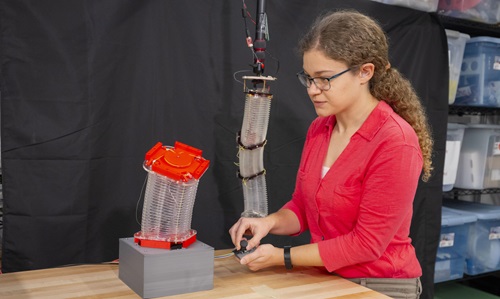
PhD student Gabrielle Conard conducts research on a soft robotic arm.

Gabrielle Conard, a PhD student, demonstrates soft robotics technology in Cagdas Onal’s laboratory.

Inspired by origami, Worcester Polytechnic Institute (WPI) robotics engineering researchers are developing a lightweight, flexible robotic arm that will enable a wheelchair user to safely grasp, lift, and carry objects that would otherwise be out of reach.

Through the four-year project, researchers Cagdas Onal, Berk Calli, and Loris Fichera are developing a framework for the design, modeling, and control of soft continuum robotic arms, which are more flexible than traditional robot arms. The research is funded by a $1,314,792 award from the National Science Foundation (NSF). 

“The basic scientific discoveries we are making in this research address real-world challenges for people who use wheelchairs and need devices that will help them grab out-of-reach objects,” said Onal, who is principal investigator (PI) on the project and an associate professor in the WPI Department of Robotics Engineering. “A new class of lightweight, safe robotic arms based on the breakthroughs we are making would give those individuals more independence in their daily activities.”

Soft continuum robotic arms expand, shrink, and bend along their entire length, like a coiled spring, to move in different directions and travel around objects. That flexibility makes soft robotics a promising technology in complicated human environments. However, soft robotic arms also tend to be weaker, more shaky, and less precise than traditional robot arms made from rigid materials.

To address the weaknesses of soft robotic arms, the researchers are developing origami-inspired designs and novel fabrication methods for modules made of lightweight plastics, 3D printed components, and off-the-shelf items such as sensors and cables. By folding flat sheets of clear plastic into springy tube-like structures, the researchers are creating modules that are strong, stiff, and resistant to twisting, all while remaining lightweight. The researchers are also developing specialized algorithms that can run on microcontroller platforms to direct the motion and reactions of a robotic arm.

The basic scientific discoveries we are making in this research address real-world challenges for people who use wheelchairs and need devices that will help them grab out-of-reach objects.
  • Cagdas Onal
  • Associate Professor, Robotics Engineering

The project builds on Onal’s research into user-friendly soft robotic systems capable of performing tasks that rigid robots cannot tackle. Calli, an associate professor in robotics engineering, brings expertise in object manipulation technologies, especially for robots in recycling centers. Fichera is an assistant professor in robotics engineering whose research includes work on the development of surgical robots.

“Soft robots have big potential for assistive robotics,” said Calli. “You would need a very large, rigid robot to reach the high shelves of a cabinet, for example, and installing such robots next to a user does not make sense. Soft robots could expand to reach objects and shrink to a compact size when not in use, and they would be safer for users than rigid robots. Our project will enable soft robotics for assistive uses by developing novel sensing, control, and AI technologies.”

Onal said that one goal of the research is to develop a flexible and extendable robotic arm with off-the-shelf grippers that can pick up and carry a cup of water without spilling a drop.

“It’s exciting to work with WPI colleagues and students on a project that is pushing the boundaries of this technology,” Onal said. “More importantly, this research offers an opportunity to directly impact people in a positive way by enabling them to lift, move, and carry objects that they previously might not have been able to reach from a wheelchair. That would be a real achievement.” 

Putting Technology to Work for People

Soft Robotics Research at WPI

Cagdas Onal is leading fundamental research into robotic arms that are soft enough to stretch and bend but sturdy enough to safely carry a glass of water. The research could lead to a new class of assistive devices for wheelchair users.

Want to learn more about Research at WPI? Subscribe to the monthly newsletter.


Offices and Departments

Berk Calli
Berk Calli
Associate Professor, Robotics Engineering
Berk’s research primarily focuses on problems related to robotic manipulation, which is a key functionality largely missing from the current state of the art in robotics for unstructured environments, including homes, modern warehouses, and collaborative manufacturing stations. H [...]
read more
Cagdas Onal
Cagdas Onal
Associate Professor & Department Head, Robotics Engineering
An integral part of a rewarding academic career is being an educator. It is a wonderful opportunity to work with students and guide their development to fulfill their potential. I enjoy teaching the fundamentals of robotics engineering, science and technology as well as training [...]
read more
Loris Fichera
Loris Fichera
Associate Professor, Robotics Engineering
My research interests are in the application of robotics and computer science to enhance medicine, and particularly surgery. What gets me out of bed in the morning is the prospect of helping doctors save lives and improve the quality of life of their patients. My students and I w [...]
read more