IWell Research Grant
The Center for Well-Being supports academic and research initiatives focused on studying and promoting holistic health and well-being through research projects, IQPs, MQPs, or graduate projects.

AY 26-27 WPI Center for Well-Being Incubator for Well-Being Research and Innovation (IWell) Grant Application
Applications are now open for the Center for Well-Being (CWB) small grant program to support research projects to increase our understanding of holistic well-being—factors that promote well-being and thriving, barriers to well-being and thriving, and/or how to mitigate these barriers.
The application deadline is February 2, 2026 at 4:59pm ET.
Eligibility/General Requirements for Applicants
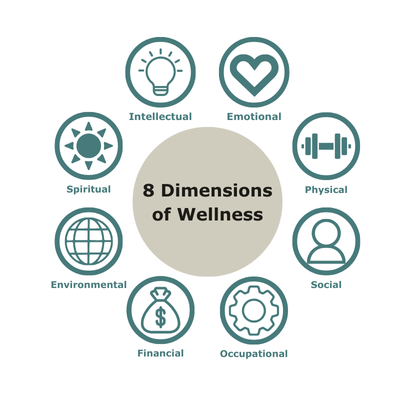
The CWB invites grant proposal applications for projects designed to increase understanding of one or more of the eight dimensions of wellness (adapted from the US Substance Abuse & Mental Health Services Administration's Wellness Wheel Model, https://www.samhsa.gov).
- Emotional: being aware of feelings and behavior and how to effectively build resilience to overcome life challenges
- Physical: promoting health and vitality through care of the body (e.g., sleep, physical activity, nourishing food, etc.)
- Social: being able to build and maintain relationships and connections within the community
- Occupational: related to personal satisfaction and fulfillment from work, school, or volunteer activities
- Financial: financial literacy and financial habits to support current and future needs
- Environmental: the ways in which physical environments and design encourage well-being
- Spiritual: issues related to having a sense of meaning and purpose in one’s life and activities to promote meaning and purpose (e.g., meditation, experiencing awe in nature, self-reflection)
- Intellectual: engaging in life-long learning and creative expression

Faculty and staff at WPI are eligible to apply for IWell grants, either individually or as part of a team that involves graduate and/or undergraduate students.
The projects receiving IWell grants can be independent projects, collaborative projects working between multiple disciplines at WPI, or partial support of an ongoing project.
Applications must specifically address one or more of the eight dimensions of holistic well-being outlined above.
Grant Application Details
Application Instructions
Click here to download application.
Title Page:
WPI Center for Well-Being
Incubator for Well-Being Research and Innovation (IWell) Grant Application
Primary Applicant:
Department:
Co-Applicants and Departments:
Dimensions of Wellness Addressed in Project:
Total funding request: $
Project title:
Goal of the project: (e.g. article, book, conference presentation, exhibit, etc.)
Duration of funded project:
--
Please Include the following information in the application (to be uploaded in one attachment):
-
Summary of proposal (75 words max)
- Project Description: Please provide a detailed description of the project, including the items listed below. The project description should be no more than 5 pages, single spaced.
- Background and Rationale
- Project Objectives/Aims
- Research Methodology/Experimental Design
- Project Impact (Benefits and Evaluation)
- Project Timeline
- Bibliography
- Project Staffing: Explain the roles, responsibilities, and relevant background of each member of the project team for contributing to the project’s goals.
- What significant problem or need regarding holistic well-being is addressed by your project? Why is this important? Does the project address a gap in the existing literature on holistic well-being? What makes this project innovative?
- Which of the 8 dimensions of well-being does this project address? How will this project advance understanding of that aspect of well-being?
- Budget: Please utilize the budget template below for your application. Please upload detailed spreadsheets of your budget as part of your application. For each category, also provide a description and justification of the expenses.
| Category | Description |
Anticipated Expenses |
Requested Amount |
| Materials/Supplies | |||
| Faculty and Staff Compensation | |||
| Student Wages | |||
|
Professional Development |
|||
| Conference Costs | |||
|
Honorariums or Transportation/Travel Costs |
|||
| Research Related Costs | |||
| Food/Facility Costs | |||
| Other Expenses | |||
|
TOTAL EXPENSES |
Application Process
The IWELL Grant Application will be posted on December 1, 2025. The application deadline is February 2, 2026 at 4:59pm ET.
The following is a timeline for the Incubator for Well-Being Research and Innovation application grant process:
| Activity | Date |
| IWell Grant Applications Open | December 1, 2025 |
| IWELL Grant Applications Close | February 2, 2026 |
| Notification of Grant Awards | April 15, 2026 |
| Grant Funding Cycle | June 1, 2026 to May 31, 2027 |
- All grant applications must include the name(s) and contact information for all WPI students, faculty and staff participating in the project and/or initiative.
- Questions about the grant proposals or application process can be directed to Paula Fitzpatrick, Director of the Center for Well-Being, pfitzpatrick@wpi.edu.
Budget
Application must include a detailed budget for up to $5,000 (using budget template) and a budget justification.
Eligible expenses include:
- Materials/Supplies – Capital expenses will not be considered
- Faculty and staff compensation – Faculty and staff compensation is allowed if the proposed grant activity extends beyond normal expectations for teaching and professional development. The budget justification must address this need in the application. Compensation will be put into participants' paychecks, with half of the compensation at the start of the project and half at the end of the project.
- Student wages – Wages for undergraduate or graduate students are allowed whenever appropriate. The budget justification should describe the student responsibilities, specify the hourly wage, and estimate the number of hours to be worked. Wages for undergraduates must comply with the state minimum wage for undergraduate students and the graduate student union guidelines for graduate students.
- Conference Fees
- Honorariums or Transportation/Travel Costs
- Research Related Costs
- Food/Facility Costs: Food expenses up to $15 per person are acceptable. Please provide supporting information.
- Other Expenses appropriate to the particular project
Award Amounts and Number of Awards
- Awards vary in amount according to the needs of the project, the number of applicants, and the money available. The CWB anticipates awarding four or five IWELL grants, with a maximum grant award of $5,000.
- Grants typically will have a duration of 1 year or less and the project/initiative is expected to be completed during that period.
- If a project’s total budget is greater than the size of the IWELL grant, other sources of support must be stated.
- If the total grant award is not spent, the remainder will be returned to the CWB or a request for an extension of the grant award must be submitted.
Selection of Award Recipients
- An IWELL Committee will review the grant proposal applications and select the finalists by April 15, 2026.
- The proposals will be reviewed by faculty representatives from each of schools representing the departments from the applicant pool. The following criteria are used to review and evaluate the proposals:
- Intellectual Merit: Ability to increase our understanding holistic well-being—factors that promote well-being and thriving, barriers to well-being and thriving, and/or how to mitigate these barriers.
- Innovation and Contribution: Demonstrate opportunity for advancing understanding of one or more dimensions of the eight dimensions of wellness.
- Applicants will be notified of application status by April 15, 2026.
Expectations for Recipients
- Grant recipients will be asked to participate in an event to showcase their work during Arts and Sciences week 2028.
- Grant recipients are expected to track and report data demonstrating the project’s impact.
- Grant recipients will charge grant expenses to the gift Cost Center for the IWell grant with your designee code. All expenses are subject to WPI’s Business Expense Policy: WPI Business Expense Policy
Grant Progress Tracking
- Grant awards will be monitored and administered by the Director of the Center for Well-Being, who will check in on a regular basis with grant recipients to verify progress and aid with any issues.
- Award recipients must submit an IWELL Project Outcome Report within 30 days of the conclusion of the project/initiative or by June 30th of the following year, whichever comes first. This report should detail the outcomes of the IWELL Grant project, including its successes, challenges, and a comprehensive comparative budget analysis.
Previously Funded Applications for AY25-26
Soroush Farzin, Ph.D., Department of Civil, Environmental, and Architectural Engineering
Title: Interference Patterns: A Resonant Space (Interactive Art Installation)
Abstract:
Interference Patterns: A Resonant Space is an immersive, interactive art installation designed to raise awareness about mental health and well-being through movement, and sensory experiences. The installation creates a dynamic space that evolves in response to participants' engagement, emphasizing the role of dialogue, collective relaxation, and environmental stimuli in mental well-being. Using projections, motion sensors, and ambient soundscapes, the installation visually and sonically shifts between fragmented and cohesive states, representing isolation and connection. Integrated stations will provide interactive mental health resources, guiding participants toward reflection and awareness. The project involves student collaboration in its design, construction, and evaluation, fostering a sense of ownership and shared learning.
Snehalata Kadam, Ph.D., Physics
Title: Using the biomechanics of yoga poses as a framework for understanding mechanics in physics
Abstract:
Biomechanics is essential for understanding the principles of human movement and structure. Combining physics, engineering, and biology reveals how gravitational forces interact with muscles, bones, and joints. In today’s rapidly evolving world, interdisciplinary studies have become crucial for students to develop a broad, adaptable skill set.
Integrating multiple disciplines enables students to solve complex problems, enhance critical thinking and foster innovation. In this proposal, we propose using two-dimensional force plates to analyze yoga movements, which can provide valuable insights into balance, stability, center of mass and weight distribution during different poses. By employing active learning techniques that connect body movement with physics principles, we will dismantle barriers to learning, enabling students to experience a new dimension of wellness that integrates STEM education and physical activity. Our tagline is “Embrace biomechanics to unlock your potential”!
Tsitsi B Masvawure, Ph.D., Integrative and Global Studies
Title: "Thriving or barely surviving? An exploratory study to identify facilitators and barriers to students’ social and emotional wellbeing during IQPs abroad and the effectiveness of students’ social support networks”
Abstract:
IQPs typically require WPI students to spend two months off-campus, often in a foreign country, working on a sponsor-led project. This immersive experience presents invaluable opportunities for personal growth—emotional and social—and yet can also be tremendously stressful. This exploratory study will employ the socio-ecological model to identify facilitators and barriers to students’ emotional and social wellbeing during IQPs abroad, including examining if/how students’ social support networks help them thrive and cope during IQPs.