Residence Hall Policies
Prior to your arrival our staff has inspected your room to verify that the items in the room are in what we consider “excellent” or “good” condition. Throughout the year it is your responsibility to maintain your room and furniture to the level they were at when you moved in. It is also your responsibility to be knowledgeable about the policies of the residence halls, what is allowed, and what is not allowed. Below you will find more information about policies for all residential spaces on campus.
All residential students are encouraged to review the information provided on the Fire Safety, Posting Policy, Student Code of Conduct, Housing and Dining Contract, Animals on Campus pages.

Capitalized terms used in this document shall have the meaning as defined in the Housing and Dining Services Contract. The policies listed below, and referenced in this document, are incorporated by reference into the Housing and Dining Services Contract.
Community Standards: The following standards are general community standards set and managed by the WPI Housing & Residential Experience Center in Residential Living Communities.
- Quiet Hours Policy
- Quiet hours are to be observed at the following times: Sunday through Thursday 11:00 pm – 8:00 am, Friday and Saturday 1:00 am -9:00 am. A 24-hour quiet time will be in effect during the last week of each term. This will begin on the final Sunday of the term at 5:00pm and continue through the remainder of the term.
- Courtesy Hours Policy
- Courtesy quiet hours are always in effect. Living in a community, students are asked to consider the impact of their music, noise, etc. on other members of their residence.
- Lockouts
- During WPI Housing & Residential Experience Center hours of operation if you are locked out of your space you may come to the Housing Office, located in East Hall (30 Boynton Street) to sign out a loaner key which must be returned within 24-hours of checkout.
- After WPI Housing & Residential Experience Center hours of operation, you will need to call Campus Police to be let into your space. Each lockout that Campus Police responds to, your student account will be billed $15.
- Snow and Ice Removal
- In Graduate Housing, residents are responsible for snow and ice removal from exterior stairwells, walkways, porches, and sidewalks, including city sidewalks around the house, in the event of a snowstorm. Ice melt is provided for students to utilize to de-ice sidewalks, walkways, porches, and stairwells.
NOTICE: At the discretion of a WPI official, you may be required to remove items in your space including but not limited to the items below. These items are NOT PERMITTED in residence halls or housing areas. The WPI official reserves the right to confiscate items as they deem necessary. If it is suspected that you are violating any of these policies, you may be subject to a conduct hearing with a conduct hearing officer to determine the validity of the alleged conduct violation.
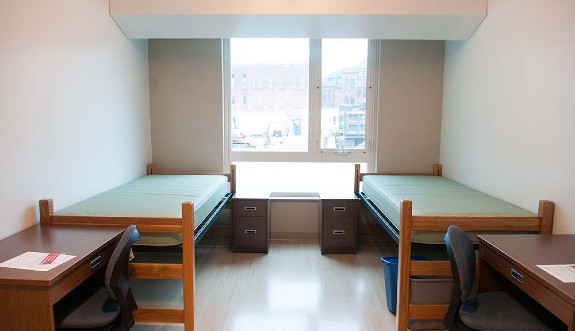
Room Furniture and Fixtures: The following list of policies outlines what is and is not permitted within Residential Living Communities regarding residential living spaces and the furniture and fixtures within them.
Student Beds
- Lofting Beds: Beds are not permitted to be lofted in residential living spaces outside of Morgan Hall, Daniels Hall, Ellsworth Apartments, or Fuller Apartments.
- Beds that are lofted by the university are not permitted to be de-lofted, unless approved by the Housing & Residential Experience Center.
- Bunking Beds: Beds are permitted to be bunked atop other beds. The beds will need to be supported with university supplied bed pegs (contact the WPI Housing & Residential Experience Center to request).
- Students will bunk the beds themselves.
- Beds that are bunked should only be bunked with university supplied bed pegs.
- Raising/Lowering Beds: Beds are permitted to be raised or lowered to the maximum or minimum setting on the supplied bed frames.
- Personal Beds: Students may not bring in a personal mattress/bed frame to replace or accompany their WPI supplied mattress and bedframe.
Room Decorations & Fixtures
- Furniture may not be set up in a way that creates an increased risk to fire safety.
- Temporary or permanent structures that are affixed to University issued furniture or walls are not allowed.
- We recommend using command strips and hooks to temporarily hang items. We ask that you use caution when removing them. Students may be liable for sufficient damage to university property.
- Nothing should be hung from the ceiling, pipes, fire safety equipment or light fixtures.
- Students should not be using their residential housing as a lab/academic workspace with tools that could cause harm if used incorrectly.
Personal Furniture & Storage Containers/Shelves
- Plastic Storage Drawers
- Hard plastic drawers for storage are permitted in residential living areas.
- Wire Storage Racks (metal)
- Wire storage racks (metal) for storage are permitted in residential living areas.
- No personal furniture is permitted in the residential living areas.
- No Beanbag chairs, love seats, couches, futons, or other upholstered or wooden furniture is permitted in residential living spaces.
- No personal shades, curtains, blinds, etc.
- All WPI designated furniture
- Furniture which was in the space when you moved into the space must not leave the space for any duration during the year.
- When you check out of the room all furniture must be accounted for and as it was when you moved in.
- Common Area Furniture
- Common area furniture must remain in common areas. No students should have any common area furniture in their residential living space.
Appliances: Below is a list of cooking appliances permitted in all locations, within full kitchen areas and not permitted at all. Because we cannot list every kitchen appliance available, you should assume if it is not on this list, it is not permitted anywhere. If you have questions about specific kitchen appliances, please direct them to housing@wpi.edu.
- Appliances, with automatic shutoffs, permitted in all locations
- Microwave, electric kettle (no exposed heating element), mini-fridge, pod-coffee makers.
- Appliances, with automatic shutoffs, permitted within full kitchen areas
- Rice cookers, air fryers, toasters/toaster oven, microwave, blender/smoothie maker, pod-coffee maker, electric kettle (no exposed heating element), crock pot/slow cooker, etc.
- Appliances not permitted in any location
- Hot plates/induction cooktops, George Foreman grills/griddles, smokers, grills (electric or gas), no electrical cookware (electric skillet, wok, etc.) of any kind, fondue sets.
General Housing Policies: The following policies outline items and activities that are strictly not permitted within residential living spaces.
Electrical Safety Policy
- No personal air conditioners.
- No refrigerators that are larger than 4.3 cubic feet and/or that use more than 120 volts of electricity.
- Personal electronic devices may be restricted depending on power consumption exceeding the maximum electrical capacity of the building in which you reside.
Fire Safety Policy
- No kerosene, gasoline, or other flammable liquids.
- No flammable covers, paper shades, or decorations on the light fixtures.
- No space heaters, halogen and lava lamps.
- No grills or fire pits of any kind.
- No incense and/or candles (whether lit or unlit), scented lamps, or open flame devices of any kind
- Cigarette lighters and matches are an exception to this rule, but they may not be used inside the building.
- No hover-boards, scooters, or electric transportation devices w/lithium batteries.
- No 3D Printers.
- No wax/candle warmers.
- No extension cords that do not have a built-in surge protector
- The HRE Center has an extension cord swap service where you can swap your old extension cord for one that is approved and surge protected.
- Any lights used for decorative purposes must be listed by UL
- Strings of interior lights may not be used as extension cords.
- Multiple strands of string lights may not be connected to one another.
- Lights should only be hung around the perimeter of the room and should never be hung from the ceiling or close to fire suppression equipment.
- No trees, bushes and similar large plant life. Plants should not be taller/longer than 12”.
- No cooking/kitchen appliances should be outside of a full kitchen area.
- For more information, please review the Fire Safety page.
Pet Policy
- Emotional Support Animals (ESAs) and Service Animals are the only animals permitted in residence halls if they have been approved and documented by the Office of Accessibility Services
- Approved animals must also receive an ID from ID Services.
- Pets visiting campus may not enter residential buildings. They must be leashed at all times and remain in outdoor areas of campus
- No animals which are vising campus are allowed in residential facilities and should not be on campus longer than 12 hours at a time.
- You are allowed one (1) 10-gallon tank that houses freshwater fish only
- No other animals are allowed in tanks unless approved as an Emotional Support Animal (ESA) or Service Animal.
- For more information, please review the Animals on Campus page.
Alcohol Policy
- If you are under the age of twenty-one (21), you cannot possess full or empty alcohol bottles or cans.
- You should not, regardless of age, display alcohol, empty bottles/cans, or empty boxes in residence hall room/windows, as decorations or collection (example: an empty alcohol bottle that is being used as the base of a lamp, beer boxes broken down and hung on the wall, or several empty bottles/cans stacked up within a room).
- If you are over the age of twenty-one (21), you may possess up to one (1) 12-pack of beer, or one (1) liter of wine, or one (1) liter of liquor (80 proof maximum) in your personal room or in apartment if all residents are 21 at any given time.
- No residents under the age of 21 should have access to alcohol in space
- If you are of age but are living with a resident who is under the age of 21, you may possess alcohol, but you must make sure the underage residents do not have access to that alcohol.
- No residents under the age of 21 should have access to alcohol in space
- Unless all residents who occupy that space are age twenty-one (21) or older, alcohol should never be in a common area
- Alcohol should also never be in a fridge that an underage resident has access to.
- You should never, regardless of age, be in a public space (hallway, common area, lobby, elevator, etc.) with an open container of alcohol.
- For more information, please review the Alcohol and Drug Policy page.
Guest Policy
- Your housing assignment is to be occupied by you and you only, subletting is not permitted. Spouses, children, family, and friends are not allowed to reside on campus in your housing assignment at any time.
- Residents must meet guest(s) in the main lobby/any building entrance and then escort the guest at all times (24 hours a day, 7 days a week). The residents hosting the guest(s) must be present in the room with their guest(s) at all times.
- A guest is defined as anyone in a residence hall room that is not assigned to that specific space or residence hall by the Housing & Residential Experience Center.
- Roommates must be courteous to one another when having guests and be sensitive to their roommate(s)’ primary rights to sleep, study, and privacy.
- Having guests is a privilege that requires the prior consent of roommate(s)
- Unresolved visitation issues among roommates may result in the loss of the privileges for all residents of a room.
- Guests should visit only with the approval of all roommates within the room.
- As long as all roommates agree, each resident is permitted to have as many as two overnight guests on any given night, but guests are not to remain longer than two days (consecutive or nonconsecutive) within a seven-day period.
- Residents assume responsibility for the conduct and behavior of their guests, including informing guests of all pertinent residence hall policies and procedures. If a guest is in violation of any policy the resident will be reported through the conduct process.
- Additionally, guests will be held accountable for their behavior and may be asked to leave the residence halls and/or campus.
- Guest privileges may be revoked for violation of university policies, and guests may be prohibited from university property indefinitely.
- In addition, the Housing & Residential Experience Center Staff may, at any time, require a guest to vacate any Residence Hall.
- Students requiring a Personal Care Attendant (PCA) that will have access to their on campus residence must comply with the PCA Policy as set forth by the Office of Accessibility Services.
- For more information, please review the Housing & Dining Contract page.
Activities Not Permitted in Residential Living Areas
- Bicycles should not be stored in building common areas or stairwells
- Bicycles may be stored in your room with the permission of all roommates.
- Removing screens and windows.
-
Throwing or hanging any items out of windows.
- Being on the roof of any residence hall.
- Storage of personal belongings in common areas.
- Adding your own personal room locking device or tampering with existing room locking devices in any way.
- Antennas attached or hung from any residence hall.
- Any commercial purpose or activities
- e.g. Etsy shop.
- Painting or marking walls or other surfaces in or outside of residence halls.
- Command hooks/3M strips on walls:
- Students should utilize push pins/tacks for spaces with drywall.
- Students should utilize painters tape/poster putty for spaces with cement/brick walls.
- Stereo equipment or speakers directed out of windows.
- Sports or similar activities in the lounges, residential corridors, stairwells, or any public area of the residence hall facility.
-
Absolutely no removal of university furniture from its designated space.
Decoration & Window Posting/Display Policy
Decorations or other items posted in student rooms/apartments are limited to walls and inside of doors. For safety and maintenance reasons, nothing may be posted on or affixed to windows, heaters, ceilings, sprinkler pipes or fire safety equipment, or room furnishings. For fire safety reasons, no more than 40% of any individual wall or door surface may be covered with decorations or other materials.
Additionally, in order to maintain residential fire safety; to prevent damage to windows; and to facilitate window cleaning and maintenance; residence hall room/apartment/common area windows must remain clear of any obstruction. Posting, hanging, painting, or otherwise displaying decorations, pictures, signs, flags, banners, lighting, or other objects or materials in or upon residence hall room windows, including common areas (such as lounges, tech suites, lobbies, etc.), or on university window coverings is not permitted.