Follow The WPI Podcast on your favorite audio platform
E29: Engineering and Technology in Auto Racing | Phil Surgen | Class of 2004
In this episode of The WPI Podcast, we explore NASCAR racing from an engineer’s perspective.
Phil Surgen, director of technology for Trackhouse Racing, former crew chief for NASCAR Cup Series driver Ross Chastain, and a 2004 Worcester Polytechnic Institute mechanical engineering graduate, discusses the role of engineering, technology, and teamwork in competing at the highest level of stock car racing.
Surgen talks about how data and simulators inform his team’s efforts, career opportunities for engineers in NASCAR, how his work as a student on WPI’s long-running Formula SAE race car program provided him with valuable experience, and what it’s like to work on a race team with three cars competing in NASCAR.
This episode is part one of a two-part feature on Surgen. You can read more about the WPI alum’s work in auto racing in the spring 2026 issue of WPI Journal.
Related links:
Department of Mechanical and Materials Engineering
Transcript
Jon Cain: 40 cars hit the track every week in NASCAR's Cup series. So what does it take to compete at the highest level of stock car racing? Our guest on The WPI Podcast knows it takes engineering technology and teamwork.
Phil Surgen: You know, it was a ton of man hours in the last, you know, 36 hours that went into the car we had today.
Cain: Phil Surgen is director of Technology at Trackhouse Racing. He's been a crew chief leading one of three Trackhouse teams in the Cup Series.
Trackhouse Racing Team Audio; Phil Surgen & Ross Chastain: Coke 600, Baby, Let’s {expletive} Go. Yeah, World 600, yeah.
Cain: Today the Worcester Polytechnic Institute alum shares his path to a career in motor sports from working on race cars as a kid in Vermont, to leading a team of WPI students to build and design a formula style race car as a mechanical engineering major, he breaks down how data and technology like simulators turn planning into performance. And he talks about opportunities for engineers in NASCAR and what it's like to work in auto racing. Hi, I'm Jon Cain and welcome to The WPI Podcast. In today's episode, we explore the world of NASCAR from an engineer's perspective. And I wanna let you know you can read more about Phil Surgen and his work in the spring 2026 edition of the WPI Journal. That's the Worcester Polytechnic Institute magazine. Look forward in April on wpi.edu. We'll have a link in the show notes. My thanks to NASCAR Media and Trackhouse racing for the audio clips in the intro. Now let's get to the conversation. I talked with Phil in early December, 2025. He joined us from the Trackhouse Racing shop in Concord, North Carolina. Phil, thanks for being on the show.
Surgen: Thanks for having me. Looking forward to sharing my story and chatting for a little while.
Cain: It's great to have you here. So let's drop the green flag on this conversation. Uh, we'll do it stage racing style. Uh, stage one is all about your work. Uh, so. Why don't you tell us what you do as Director of Technology at Trackhouse Racing and what excites you about the role?
Surgen: So, director of technology is a new role for me starting, uh, just a few weeks ago. Prior to that, I was the crew chief on the number one car, Ross Chastain being the driver for the last, uh, five and a half years or so. But as far as, uh, you know, the director of technology role that. We kind of set this in motion about a year ago, personally, I had a desire to travel less. You know, as a crew chief, I was traveling 38 weekends a year and, uh, with a young family, I just felt the need to spend more time at home with the family. So now I've transitioned to director of technology. So, um, on the day-to-day I'll be looking after a, a group of, uh, performance engineers, which is kind of made up of race engineers, um, and some software engineer types. And, uh, you know, the goal of the performance group is to support the teams, the race engineers specifically, and help elevate the performance of the company. Uh, you asked me what motivates me and you know, it's really just the competition, it's the technology, uh, it's the racing. And as the director of technology, it'll be a little bit different, not being at the track and, um, that'll be something I'll have to adapt to. But, um, you know, it exists in every element of the company. Everything we do here is very calculated and very pointed at improving the performance of the cars, improving the performance of the drivers, the pit crews, making better strategic calls, and, you know, being in a, a role where I can help facilitate some of the people and the tool development to make better decisions, make faster cars, is, is what motivates me.
Cain: I'm wondering if you talk a little bit about how long you've been involved in NASCAR racing and, and how you got into it.
Surgen: So I've been involved in NASCAR since 2005. How I got into it was just my love for racing, my passion for racing and technology. When I was a child, my dad was involved in some, some hobby racing, snowmobiles, formula, Fords, that type of thing. And I was always interested in cars and snowmobiles and going fast, and I had an opportunity to start working on some late models. Late models are, uh, uh, probably the highest form of hobby stock, car racing. And I would work on those cars during the summers, you know, school breaks, that type of thing. And, uh, that's really what led me to a career in engineering. I got, uh, I was really interested in the technology and I found myself trying to figure things out beyond what other people were doing. I was rating springs and dynoing shocks and bump rubbers, and at that time there wasn't many people doing those types of things. So that got me interested in the technology and the engineering and ultimately led me to a career in mechanical engineering. So I, that's, that's what led me to WPI. After I got done my degree, I knew that I was gonna be in racing. That's where I wanted to be. And at that point, I didn't know that it was gonna be NASCAR or really have a, a strong desire for it to be NASCAR. It could've been, you know, working on snowmobiles in Wisconsin or dirt bikes in California, or, you know, uh, whatever it might've been.
But I had, you know, I put some resumes out and I had some, some connections in the industry and got a resume on a desk, really is all it amounted to. And that just kind of set off a course of events, came down, interviewed, and uh, here we are, you know, 20 years later
Cain: And you've had a, a few different roles in NASCAR. Can you talk a little bit about what those have been?
Surgen: Initially when I came in, I was a, a junior engineer and as a junior engineer, you're doing, uh, race engineering type tasks. But, uh, you know, certainly not traveling, uh, to races, you're traveling to a lot of tests. Data acquisition was a big part of what I did day to day. Installing the equipment on the cars, collecting the data, and providing those data sets to the teams and to the, you know, to the engineering staff. And that at the time, that was kind of the normal building ground for, for training race engineers. And, uh, about a year and a half later, I had the opportunity to start traveling with a team. And then, you know, in 2007 was my first year as a full-time traveling race engineer. So I, I race engineered from 2007 all the way until 2020. And in 2020, uh, you know, the, the cards fell right and I got the opportunity to, to start crew chiefing. So I took over the crew chief role in 2020, all the way through the end of this past season.
Cain: It's fascinating to know that there's so much engineering and technology that goes into these cars. You know, I think back to being a kid, going to the go-kart track and they just tell you, you know, gas is on the right, brake is on the left, and that's pretty much all they tell you. Just say go fast. Right. And beat everybody else. But, um, you're, you're, you're telling us there's a lot that goes into it. So I'm wondering if you could talk a little bit about that. How are engineering and technology, uh, such an integral part of preparing the race cars, uh, and competing at the highest level in, in stock car racing?
Surgen: Yeah, everything we do is driven by engineering: science, technology engineering, you know, from simple things as you know, using Faro arms to measure to some of the most advanced vehicle dynamic simulation that exists in the world, really amongst all series. And that would include Formula One and everything we do, we hyper analyze, you know, as critically as we possibly can. So we're looking at Faro arm measurements, we're looking at surface scanners. We have a group of software engineers here that are building software tools for us to sort chassis to make full vehicle dynamic simulation laps to sort tires, to analyze pit stops, to query databases of historical information, trying to look for trends to help improve our drivers with what line they run and how much brake to use. And there isn't a thing that we do that isn't surrounded by technology.
Cain: You mentioned simulators. What are the different simulators that are used to prepare your race team for competition, and what do you learn from them? And is that something that the drivers sit in, um, and they mock out a race? Or is it all sort of computerized and done automatically without the driver present?
Surgen: Yeah, we have three types of vehicle dynamic simulations. One is what we call offline sim, which is just run on your laptop and that's a full vehicle dynamic simulation of a lap at any track. It includes the mathematical and the physics models of every component on the car. That's the aero map, that's the tires, the chassis, the kinematics, the shocks, the springs, the track profile, the track roughness. All of that is included and we run that on the laptop and we can, we can make laps and we can try to optimize the car using that. The second style simulation we have using the same base physics model and software tool, we add the driver in the loop and that's what you'll commonly hear drivers talking about ;in the sim’, we call it DIL, driver in loop, and we have two type of driver in loop simulators. We have a static and we have a a full motion rig. The static is what you'd see on tv people are doing iRacing video game kind of things on where there's a, you know, a full wraparound screen. There's a simulated cockpit dash. All the controls are laid out just as it is in the car, but the rig doesn't move. Just the video and the audio exist. And then there's full motion simulators, which is a identical copy of the driver's cockpit in the real car. It's in a, a medium sized room. It's dark, and there's the screen wraps around the perimeter of the room, and the cockpit is mounted on a bunch of actuators. So as the driver is driving a lap, the whole cockpit moves to simulate the accelerations that he's experiencing on the track. So, you have those three styles of simulation. All have their place and their need. Obviously when you want, drivers are human and it's hard to simulate the reaction of a human and the feedback you get from a human. So after we do maybe 20, 30,000 runs offline, sim. We'll bring the driver to the simulator and ask his opinion. We'll have him drive it, we'll ask his opinion, and we'll see what the capability of the car is in the simulator with the real driver. Largely, the simulators are, are really good. Um, there's some factors, there's some variables that the simulators can't account for. For instance, when we're at the track. We got a cloudy day and the clouds roll through and the track changes all of a sudden we can't really replicate that in real time in a simulator. But you know, the drivers experience a lot of the same things in the simulator they do at the racetrack. The feedback's very similar. It certainly helps us sort through setup changes and, you know, allow us to execute a test plan. And it helps them too, you know, particularly on the, the road course tracks where we only race at the road courses once a year, uh, for NASCAR road courses are a little out of the normal. And just to help the drivers reacclimate at those style tracks, it's, it's a really valuable tool.
Cain: It sounds like you're getting a ton of data through all these different, um, simulations and, and the other things that you're trying to analyze as you prepare for a race, how do you monitor that data? How do you process the volume of it and make it, uh, something that you can turn on your deadline to get ready for a race?
Surgen: Like you mentioned, we have a lot of different data streams. Uh, I was talking about the simulation data. We can create simulation DOEs and run 20,000 or 30,000 laps of, of data in a matter of a few hours, and we've got three teams that are all doing similar things. When we go to the racetrack, the ECU, there's a data logger and we can log all of the engine parameters and we can log the driver controls as well as a few accelerometers. So every time the car's on track, we're logging, you know, hours worth of data and that doesn't even include, you know, other forms of data that we're generating in the shop. And, you know, data management's certainly something that we put a lot of time and energy into. We've got a team of people in the engineering area that just work on processing, filtering, and loading these data sets into a common database for us to be able to use and query.
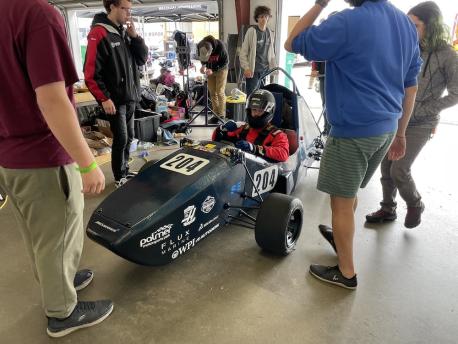
Cain: Very cool. I wanna go back a little bit to your time at WPI. When you were here, you worked on the formula SAE race car, and that's a tradition at WPI for several years now. A student club. The WPI chapter of the Society of Automotive Engineers designs and builds a formula-style race car every year, and it gets judged on things like engineering design and high performance endurance. And many students work on the car as part of their senior year professional level design project required for graduation. That's called a Major Qualifying Project, or MQP at WPI. Uh, for the last several years, the formula SAE program at WPI has designed and built all-electric race cars, and the students working on the project come from a variety of majors like mechanical engineering, robotics engineering, and electrical and computer engineering. So I'm wondering, Phil, if you could talk a little bit more about what you did during your time working on the car and what it means to you that you had that experience in college.
Surgen: The. Formula. SAE program was one of the reasons I was attracted to WPI, uh, you know, having grown up in racing and around racing and really felt like my career was gonna be focused in motor sports, it was important to me that wherever I went to school had either a Formula program or a Baja program, something that tied all of the engineering disciplines in together then included the manufacturing, the build, uh, and the testing of the cars. You know, having grown up around racing, I was doing a lot of these things on my own. I was never formally trained in engineering when I was, you know, a teenager. But I designed parts and I built parts and I put 'em on the car and I got to see him work. And having had that experience, it was important to know that I was gonna have the opportunity to tie in all my formal education, formal engineering training into some type of reality. Uh, so that's one of the factors that drew me to WPI. But, uh, as far as my experience went, you know, 2000 was when I started at WPI and the Formula Program it was really broken up into two separate pieces. You had the Formula SAE program, which was largely seniors, a few juniors, a lot of MQP Projects were done on the formula car and then you had kind of a separate group, which was a car club that actually had the previous years’ SAE cars. So coming in as a freshman, you know, get, get to be part of the car club and as the club has previous year's cars, so we maintain those cars. We went out and drove 'em occasionally. But you didn't build, you didn't design really anything, but you were kind of exposed to the, the. The Formula SAE program, which was largely upperclassmen, uh, doing design projects. I was fortunate enough to be able to work at the Higgins Lab machine shop. That's where the project took place. That's where the group met, that's where the car was built. And they used that machine shop to build a lot of the parts. So even as a freshman, I was around the group of guys that were doing their MQP and building the car. And you know, by the time I was probably a junior, I was pretty actively helping out on the SAE program, even though I wasn't, uh, you know, an official member or doing an MQP yet. I was down there all the time. I knew the team really well, and that got me a, a lot of experience with it. And then that, that just rolled over into an MQP for me in my senior year. Did the suspension design and the crash protection on the car. The safety element was uh, maybe a 10% part of the project, and then 90% was the suspension, which really included a good bit of the frame 'cause that's obviously where the suspension mounts is critical, where the steering mounts and the, the shocks and pull rods and all that mounts. So really it was a good bit of frame design, all that were part of the project.
Cain: Very cool. Um, I, I wanna shift gears now to, to stage two of our conversation and, uh, explore some of the behind the scenes of, of your time in racing. So, uh, I'd love to start by asking you, you know, NASCAR's a pretty high profile sport. I'm guessing there were some people growing up that you looked up to in the sport that were doing it. Um, did you ever get a chance to end up meeting or, or maybe working with any of those people and what was that like?
Surgen: To be honest, when I was growing up, I was not a huge NASCAR fan. I loved racing and I watched NASCAR races periodically. I watched local short track racing and snowmobiles and road racing. I watched it all. Drag racing. But I didn't. I wasn't one of those guys that had to watch NASCAR every Sunday. I will say though, once I moved south and I was in the industry and I started learning more about the history of the sport and started learning more about the people and the development process on the cars, and all this is taking place all the time, but as a fan, you never really get exposed to any of it. But as I was starting to be exposed to all this. There was instances where I was like, man, that guy is a innovator and I'd like to meet him. And uh, probably the guy that sticks out to me the most is Dale Inman. Dale Inman was, uh, Richard Petty's crew chief for decades. You know, they won seven championships together. Dale went on to win an eighth championship, one of the only people ever to do it, an eighth championship with Terry Labonte. And so. You know as I'm learning more about this, and Dale was a crew member, which is a little bit more relatable for me. He wasn't a driver, so I started in the industry working for Evernham Motorsports, and there was some business transactions that took place and kind of transformed Evernham Motorsports to Gillette Evernham, and then to Richard Petty Motorsports. And when it became Richard Petty Motorsports, Dale and Richard were around all the time, and I had many long conversations with Dale, um, in the shop, and he acted as a consultant for the team. So, uh, that was probably the most relatable person that I had in, in my life. That probably partially answers your question.
Cain: What was it like to, to meet him? Were, were you feeling intimidated just because it's someone that had had such a long career that you kind of looked up to? Or, or was it just like, uh, talking to a colleague across the table?
Surgen: For me, more of a colleague, you know, I'm not somebody that's real star struck or anything like that, but, you know, certainly you meet this guy and, and, uh, has a little bit more of a presence than most people. And anybody that knows Dale knows that he's got, you know, a handshake that take you to the ground. And, uh, so when you meet Dale Inman and you, you shake his hand, he, he lets you know that he's there. And, uh, but other than that, no. Uh, just it felt like a normal conversation. And, and like I said, over the years, have had many conversations with him.
Cain: Very cool. Um, you know, for the last five seasons you were the crew chief for Ross Chastain. Uh, and I'm wondering what does it feel like to win a race at NASCAR's highest level? Because, uh, you won with Ross.
Surgen: Yeah, it feels incredible. Uh, it's, it's rewarding. Uh, you're really proud, happy for your guys. Um, it's tough to describe, you know, we're. We're in a sport where on any given weekend there are 39 losers. There's only one game a weekend and there's 39 losers and one winner. And there's a lot of teams that go years and years without winning. And at times I've been on those teams that haven't won for, for years on end. And to be able to win one or two races a season and do it season over season is, uh, you know, it's an, it's an incredible feeling. We, and I say, we as a team dedicate so much time and put so much energy into these race cars and these teams, and to see that all come to fruition and to win a race is, is a, is a really incredible feeling.
Cain: The competition sounds so intense and, and to have it every week and, and those are the odds. You know what it turns out, Ross, he's not just a race car driver, but he's an eighth generation watermelon farmer. And, and when he wins a race, uh, some folks may know this, he celebrates by climbing onto the roof of his race car and, and smashing a watermelon onto the racetrack. And I just have to ask you, who cleans up after the watermelon when it gets smashed on onto the track during one of those celebrations?
Surgen: I, I don't know. I'm glad it's not me. One of the first races, it was the first race we won was, uh, Circuit Of The Americas in 2022. You know, I was lucky enough to be one of the like 15 guys that was on the one car that won the race and was in COTA that day. And Trackhouse Racing has 160 employees, so we tried to bring that win back home so that we could celebrate with everybody 'cause it does take a, a full team effort. And so we, we brought that race car back in the shop and Ross smashed a watermelon on the floor in the shop that day and man, it makes a mess. And it was, you know, somebody cleaned it up. I'm not sure who, but it was, it was sticky for days after that. I, I'm glad I'm not the one.
Cain: That's pretty awesome that, uh, the celebration got to happen at the shop as well, uh, back in North Carolina. That's, that's really cool. I'm wondering, do you have a most memorable race that you've been part of and why?
Surgen: Man, it's hard to pick one out. We've had a lot of really memorable races, and if I have to choose one, it's gonna be the Coke 600 from this past season. So the 2025 Coca-Cola 600, that's the race at Charlotte Motor Speedway on the oval, and it's the longest race of the season, 600 miles. There's a lot of reasons that that one's really memorable. It's a marquee race for us, so there's only, there's only four races throughout the season that you'd call marquee events for the Cup Series, and Charlotte's one of them. One of the reasons that that is so memorable that weekend for me is on Saturday in practice, we hit the track and we were really fast and about 25 laps in, he backs it in the fence. We blew a tire and crashed the car. And it's beyond repair. So, we're of course prepared with, uh, you know, spare parts and backup cars. And, uh, one of the unique things about racing at Charlotte, because it's only six or seven miles down the road, we keep the backup car at the shop instead of in the trailer.
So we get done at the track, clean up the pieces, get that car back to the shop here, and when we get here, there's 30 people here ready to work on this backup car and put it together, and we stayed. The last person left on Saturday night, actually Sunday morning at 2:30. The first guy got back here at five, and then on Sunday we go back through inspection Sunday morning, which nobody else is going through inspections. So we got there early, went back through inspection. One of the consequences of crashing in practice and going to a backup car is you have to start last. So we started last. And we passed the fastest car that had dominated all day with about 20 laps to go and won the race and just, you know, marquee event, um, close to home, started last, you know, straight up, heads up beat the fastest car all day, uh, won the race. That was just a really gratifying win.
Cain: Oh my gosh, that sounds amazing. Just to think about what everybody had to do to come together to pull that off.
Surgen: Yeah, it was incredible. Like I said, probably 30 people, 40 people here at the shop when we got back here and, and essentially worked all night. And, uh, that was, that was a really rewarding day.
Cain: You know, I wanna ask you a little bit about your time as crew chief, and is there a moment that sticks out in terms of, you know, maybe what was the toughest call that you ever had to make during a race or during a vehicle setup? Because I imagine the stakes are pretty high, uh, you know, little tweaks here and there can probably mean a lot of difference in terms of the amount of speed a car has on a track or, uh, your, your track position, I suppose too, in terms of strategy.
Surgen: Yeah, agreed on both, you know, the car setups are very sensitive and a lot of time and effort and engineering resource goes into helping us make those decisions. And to answer your question, are there, are there calls that were harder than others? And there's, there's a handful that may stick out in my head, uh, calls that were hard to make. The one commonality with all of 'em is they're in races that are a little bit higher, there's a little bit more on the line. I'm sure you're familiar with the NASCAR championship format. So there's 16 cars with 10 races left to go on the season, but in 2022, we had made the championship race and there was a couple instances in the race that were pretty hard pit calls. There was a, I think it was the middle of stage two. The caution had come out and we were a little bit outside the fuel window. We couldn't make it to the end of the stage. So the call to save fuel in that circumstance and try to stretch it to the end of the stage versus stopping for tires, which would inherently put you a lap down. You'd be faster, so you'd race your way back on the lead lap, but then trying to make all those spots up. So I chose to save fuel in that circumstance, but that was a hard call to make that sticks out in my mind, uh. On the car setup side, playoff races, uh, certainly that championship race, those are, uh, just there's a little bit more on the line and those circumstances certainly lead to a little bit more stress when you're trying to make those decisions.
Cain: And you've gotta do it in, in a very short window of time, I would imagine as well.
Surgen: Yeah. Uh, particularly race strategy calls. We try to inform ourselves with as much data as possible. We have software tools to help us make informed strategy decisions, but often the circumstances are changing so quickly and we don't know what other teams are gonna do. We can try to predict what other teams are gonna do, but when other teams elect to execute a strategy that is either a little bit earlier than we were expecting, or it's a little out of the norm, then we're immediately trying to kind of recalculate our strategy. But. With almost no time to react because some of these strategies, in order to counter their move, we're gonna have to react immediately. And if we don't react immediately, we're gonna continue to be on the losing end of it. So yeah, like you said, some circumstances are very small amounts of times, you know, less than one minute, certainly probably less than 30 seconds in some cases.
Cain: Wow. That's not a lot of time to work with. Um, Phil. You know, a new NASCAR season is about to begin. There's. 36 points races. It's about eight months long. Your team is all over the country with these races. How do you prepare yourself for the grind that is staying focused and keeping everybody in the race shop on top of their game for every week, all season long, and ready for the 10 race chase for the championship at the end of the season? You've gotta race pretty much every weekend. How do you keep in the right mindset and keep that focus?
Surgen: It's difficult. It's very difficult. And the season, it's an absolute grind. This last year we went 26 straight weeks without a weekend off. The average race engineer, crew chief probably gets one day off a week and as is true for some other professions, there's no discrete amount of work for us to do on a given week. Yes, there's some deadlines we have to meet. The car has to be loaded. We have to have final setup answers, but there's always more analysis we can do. We can always look at another setup option. We can always look at a different combination. We can always look at more strategy situations. We can always look at more history, so it's difficult to draw a line in the sand and say this week's done, time to move on to the next. And what I see happening and what I saw happening with myself for years and, and the people around me is we all wanna win so bad, everybody goes to that, that nth degree on everything. And it's very time consuming. And at the beginning of the season, it's easy to work six days a week or six and a half days a week. It's easy to stay up a little later. It, it's easy to consume yourself by it. But when you look back at the end of the season, you're on a trajectory to burnout at probably one of the most critical times of the season when you need to be your sharpest, and that's the end of the summer, starting the playoffs in the early fall. So managing that is the most difficult thing, and I've had hundreds of conversations with guys I've worked with and around about this very thing and just trying to control everybody's workload and control the number of hours everybody works and puts in early in the season, particularly, just to set ourselves up for more success later. I want everybody to be the sharpest they can possibly be on September 1 instead of burnt out at the end of August. That's the hardest thing to balance.
Cain: That's such a good point. There's so much that goes into it and, and the human perspective. Um, let's, uh, let's enter the third and final stage of the conversation and talk about some, some big picture things. And this kind of ties into what you were just talking about. I'm kind of curious your thoughts on what's the most important part of being successful in a team environment in a fast-paced, high pressured sport where inches and seconds matter, what are those keys to success?
Surgen: Oh heck, good question. You know, teamwork's certainly on the list. Nobody's gonna do this alone. There isn't anybody or any position that can do this by themselves. So certainly a key factor is knowing how to work with your coworkers, your colleagues, and knowing how to take advantage of, uh, technology and software tools to try to help you either expedite your work or optimize solutions more quickly,
Cain: What do you love about NASCAR? What keeps you coming back year after year?
Surgen: Uh, it's the competition and the technology. It's hard to explain, but everybody's been part of, you know, stick and ball sports at some point in their life. And when you get in those moments in the game and you know, you're, you're laser focused on whatever it might be, and that, that competition in that moment is driving you to push yourself harder, to do better, to accomplish the goal for the team, or to help the team accomplish their goal. That competition for me drives me. And then just the technology's just really cool and fun to be around. And technology in NASCAR is developing as fast as it is in the world.
So any new technologies that exist in the world, The NASCAR industry is on top of trying to apply, utilizing immediately. So in the 20 years I've been doing this, things have changed dramatically, in a lot of cases don't even look anything like they used to today. Just trying to develop that technology and apply it is is super interesting.
Cain: You know, if, if somebody's listening to this now and they're saying, man, I wanna do that too, I'm wondering if we could lift the hood on it a little bit and just, uh, explore this a little bit more. What types of jobs are available for people with an engineering background or a technology background or an interest in those things in racing? And, uh, what type of experience is required to get in the door?
Surgen: You know, NASCAR has a need for electrical engineers, mechanical engineers. There's some vehicle dynamics or motorsports programs out there, which are great. We employ design engineers. We do obviously aerodynamics. There's a lot of fluids, and we run CFD, and there's a lot of different engineering disciplines that we use in NASCAR racing, and we're always looking for good people. And good people come in all forms. They're experienced people and they're green. They're people that are just outta college that had never raced before, that are really intelligent, sharp people and we're looking for all of them. You know, like I said, Trackhouse racing right now is about 180 people. Uh, I don't know how many of those are engineers. There's a lot that are engineers. And we do everything from quality control measurements to aerodynamics, to vehicle dynamics, to design, surfacing, uh, surface scanning, microelectronics, there's folks on the engine side that do engine mapping and design, you know, engine systems and machine work. And I mean, you name it, we have it and we're, we're always looking for good candidates.
Cain: And what advice then, would you have to, for someone who wants to get into, uh, working in NASCAR racing, what's a good place to start?
Surgen: You know, it is not a requirement to have an engineering degree to work in NASCAR racing, certainly. But if you wanna be on the engineering side, I would recommend, you know, get your bachelor's at a minimum, explore master’s beyond that, and then as a great opportunity for experience grassroots racing is great in terms of real world experience and for a resume, and that could be, you know, going to your local drag strip or your local short track, anything like that for a little bit of experience is awesome. Not required, and then ultimately just getting a resume on somebody's desk down here. And most of the teams in NASCAR, all the big teams are posting job openings on, you know, Indeed and the list of big recruitment sites.
Cain: Uh, so Phil stage three is pretty much done, but as you know, occasionally NASCAR races go into overtime with a green, white checkered finish. And I, I, I just wanted to ask you a couple more questions in, in overtime here. I'm wondering if there's any lessons that you learned at WPI that, uh, apply to what you do today? Was there a particular class or experience that that helps you still today?
Surgen: There was a few, uh, I find, you know, mechanical engineering for me was great for my career because it was very well-rounded. You know, in motorsports we're dealing with fluid systems, we're dealing with aerodynamics and kinematics, and we're dealing with FEA and CFD and design work and the mechanical engineering degree gave me a little exposure to all of that. Uh, one thing that was, and I didn't know it at the time, one thing that was really important to me on the Formula, SAE project was management. I was the team captain on the, on the SAE program when I was a senior, and one of the unexpected challenges I had that year was managing the group of people. I had about 10, 12 kids that were involved with the program that year, managing all those people to kind of do their part, come together to, to build, to design and build this product, that was the, one of the biggest challenges I had, I didn't realize that was gonna be such a big part of the project, but, uh, understanding management was important for me.
Cain: Absolutely. It makes a lot of sense. Uh, how do you envision AI in your role? What's the role of ai, uh, for your race team and, and are you optimistic about its potential to help you maximize your performance?
Surgen: Yeah, certainly a part of our team, uh, we've been pretty heavily invested in databasing information to integrate with AI agents for, I don't know, a year and a half now. We have, uh, a few programmers that are solely dedicated to that project and, uh, we're at the point where we've got the infrastructure built, we've got some of the UI, some of the agents built, and we're starting to be able to get useful information, useful optimizations out of the systems. And man, when I think about the power that'll exist in those systems in about, I don't know, a year or two. It's gonna be incredible. Right now, we've, we've laid the foundation and the house is mostly built, but we gotta, you know, we gotta trim the house out and finish putting the shingles on the roof and, you know, it's gonna play a, a pretty major role in NASCAR racing. I think we're maybe a little ahead of the curve compared to other teams, and we're just starting to, to reap the benefit of that, but there's a, there's a lot more available, uh, for us in the, in the near, near future.
Cain: Well, that brings us to the finish and the final checkered flag on this conversation. Uh, Phil, thanks so much for taking the time to speak with me on The WPI Podcast.
Surgen: Yeah. I appreciate you having me. I appreciate the in interest in motorsports and you know, like I said earlier, anybody that aspiring engineers that have an interest in motorsports, certainly uh, there are opportunities available and, you know, just look us up.
Cain: Phil Surgen is the Director of Technology for Trackhouse Racing. You can read a story about Phil and his career in racing in the spring 2026 edition of the WPI Journal, the Worcester Polytechnic Institute magazine. It'll be out in April on the WPI website. We'll put a link in the show notes when it's published. You can learn more about mechanical engineering and the Formula SAE program here at the university by visiting wpi.edu. This has been The WPI Podcast. Find this and other podcasts from across campus at wpi.edu/listen. That's also the home for audio versions of WPI news stories about our students, faculty and staff. Please follow the WPI Podcast and WPI News on your favorite audio platform. Please leave us a review and tell a friend about the show. You can also get the latest WPI news by asking Alexa to ‘open WPI’. My thanks to the WPI Global Lab in The Innovation Studio on campus for their production support. I had audio engineering help from PhD candidate Varun Bhat. I'm Jon Cain. Talk with you again soon.