Follow The WPI Podcast on your favorite audio platform
E28: Engineering Safer Skiing | Christopher Brown | Mechanical and Materials Engineering
In this episode of The WPI Podcast, we explore the role of engineering in safe skiing and ski racing, and design improvements in athletic equipment that could help prevent ACL injuries, which are common in skiing and other sports.
Christopher Brown, professor in the Department of Mechanical and Materials Engineering, director of WPI’s sports engineering laboratory, former collegiate All-American ski racer, and former collegiate and youth ski coach, discusses the research he does with students to develop patented sports equipment designed to reduce loads that can lead to injuries like torn ACLs.
He also shares his insight on how sports science institutes leverage research and technology in the quest for success in international skiing competitions like the Olympics.
Related links:
Department of Mechanical and Materials Engineering
Transcript
Jon Cain: Ski racing pushes athletes to average speeds over 60 miles an hour. They go that fast while holding their lines within inches, and they're doing it while plunging down icy mountain sides over all kinds of terrains. For many, the Olympics are the ultimate goal, but sometimes injuries get in the way. Knee injuries are all too common, particularly ACL tears. Athletes can also be hurt in barrier nets along the course. Engineering design improvements to skiing equipment could help change that. Hi, I'm Jon Cain. This is the WPI Podcast. Your home for news and expertise from the classrooms and labs of Worcester Polytechnic Institute. Today's guest is working to engineer safer skiing and ski racing. Christopher Brown is a professor of mechanical and materials engineering at WPI. He's a former All American ski racer. He coached men's Alpine skiing at the University of Vermont to two division one Eastern Championships, and he was a Swiss youth and sport ski coach before coming to WPI. He holds several patents for athletic equipment designed to reduce loads that can lead to injuries in sports, including skiing, skating, soccer, and basketball. He teaches a course on the technology of alpine skiing, advises projects on sports engineering and directs WPIs sports engineering laboratory. Chris, thanks for being on the WPI Podcast.
Christopher Brown: You're welcome. It's a pleasure.
Cain: So, Chris, we're talking right before the start of the 2026 Winter Olympics in Italy. Skiing is always one of the most watched sports in those games. Uh, unfortunately, there's been far too many stories of knee injuries to skiers including, uh, elite racers like Lindsey Vonn. One of the most common injuries in competitive skiers is a tear of the anterior cruciate ligament or ACL, what exactly is an ACL tear and what causes it, especially in skiing?
Brown: Well, so ACL is uh, one of the four major ligaments in the knee, and, uh, there are two in the middle that cross hence cruciate. And this is the one that limits anterior motion or forward motion of the tibia relative to the femur. Um, and what causes it? It, it got stressed too much. You exceeded the, the design load for the ACL and it broke. There's two main mechanisms that we've identified that can cause ACL injuries in skiing. The first is, uh, what we call the boot induced anterior drawer. The anterior drawer is actually one of the tests that you use to see if the ACL is intact if you sort of stabilize somebody's femur and then try to pull the shin bone, the tibia out by putting your hands on the calf and see if you can slide that out if the ACL is missing, your lower leg slides out like a drawer. So there's the boot induced anterior drawer, and because the boots in skiing are high and stiff, they're good at transmitting loads from the ski to the lower leg. That's how we control things. We transmit from the lower leg to the ski. But then, uh, if you go say this happens sometimes in downhill, you go in the air and you get leaning back and the tails of your skis hit first when you go to land, the skis are trying to flatten out. And the stiff back in the boots, pushing your lower leg forward like an anterior drawer. And that can be more than the ACL will take. That was the first ski specific ACL entry mechanism that we identified, and that was at the University of Vermont when I was a graduate student. The second one gets identified a little bit later and I've been calling that the combined valgus inward rotation, CVIR. That involves twisting the knee so that it sort of gets pushed outward laterally. Valgus is the term for that. So it's a valgus movement at the knee, plus an inward rotation of the foot. As such as you might do if you're given a chicken leg and thigh together and you want to break the leg off, you've gotta rupture all those knee ligaments. And so you might get a handy little twist to do that, and the skis can do that, and they apply those loads through the stiff boot. These, uh, injuries showed up when the boots got higher and stiffer in the seventies.
Cain: Are these ACL injuries preventable in skiing? And, and, and how so?
Brown: Well, we think they are, mechanically they should be, we don't have the, uh, epidemiological data to show that they are, 'cause there's not enough equipment with that kind of capability to limit those loads so that you're not pushing so hard on the ACL. Skiing actually is one of the best examples of equipment modifications to nearly eliminate injuries. If we go back to the fifties and sixties, tibia fractures were very common. It was almost like the cliche, you see somebody with a cast on where have you been skiing? Mm
Cain: Yep.
Brown: And sort of the classic thing, sitting by the fire with the cast on your leg and your foot up.
Cain: Elevated.
Brown: Yes. With the snowy landscape through the windows.
Cain: Definitely picture it.
Brown: So that was like the cliche of skiing. And it was interesting, the University of Vermont, John Outwater was the head of the engineering department back then in the sixties. And somebody came to him and said, why are so many people breaking their legs skiing? And John was a very sort of out of the box kind of thinker. And the first question, he said, well, how much stress does it take to break a leg? I don't know. And so they started getting cadaver bones and breaking 'em and measuring say, well, how hard do we have to push on the leg before it breaks or twist it before it breaks? A number of people across the country started working on these sorts of things. There was so much friction in the binding that unless you had a strong impact, the binding wouldn't release. The bindings were designed to try to protect the ACL, uh, the first, uh, releasable binding patent. It goes back to 1939. Hvam, this poor guy broke his leg while he was recovering from the broken leg designs a binding that should prevent these kinds of loads and goes out to test it and promptly breaks his leg again. So there's something to this. The binding has to transmit the loads we need for control in skiing, and we don't want it to transmit the loads for injury. In other words, when I'm moving my legs and pushing on the skis, I want the binding to be there and transmit those loads. Some people think, oh, my ski should come off when I fall. No, your skis should come off when you exceed the loads that you need for ordinary skiing. And that was part of the stuff that was developed at the University of Vermont in testing. There was also a lot of work going on in Europe. So this research and the stuff, realizing that friction is important and here's how we can test bindings. So they developed laboratory tests for bindings to see what they were doing. As a result of that work, the bindings got modified. They put Teflon in so that things could slide and moved into the friction problem. They developed charts so that you could adjust bindings appropriately for people's weight and skiing style and risk taking behavior. The bindings finally developed, and in the seventies we see the tibia fractures almost disappear. Now, coincidentally, the ski boots change from being leather and sort of laces and things to, uh, polyurethane stiff. So they get much better at transmitting the control loads and everybody wants those. They also get much better at transmitting the injury loads. Now we're looking at a different injury mechanism and just like athletic trainers found out in field sports like football that, uh, geez, we're having a lot of ankle injuries. Let's prophylactically tape the ankle so they don't get injured. The injury moves up the leg to the knee.
Cain: It sounds like the ACL is the next frontier then if you've made progress with broken legs. But the ACL remains a challenging problem.
Brown: It did. We've been writing papers and reporting on this since 1983. Since the bindings are developed to save the tibia, partly from spiral fractures, \they have, uh, their center of rotation of most bindings is right under your tibia. So if I apply a load somewhere near that center of rotation, the binding's insensitive to it, it's like I jump on the middle of a teeter totter.
I can't make it go either way. Um, and if I'm very near the middle, a light person can lift me up. So in those positions, the ski has got tremendous leverage on your knee.
Cain: Gotcha.
Brown: And you need another rotation access. So in answer to your question, are they preventable? In theory, yes. Will we get epidemiological evidence? We've gotta get more equipment on the hill that is capable of doing that. We've gotta follow that with epidemiological studies that are good. The first releasable binding patent to try to protect the tibia comes out in 1939, and it's not until the 1970s that we see solid epidemiological evidence that oh my goodness. These are disappearing.
Cain: Yeah. That's a long road.
Brown: It's a long road. And there's not many other examples in sports where we can say, look at this improvement, and this is dramatic, the reduction in those injuries. So it's fantastic what the ski bindings did, but it wasn't just the binding design. It was also the ski shop practices, developing the standards, developing the test methods, getting binding testers in all the ski shops, training everybody to do that. It's a big job. And so, uh, this took a while, but it happened finally. And I, I see the possibility of doing the same thing with the ACL. But it's, uh, gonna take some time and it takes some binding companies with the courage to make a commitment to this sort of thing. And we need places that are doing the epidemiological studies.
Cain: Well, I know it's something that you're very passionate about. You mentioned that you've been doing research on it for, for a while. I'm wondering if you can talk a little bit about what you and your students have been working on here at WPI in terms of designing equipment that has a goal of preventing ACL injuries, in particular, in skiers.
Brown: Well, actually we've been doing quite a few things on this and for a while that was, uh, one of the reasons why I was very happy to come to WPI 35 years ago so that I could work with students on this kind of thing. And we've made presentations the um. Uh, International Society for Skiing Safety and students have done that. I've presented students’ work there too. We've also done it for the International Congress on Science and Skiing. Students have traveled to Europe to do this and uh, so we've had good exposure. On one of our projects, it was related to lacerations 'cause that's also a ski injury problem. Because you have very sharp edges 'cause you're on hard snow.
And then if you fall and the edge hits you, you can have severe lacerations. We had a project on that and our MQP students uh, won the prize for best poster at an international conference for science and skiing in Austria. I think all of the rest of the posters were at least PhD students.
Cain: So, yes, the MQP, that's the Major Qualifying project. That's a senior level undergraduate design project here at WPI.
Brown: And it was a, you know, it was a group of, it was two students and. Yeah, it blew me away Things more specifically for the ACLs, we've made a number of prototypes, actually bindings that could do that. Both, uh, addressing the boot induced anterior drawer, so to, uh, make a, uh, a binding where the heel can move down, the toe can move up, and we can solve some of these problems. We don't always need to release. And this is a common misconception, at least theoretically, we shouldn't always need to release, we just need to get by this transient state where the knee's being loaded in an adverse way. Uh, for the ACL, uh, because skiing's a dynamic sport and uh, we also give the athletes more time to respond 'cause you can tell something's going wrong. Some people will tell you, I could feel my ACL going.
Cain: Really?
Brown: I just couldn't, couldn't react fast enough.
Cain: Oh, wow.
Brown: Well, the athletes are very tuned in to what they're doing, what they're feeling. So if we give them a little bit more time, and we can also make these things to absorb so you get the same sort of impulse, but over a longer time with lower loads. And if you keep the loads below the loads that will cause the ACL rupture, you made it. So we've addressed the boot induced anterior drawer and the CVIR, the combined valgus inward rotation by putting another pivot point. So, uh, having a plate binding and actually we have patents on some of these things. So we can put a plate that has a pivot out in front of the, uh, current binding pivot, so something up towards the toe or even in front of the toe so that the binding can respond to loads on the side of the ski that are coming in near and just behind the axis of the tibia. We've been working more on absorption than release, and uh, the idea of having a plate means I could put any binding that I want on the top of the plate and then the plate can also help prevent, uh, inadvertent release. Sometimes bindings come off when injury is not imminent and leave a skier on one ski with severely reduced control naturally.
Cain: That sounds like a scary situation as well.
Brown: Yeah, and for good reasons because, uh, at can end up, um, in tragic kinds of injuries, so.
Cain: Sure. How did you first get involved in combining engineering and sports?
Brown: It was at the University of Vermont. I had never really thought about studying engineering before. And, um. My sophomore year there, they brought in a new coach who was from Vermont, Mickey Cochran.
Cain: Ski coach.
Brown: Ski coach. Yeah. And I can remember exact things he said in the first meeting. I was good at through math and physics and never thought about engineering. And he was starting to say, listen, you know, this is how you have. This is how the skiing works, and here's how you push at the end of the turn, and here's how you're doing this. And I, wow, this makes sense. I mean, I've always been coached by people that are just talking about technique, but he's talking about physics. So I asked my physics teacher about some ski problems, and he said, that's not physics, that's engineering. And I, oh. Well, that's what I'm interested in. I guess I'll go to the engineering building.
Cain: So a little bit of a shift based on the things you're learning.
Brown: And I just, I was fortunate to be at the University of Vermont and uh, and they had that group there and I ended up getting involved with them. But Mickey Cochran was just an amazing coach He had, uh, all four of his children skied in the Olympics and he was the one who coached them. He ends up at the University of Vermont on a skiing football scholarship, and he's a talented athlete. Um, serves in World War II combat and comes back, works as an engineer, but he wants to teach and coach. And so he gets into that as well as engineering. He builds his own ski area in his backyard and, uh, welcomed us out there, uh, the UVM ski team to train on that. And when he started coaching, University of Vermont had never won a major meet. And then we went on to something like 10 years, the longest undefeated streak.
Cain: Wow.
Brown: Um, in regular season NCAA history. And that included eastern championships and national Championships. And, uh, he started it. When I finished racing, I got to coach for a couple years there when I was starting engineering studies, but there was the skiing that got me into engineering and I thought, this is, I want to like design ski equipment. I want, I wanna understand this better. So that's what led to it.
Cain: And you had, you had been skiing from a young age, right? Even before you got to UVM?
Brown: Yeah, my parents were skiers, actually, my grandfather skied. So yeah, skiing goes back a long way in our family. Uh, my parents were both ski instructors, so yeah, skiing is what you did every weekend or every, every time you could go.
Cain: Can you tell me a little bit more about Mickey Cochran and how he incorporated engineering into skiing? I think you mentioned he's sort of thinking about how to optimize the skier's performance using engineering techniques. Is it like trying to figure out the right line down a ski slope or something else?
Brown: Oh yeah. That's part of it. So getting the right line is, is a key and um. It's, it's an interesting problem and it's not well understood among ordinary coaches 'cause they don't have a physics background. So you can work out optimal lines based on how you're converting, uh, potential energy of altitude into kinetic energy in motion, and how much time you're taking, how far you're going. At the NCAA championships. I remember in 1973, everybody was taking the same line through a couple gates and uh, Mickey told us, no, no, no, you're right here. You're not going that fast. You don't need to set up that much.
Cain: Hmm.
Brown: You can go much straighter. Give it a try and then get back on everybody else's line until the race.
Cain: You don't want to give it away. Right?
Brown: You don't want to give it away. Um, ski everybody’s and then in the race, we'll, we'll take. The fast line that we know to be fast because of engineering analysis. I learned a lot of engineering from him and a lot of good engineering techniques. He had an amazing feel for mechanical things, much better than I’ll ever have. So one of the things I got to do when I finished my doctorate at the University of Vermont and I got to spend a lot of time working on skiing, my doctoral advisor was very generous. My doctoral dissertation was on machining—metal cutting. So. Scraping metal. I went out to Berkeley and worked in Dan Mote's lab out there. He was working on the ski bindings and testing instrumented bindings and worked with Dennis Lieu, who's later a professor there. But, uh, when I got to, uh, Switzerland, I'd been coaching the University of Vermont ski team and I wanted to coach in Switzerland. You need a certificate for doing everything. We now do this too. But at the time, back then in the United States, we didn't do the same thing. So I went through the Swiss ski coaches schools and they've got their sports university Magglingen, and so there's people from that university training you and they had three different levels, and so you had to do well enough in each level to move to the next. When I got to the top level, what they were teaching us and what they were breaking it down was just like what Mickey was doing.
Cain: I love it.
Brown: The same analysis and using the same sort of engineering dynamic physics equations for the loads and the turn, the acceleration of gravity. The whole thing was, um, and the book they gave us to go, yeah, this was just what Mickey Cochran had coached us to do 15 years ago. And Mickey was, uh, you would need to get the pressure on at this point in your turn. You need to maintain it. You need to have you, you need to have a low body position here. You need to extend here, and that is to maintain the pressure and this is the way you can do it. And, and so it was all back to, to physics. So there was never any doubt about that. And I knew I was very lucky because nobody else coached that way.
Cain: Very cool, Chris. So you've made a career out of looking at engineering sports equipment for athlete safety. Um, I'm wondering about what motivates you personally to try to tackle this particular injury, the ACL?
Brown: Well, it's the most common serious injury in skiing. Um. Both my sons are ski racers. Both of them tore their ALCs. I've got four grandchildren skiing so far,
Cain: Knock on. Yeah,
Brown: Their ACLs are intact. Uh, but none of the work I'm doing is influencing any of the equipment they're on that, uh. Keep trying
Cain: The hope
Brown: Yeah. And, uh, yeah, yeah, there's, uh, not giving up on the hope.
Cain: Mm-hmm. We've talked a lot about ACL injuries and, um, the other ways that skiers can get injuries, broken legs. There are other considerations, including some of the equipment around the course that is meant to protect skiers. Can you talk a little bit more about that?
Brown: Yeah. It's nice seeing how that developed. Many years ago when I was racing, they would put up hay bales or snow fences as a way of keeping you out of the trees, and those were not particularly good barriers.
Cain: Can't imagine.
Brown: Uh, so, uh, they developed what they called A nets, which are fixed nets, which sort of looked like a trampoline on its side to keep you on the trail, but it didn't have the same sort of springiness as a trampoline. And then what they called B Nets, which are held in with the plastic poles and are easy to move. The A nets are sort of permanent. Those have to be installed in the off season. And these were much better ways of keeping you out of the trees and they're very prevalent on the ski hills. The problem that we're seeing though, is that in ski racing there are situations where people are going into these nets, almost perpendicular 'cause the skis are so good at turning that you lose a little bit of control. The ski takes a funny catch, and all of a sudden you're going sideways across the trail. And so now you're projected into this net almost perpendicular to the net. You need it to absorb and it doesn't absorb much. And so people, notably some top skiers, Ryan Cochran-Siegle, for example, the top US speed skier broke his neck at Kitzbuhel, which is the big downhill race in Austria. Um, people call it the Super Bowl of skiing, so they should have excellent nets there. And we analyzed that fall, and it's one of the presentations actually I've made to the International Congress on Science and Skiing. Look at the problems here with the net. It came apart. Part of the net’s holding his head. The part holding his body didn't. His neck broke. Uh, fortunately there was no spinal cord damage, but he missed a lot. Once you're in the net. You are in the hands of the engineers. Our engineering is better than this. Uh, and there's more that we should be doing to look at the absorption in the nets and, and the loads on the skiers. So they're far better than going, hitting a tree, but they're not as good as they could be. So one of the things that could be done better with the B nets, and we've actually had, uh, an IQP looking at what kinds of problems are we having with the B Nets. So the B Nets, as I said, are put up with plastic poles that are just placed in the snow, and they basically absorb energy by pulling those poles outta the snow. Most people put them up tight.
Cain: Mm-hmm.
Brown: So that when a skier hits it, you're loading many different poles. From an engineering standpoint, it's pretty obvious. You should put it up loose. So you load one pole at a time, so you're getting more of a constant force kind of thing, or, and if you load all the poles at once, the thing just bends over and you go over the B net. So you need a second one and you're not absorbing as much energy as you could. So you want to catch the skier in the net like a fish. Nearly 50 years ago, we started seeing these nets come up more and more, and now there's a lot in Vermont actually. There's the Kelly Brush Foundation. Kelly Brush was a college skier at Middlebury, and she got paralyzed in the ski race. So the Kelly Brush Foundation was put together after her accident with her parents. Her father was a coach at Middlebury when I was a coach at UVM. Her mother was on the US ski team. So they're very committed to safe ski competition. So this is a wonderful thing that they put together to help ski areas buy nets and install them. So they're doing great work, but there's, there's more we could do with the engineering. We haven't been looking at how, what's the next step? Where do you see ski safety in 10 years? And if you'd asked it 10 years ago, the answer would've been right where it is now. Mm. In terms of the barriers, yeah. We put up more, we do a better job of putting 'em up perhaps, but, uh, we could do a better job with the design. We're not doing as well as we could.
Cain: Mm-hmm. Now it's not just skiing, right? Uh, I think about ACL injuries, uh, multiple sports. Um, it's been high profile injuries in football, uh, women's basketball, um, lots of sports. What are you and your students working on to address ACL injuries in some other sports?
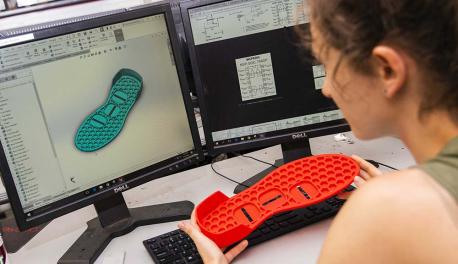
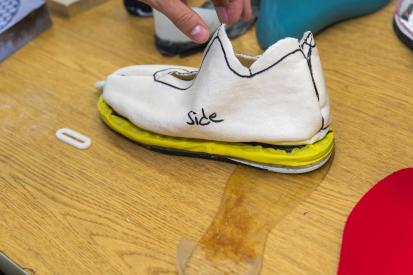
Brown: Well, interesting from what we've learned in skiing, we've said, alright, so how can we control the transmission of ground reaction forces, which is essentially what the ski binding is doing. How can we do that in a shoe sole? Well, we have to split the shoe sole horizontally and then put in some sort of structure to control the load transmission. And one of the things we've been doing is trying to design ski bindings that do a better job of transmitting the control loads up to the limit of normal control loads, and then not increasing, but continuing to transmit the load. So you get a load displacement curve that's initially very steep and then flattens out. So, so how could we do that in a shoe? So we took what we learned from skiing and, uh, we've got several patents now. WPI has the patents, but students and I are the inventors and we have a startup company that came in to, to fund this. And so, um, very soon we'll be getting some prototypes. We've actually been working on that now for 12 years. We'll be getting some prototypes again, a second round of prototypes that, uh, we'll be testing. Um. This is, uh, especially for the women. The thing that motivated me for this was that there was a book by Michael Sokolov that comes out about 15 years ago about what he calls an epidemic and knee injuries, ACL injuries, particularly in women's sports, and talks about women having and studies in soccer and for example, something like seven times, uh, the risk of ACL as men. So this was, this was motivating and it's hard. You won't find somebody that's played high school soccer, a woman who's played high school soccer that hasn't torn her ACL or doesn't know somebody, a teammate that's torn their ACL. Just doesn't happen.
Cain: It's pretty close to home.
Brown: Yeah.
Cain: What's the name of the company and what's sort of a little bit more of the design philosophy behind the sole, uh, the changes in the sole that, uh, you've made?
Brown: The, uh, startup is called Sports Engineering Inc. In this case, in the shoe, getting this non-linear spring system that will be stiff and then soft is a particular challenge 'cause it's gonna fit in a shoe sole. And while there are such springs, they don't fit in shoe soles. So this has been part of our, uh, intellectual property work that, that we've developed.
Cain: It is not so simple. Right. There's some movement in different directions as opposed to just, uh, up and down vertical.
Brown: Well, yeah. Most of the work in shoes has been done vertically. One of our hypotheses is that if we can control the horizontal loads and shoes haven't been designed to do that. If we can control the horizontal loads, then uh, we can do this. We, we also have patents on, on vertical loads, but, um keeping these things independent, decoupled so we can work on the horizontal loads and the vertical load systems independently. So, uh, yeah, the springs that we have, I mean, all material has got some springiness. You load it, it deforms even if you can't see it, and it recovers. So the springs we're talking about are not like Wile E. Coyote ACME spring company.
Cain: That's what I'm picturing in my head, but I know that that's not how it works for you.
Brown: Catching Roadrunner or something. These are, uh, shear springs made with, uh, uh, using elastic material, but uh, deforming it in a certain way and, uh, so that we can fit this in a shoe sole. Uh, so it is actually a shear spring and we work on different designs and testing those.
Cain: Um, I wanna go back to winter sports and you know, when I think about skiing and success in ski racing, I think of a few countries, I think of Austria and Switzerland off the top of my head, and Norway's often in the conversation as well. What do you think makes these countries so successful when it comes to the performance of their ski racing programs?
Brown: That's a good question. 'cause often we look and say, well how can they do that? You know, Norway is, uh, population, you know, smaller than New England and they've got, uh, more medals in alpine skiing.
Cain: That’s true. I hadn't thought of it in a per capita. That makes it probably even more, uh, amazing.
Brown: Well, uh, and I've been so fortunate to be asked to participate in some doctoral exams at their Sports Science Institute in Oslo. This is an amazing place. We don't have anything like it in the United States. Their top athletes and coaches get advanced degrees in their sports. So they are excellent students of their sports. They're doing research there. So Rob Reid, interestingly enough, originally from Texas, I was on his exam committee on technology of alpine skiing and slalom. I can remember heading over for his exam thinking, let's see this candidate's from Texas. I'm going to a Nordic country for an exam on alpine skiing. Is somebody putting me on?
Cain: Yeah. Is this a candid camera?
Brown: No, but I, I knew somebody else. I knew what was going on. You had Norwegian skiers there. Some of them had gotten master's degrees helping him with his doctorate, uh, research. So one of them spoke at his dinner and attributed his, uh, Olympic medal to, uh, at least in part and worked to Rob, uh, had done, uh, Rob is one of the coaches on the Norwegian team still. This exam was at least 10 years ago. So they have people that have earned their doctorate at institutes dedicated to studying sports, and it's not just skiing there, and they've got all kinds of human performance labs and things. The Austrians too, I've been, uh, to a couple of their sports science institutes and a visiting professor there in Salzburg and Innsbruck. Yeah. And actually in Salzburg, they paid for one of our students to do his IQP there. 'cause we had done some work online in skiing that nobody else had done before. It was, uh, you know, a sophomore here that figured this out. I explained to them, oh yeah, we have a student that's worked this thing out about the line and speed. And it was, oh, that sounds interesting. And so, uh, they ended up paying for him. To go to Innsbruck and show them how he was solving this problem.
Cain: What a great experience for the student that, that's the interactive qualifying project typically done in third year at, uh, some of our project centers around the world, that we have 50 project centers and six continents, and really gives students at an undergraduate level an opportunity to go out in the world and tackle some of these, uh, challenges. Now, you had mentioned Innsbruck. There are some interesting facilities there, I believe a refrigerated test track. Uh, what's that all about?
Brown: Oh, they've got some amazing facilities. The refrigerated test track, it's 30 meters long. You can use it year round. There's a, a snow track. They can run skis over it with a sort of rack and pinion sort of cog thing. They can measure all the loads on the ski so they can change the vertical load. They're measuring the horizontal, you know, drag on it. They run it at a range of different speeds. They prepare the snow in different ways. They measure the base of the skis with a focus variation microscope, one of the best in the world for measuring complex topography, so you have over a million different height measurements in less than a millimeter by a millimeter patch of the ski, and you can sort of paste those together, stitch those together so you can, uh, analyze the ski base. They use, uh, CT scanning. They're using tomography to look at the snow structure as a function of depth, uh, in addition to measuring the surface roughness of the snow. So they're getting fantastic data. They've got a room where you can change the air pressure and the humidity, and that you can make special snow and spread it out on this track. Um, it's an amazing facility. It's supported by their ski industry, but it's just one of their research things. They've got a tremendous biomechanical research, uh, facilities and, uh, testing, physiology, endurance, and treadmills. In Western Europe, people see higher education as a societal need. And this philosophy also allows 'em to support things like sports science institutes and we don't have anything like that here.
Cain: Yeah. It's really interesting to learn about the experience that you've seen working with those three sports institutes in Europe. Um, you know, we've talked a lot about the engineering. And some of the safety issues. I wanna talk a little bit about some of the fun, uh, around the Olympics and wondering you personally, uh, what do you most enjoy about watching the Winter Olympics?
Brown: What I enjoy most really is watching the technique. How they're skiing, what line are they taking? How are the courses set? Because in skiing, um, unlike say track where you're always running the same course, yeah. The hurdles are always set in the same place. Skiing, you have a course setter that goes and can be creative and you have certain rules about. How far apart the gates can be and how they have to be set and how many turns you have and so forth. But within those rules, you go, wow, what an interesting set that's gonna be challenging. And so what I like best, uh, is uh, when I was in Switzerland, they did a much better job with the coverage and they would show you the forerunners so you can see how the course is set, and they show you every racer. And you're watching the ski race and you're all right, here's the results and here's the intermediate times, and you're looking, oh yeah, that should affect their time. And oh my goodness, they ran that really well. I wonder what their time is gonna be in that section. So it it's, it's the technique in getting involved and how they've executed.
Cain: You know, as we've talked about, you did competitive ski racing and you coached ski racing. If you could choose any other winter Olympic sport to compete in, what would it be? And then why would you choose that one?
Brown: Are there other Olympic sports?
Cain: Wow. He just, uh, he just laid that one down.
Brown: Uh,
Cain: Skiing is life?
Brown: Yeah, skiing is life.
Cain: There's no second choice
Brown: Life is skiing. Yeah. Uh. Yeah. Hockey would've been neat if I could have played for Herb Brooks, right on the 1980s.
Cain: That might've been the second miracle on ice.
Brown: The 1980s. Yeah, that's right. But they play hockey indoors.
Cain: You got no time for that?
Brown: No. I like to be outside.
Cain: Well, the next time you're watching skiing or ski racing, or maybe you're going down the slopes yourself, I think you've given us all a lot to look for and think about and watch, uh, from engineering and safety. Uh, Chris, I really appreciate you being here and sharing your expertise and your work. Thanks for being on the WPI Podcast.
Brown: You're welcome. It's a pleasure working with you and I feel so fortunate to be here at WPI. I get to teach a course on technology of alpine skiing. I get to do research with all kinds of wonderful students. It's, it's a great place to be.
Cain: Christopher Brown is a professor in the Department of Mechanical and Materials Engineering at WPI. That's just about it for this episode. But before we say goodbye, I want to invite you to follow the WPI Podcast on your favorite audio platform. It's a good way to make sure you don't miss an episode. And if you like what you hear, please leave us a review and maybe tell a friend about us. We'd appreciate it. You can find all our episodes and other podcasts from across campus at wpi.edu/listen. On that page, you can also check out WPI News on the go. That's a section with audio versions of stories about our students, faculty, and staff. You can get the latest WPI news by asking Alexa to open WPI. This podcast was produced at the WPI Global Lab in the Innovation Studio on campus. I'd like to thank PhD candidate Varun Bhat for the audio engineering help. Tune in next time for another episode of the WPI Podcast. I'm Jon Cain. Talk to you soon.