Addressing the AI Talent Gap: WPI Launches Bachelor of Science in Artificial Intelligence Focused on Real-World Applications
Worcester Polytechnic Institute (WPI), has announced the launch of a new bachelor of science in artificial intelligence (BS in AI), a timely and strategic response to the global shortage of skilled AI professionals and the growing demand across industries for specialized AI knowledge.
“Artificial intelligence is shaping the future of work and workplace and driving the shift of industry landscape. WPI has both the responsibility and expertise to prepare students to lead that transformation,” said WPI President Grace Wang. “Our new bachelor’s in AI leverages WPI’s robust interdisciplinary curriculum with deep grounding in AI and its legacy of producing graduates who are ready to develop and apply technology responsibly and create solutions that truly matter to the society."
As AI continues to transform every sector—from healthcare and manufacturing to finance and education—the need for highly trained professionals capable of developing, deploying, and ethically managing AI technologies has never been greater. The World Economic Forum lists AI and machine learning specialists as the third-fastest growing job sector of 2025–30, and according to the U.S. Bureau of Labor Statistics, employment in computer science and information technology is projected to grow 17% by 2033, adding more than 350,000 new jobs annually. Closer to home, key findings of a Massachusetts High Technology Council report include Massachusetts leading the nation in AI job demand in sectors like life sciences, education, and financial services, with job postings increasing 50–85% from 2021. This data highlights both the urgent demand for skilled professionals and the vital opportunity for WPI to help strengthen Massachusetts’ innovation economy and talent pipeline.
- President Grace Wang
The new undergraduate degree builds on the success of WPI’s Master of Science in Artificial Intelligence, launched in December 2023, which quickly attracted national attention and strong enrollment. The BS in AI degree capitalizes on existing strengths in courses and faculty expertise in AI at WPI while providing a focused, flexible curriculum centered on core AI topics such as machine learning, deep learning, generative AI, agentic AI, and AI ethics—preparing students to integrate AI into both technical and societal contexts.
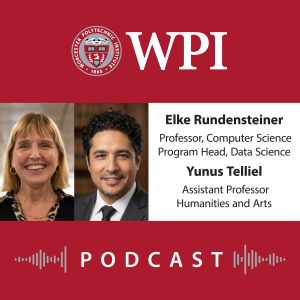
“Unlike traditional computer science or data science degrees, this program allows students to specialize deeply in advanced AI methods and technologies while maintaining the flexibility to apply AI techniques to diverse disciplines with pressing societal problems—from biomedicine to urban environments and global sustainability,” said Elke Rundensteiner, head of the AI and data science programs. “WPI’s program uniquely stands out for its rich interdisciplinary structure, project-based learning approach, and strong connections with industry partners that ensure students gain real-world experience alongside rigorous academic training.”
To learn more about the bachelor of science in artificial intelligence and its curriculum visit: Bachelor's degree in AI
Offices and Departments
Profiles