
ActivePusher earns the Best Student Paper Award at IEEE’s International Conference on Robotics and Automation (ICRA) 2026
Pushing an object across a table looks simple. For a robot, it means predicting how the object will slide or turn, deciding where to make contact, and finding a sequence of movements that reaches a destination without hitting nearby objects. A small error in one push can change what the robot needs to do next.
Researchers in Worcester Polytechnic Institute’s Efficient Learning for Planning and Intelligent Systems (ELPIS) Lab are developing ways to make those decisions more reliable while reducing the data needed to learn them. Their framework, ActivePusher, combines a basic understanding of physics with machine learning and motion planning. It helps a robot select informative interactions during learning and favor more predictable actions when carrying out a task.

The work received a prestigious Best Student Paper Award at ICRA 2026, the IEEE’s flagship Robotics Conference n Vienna, Austria.
ActivePusher was also a finalist for the Best Paper Award on Planning and Control.
The paper was authored by WPI robotics engineering PhD students Zhuoyun Zhong and Seyedali Golestaneh, together with Constantinos Chamzas, assistant professor of robotics engineering and director of the ELPIS Lab.
Choosing what to learn
The research focuses on nonprehensile manipulation: moving objects through actions such as pushing, without holding them in a grasp. These actions can help a robot reposition an object that is difficult to
pick up directly. This has direct applications in warehouse and logistics industries, where Their outcomes, however, depend on contact and friction, which are difficult to capture perfectly in a mathematical model.
ActivePusher begins with a simplified physics model that predicts how an object will move. A neural network then learns corrections to that prediction from examples of actual interactions. This approach, called residual physics, gives the learning system a useful starting point while allowing it to account for behavior the simplified model misses.

The system also estimates uncertainty in its predictions. During learning, it uses that information to select groups of pushing actions expected to improve its understanding. This gives the robot a way to direct its practice toward useful information.
When planning a task, uncertainty serves a different purpose. The planner favors actions whose outcomes the model predicts with greater confidence. An unfamiliar push might be valuable for learning, while a well-understood push might be a better choice for moving an object past an obstacle.
Putting the approach to work
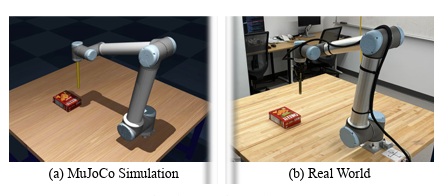
The team evaluated ActivePusher in simulation and with a UR10 robotic arm manipulating household objects. In one task, the robot pushed a mustard bottle into a designated region of a table. In another, it maneuvered a cracker box around obstacles and toward the table’s edge, positioning the box so it could be grasped.
In the study’s model-learning experiments, the combined approach matched the final prediction accuracy of a neural-network baseline trained on randomly selected interactions while using 55 percent of the training data on average. That amounts to 45 percent less training data for comparable accuracy in the reported tests.
The researchers measured this improvement by selecting training examples from previously collected pools of interactions. The result shows how choosing informative examples and incorporating physics can make better use of available robot experience.
The study also found that using uncertainty to guide planning improved task success and reduced differences between predicted and observed object motion. These improvements matter when a robot must carry out several pushes in sequence, because errors can accumulate as the task progresses.
Connecting learning with physical action
The project addresses a central challenge in physical AI: giving robots the ability to learn from interactions and use that knowledge to act in the world. ActivePusher connects the decisions about which experiences are useful for learning with the decisions about which actions are dependable enough to include in a plan.
The current study focuses on objects pushed across a flat surface. The researchers identify richer contact dynamics and three-dimensional manipulation as directions for future work. Extending the approach could help robots handle a wider range of objects and tasks while making effective use of each physical experiment.
The research was supported in part by an Amazon WPI Robotics Engineering research award, a National Science Foundation CRII grant, and WPI funds.
Topics

People
