
We use terms like “cutting edge” and “groundbreaking” to describe WPI’s approach to science, technology, engineering, and math education. But do we need to understand the past in order to develop a better future?
People have debated that question for hundreds, if not thousands, of years—since long before the Worcester County Free Institute of Industrial Science was even a glimmer in John Boynton and Ichabod Washburn’s eyes.
A fitting way to answer the question here at the most immersive STEM university in the United States is to turn to a foundational STEM axiom: To every action there is always opposed an equal reaction. When considered in tandem with WPI’s focus on future innovation, Newton’s third law of motion says it’s not only helpful, but necessary, to consider what came before.

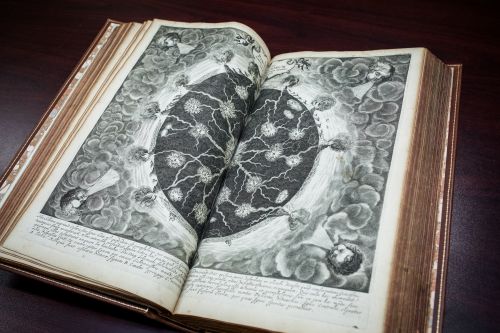
Kircher’s illustration of his theory of the Earth’s volcano system
Believing that the history of science is a vital part of the future of science is what recently inspired a retired engineer from Hudson, Mass., to donate some rare books and journals to the Gordon Library’s Archives and Special Collections. The donation earlier this year from Owen Gallagher included two monographs from 17th-century polymath Athanasius Kircher and five volumes of the journal American Electrician dating from 1890 to 1901 that contain articles on early hybrid vehicle technology.
One of the donated books, Mundus Subterraneus, is believed to be the earliest known geology textbook, according to Emily Ping O’Brien, head of archives and special collections and digital collections librarian at WPI. A German Jesuit priest, Kircher is reported to have descended into the crater of Vesuvius, in southern Italy, while researching the book.
“There is a fascinating cut-away illustration of the Earth showing what Kircher thought the volcano system looked like,” O’Brien says. “Students can decide for themselves whether these ideas were fantastical or ahead of their time.” (See the photo gallery below for additional images.)
Direct experience with historical texts can help researchers gain a fuller understanding of their topic, she adds. “We want people, especially our students, to see firsthand how early ideas were formed, and how those ideas were the beginning of the study of the sciences.”
Adding context
For Dashiell Elliott ’27, MS ’27, taking that kind of long-term perspective has deepened his understanding of and interest in topics he’s studied at WPI.
During A-Term of his first year, he took Theoretical Calculus III with Joseph Fehribach, a professor in the Department of Mathematical Sciences. Whenever Fehribach teaches that course or Calculus IV—both of which touch on the origins of calculus—he invites students to the Special Collections Reading Room to see an original copy of Isaac Newton’s Philosophiae Naturalis Principia Mathematica. The offer piqued Elliott’s interest.

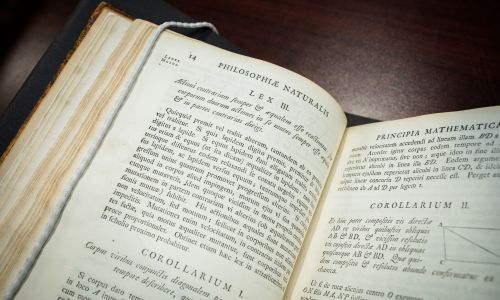
Newton’s third law of motion, in the original Latin
“Professor Fehribach makes a point of bringing up history in his classes because it adds context,” Elliott says, noting that he’d been surprised to learn that WPI has a copy of Newton’s masterpiece. “I knew a little bit about the history of the formalization of math, and I wanted to learn more because Principia is just a neat part of history.”
When Newton was writing the first edition in the late 1600s, “calculus was still in its infancy, and he wasn’t sure he believed it, so he actually did calculations in such a way as to avoid using calculus,” says Fehribach. Even though the text of the book is in Latin and the main focus—despite the title—is on physics and not math, he adds, Newton used theorems and proofs that look very familiar to math students today.
“And if someone in the group can read Latin, I take them to the page where Newton writes down his three laws of motion. They are pretty much verbatim what you learn today,” Fehribach says. “Nothing in there has really changed.”
Case in point: To every action there is always opposed an equal reaction (as mentioned above).
Spanning disciplines
Not many people are aware that WPI’s library contains rare books, but Principia and Mundus Subterraneus are only two of the almost 8,000 volumes in its Special Collections. The Robert D. Fellman Collection on Charles Dickens, which is more widely recognized, features not only first editions of all of Dickens’ novels but also original serial installments of several works, including A Tale of Two Cities, Hard Times, Great Expectations, and Bleak House.

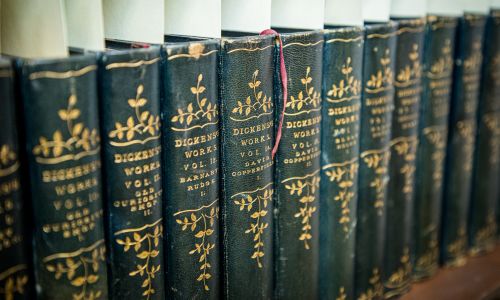
Part of the Robert D. Fellman Collection on Charles Dickens
The full collection of rare books is more extensive and spans hard sciences and humanities in a way that is uniquely WPI. In addition to a 16th-century book on metallurgy and mining, for example, there’s a 1476 collection of writings by Pope Gregory I. That volume—one of the oldest in WPI’s collection—was published just a couple decades after the printing press revolutionized European society by allowing books to be produced and replicated en masse.
By today’s standards, even those print runs were small: Only 1,250 copies of the third edition of Principia were ever printed. WPI has one of them thanks to a gift in 1916 from the widow of Levi Conant, a longtime faculty member who served as head of the math department and interim president of the university.
Just because the books are rare, though, doesn’t mean they should sit on a shelf and be forgotten, says O’Brien.
Gallagher, who donated the Kircher books, agrees. “We don’t want them to gather dust,” he says. “Read them!”
And as he considers his education at WPI, Elliott appreciates that he’s had the opportunity to do so during his time here. Reflecting on what he’s gotten out of doing so, he naturally turns to WPI’s own history. “In a way, it feels like the theory and practice,” he says, referencing the English translation of the university’s motto: Lehr und Kunst. “You need to do some things—and then you need to back up those things by knowing the theory behind them.”


