three people smiling in front of a banner with logos for WPI

Left to right, Rep. James McGovern, Professor Michael Timko, WPI President Grace Wang

Worcester Polytechnic Institute Awarded $1.5 Million to Advance Breakthrough Technology for Destroying PFAS “Forever Chemicals”

Congressman James McGovern announces funding during event at WPI. Project will accelerate research to eliminate PFAS contamination while producing sustainable fuels.
Media Contact
July 30, 2026

WORCESTER, Mass.—Worcester Polytechnic Institute (WPI) has been awarded $1.5 million in federal funding to advance a promising technology that destroys harmful per- and polyfluoroalkyl substances (PFAS), commonly known as “forever chemicals.” The funding will step up research aimed at providing communities with a scalable solution for eliminating PFAS from contaminated soils, while producing renewable fuels as a valuable by-product.

The award builds on WPI’s leadership in PFAS remediation and environmental engineering, advancing innovative technologies to detect, remove, and destroy forever chemicals. Widely used in industrial and consumer products for their resistance to heat, water, and oil, PFAS persist in the environment for decades and have been linked to serious health conditions. This project moves one of WPI’s most promising PFAS destruction technologies closer to real-world deployment, helping address contamination from sources such as polluted soils and firefighting foams in Central Massachusetts and beyond.

“WPI researchers are making major strides toward their goal of providing communities with a tool to help solve a problem that some have said is impossible to solve,”  said Grace Wang, president of Worcester Polytechnic Institute. “With this federal support, we are advancing a technology that not only eliminates so-called forever chemicals but also converts contaminated biomass into sustainable fuels, demonstrating how innovation can protect public health, restore contaminated landscapes, and create a more sustainable future.”

The funding was secured in the fiscal year 2026 federal appropriations process through Community Project Funding—a joint congressionally directed spending award—led in the House of Representatives by Rep. James McGovern and in the Senate by Sens. Elizabeth Warren and Edward Markey. McGovern announced the award during a visit to WPI today.

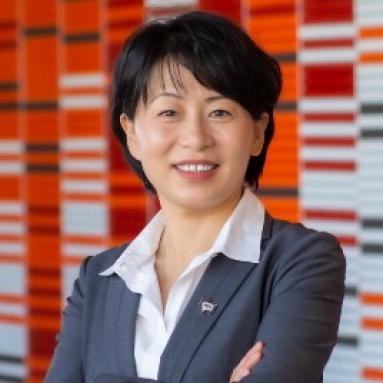
Grace Wang
Beginning Quote Icon of beginning quote
WPI researchers are making major strides toward their goal of providing communities with a tool to help solve a problem that some have said is impossible to solve. Beginning Quote Icon of beginning quote
  • Grace Wang
  • WPI President

“Folks in Massachusetts and across the country deserve to know that their food and water is free from toxic PFAS chemicals,” said McGovern. “I’m proud that WPI is on the cutting edge of research to get these substances out of our soil for good. Because of the new funding we are announcing today, our commonwealth will remain at the forefront of the fight to get rid of forever chemicals once and for all. I’m grateful to President Wang, all the incredibly hard-working researchers at WPI, and Senators Warren and Markey for partnering to deliver this major new investment that will make a PFAS-free future one step closer to reality.”

“Massachusetts families shouldn’t have to wonder whether their water is clean and safe to drink,” said Warren. “I fought hard to secure funding for the cutting-edge research WPI is leading to clean up these chemicals and protect communities across the commonwealth.”

“As residents, businesses, and municipalities across Massachusetts continue to face the consequences of PFAS contamination, we are proud to partner with Worcester Polytechnic Institute to move forward essential research in the development of new technologies to remove these dangerous forever chemicals and protect our drinking water, farmlands, and environment,” said Markey. “Thanks to the hard work of the scholars at WPI, Massachusetts will be a leader in the next generation of PFAS remediation.”

Preview

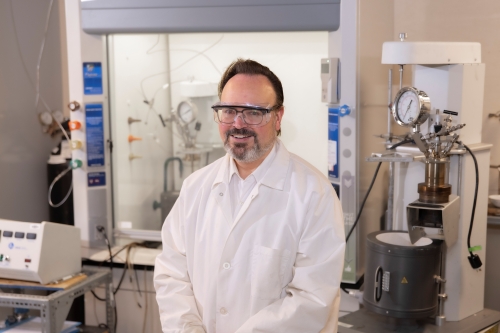
Professor in lab coat smiling in a laboratory in front of equipment

Michael Timko, William B. Smith Professor of chemical engineering

The WPI-led project centers on a novel process known as Radical-Initiated Hydrothermal Liquefaction (RI-HTL). The technology uses heat, pressure, and nontoxic chemicals to destroy PFAS by breaking the strong carbon-fluorine bonds that make the compounds so persistent. Early laboratory testing has demonstrated that RI-HTL can destroy more than 99% of PFAS across multiple forms of contamination, including firefighting foams.

One of the greatest challenges in PFAS remediation is removing the chemicals from contaminated soil. WPI researchers will investigate the use of plants that naturally absorb PFAS as they grow. Once harvested, the contaminated biomass will be processed using RI-HTL, offering a promising new strategy for removing and permanently destroying PFAS from the environment.

Beyond environmental cleanup, the technology offers an additional sustainability benefit. The RI-HTL process converts contaminated biomass into bio-oil that can serve as a feedstock for sustainable aviation fuel and fuels for heavy-duty transportation, creating value from material that would otherwise be considered waste.

Michael Timko
Beginning Quote Icon of beginning quote
We hope this work will lead to partnerships with municipalities, environmental agencies, and industry to help address PFAS contamination. Beginning Quote Icon of beginning quote
  • Michael Timko
  • William B. Smith Professor of chemical engineering

The project will advance two parallel areas of research:

  • Enhance WPI’s PFAS analytical laboratory with advanced instrumentation to strengthen the university’s ability to detect, measure, and analyze PFAS compounds
  • Apply RI-HTL technology to PFAS-contaminated biomass to establish the scientific foundation for destroying PFAS in plant material

The funding will support research activities and investment in laboratory equipment that will expand WPI’s PFAS testing and analysis capabilities.

“This investment will allow us to establish an advanced analytical laboratory and generate the scientific evidence needed to move this technology closer to commercialization,” said Michael Timko, the William B. Smith Professor of chemical engineering at WPI and principal investigator of the project. “Ultimately, we hope this work will lead to partnerships with municipalities, environmental agencies, and industry to help address PFAS contamination across Worcester County and throughout Massachusetts.”

Profiles