sarah
Office
100 Institute Road
Areas of Research

Global Initiatives

Affiliated Department or Office
Education
PhD Learning Sciences and Technology Lehigh University 2015
MA Conflict and Coexistence Studies Brandeis University 2008
AB International Studies Lafayette College 2004

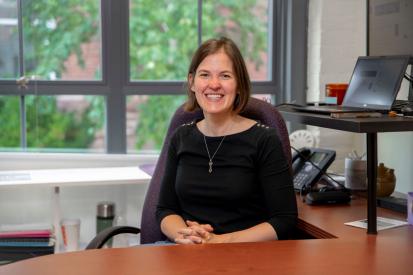
Sarah Stanlick, Ph.D., is the Associate Dean of the Global School and Associate Professor in the Department of Integrative and Global Studies at Worcester Polytechnic Institute. She is a social scientist and community-engaged researcher who studies how technology can empower, connect, and support populations experiencing vulnerability and/or marginalization.

Prior to her time at WPI, she was the founding director of Lehigh University’s Center for Community Engagement and faculty member in Sociology and Anthropology. She previously taught at Centenary College of New Jersey and was a researcher at Harvard’s Kennedy School, assisting the US Ambassador to the United Nations, Samantha Power. She has published in journals such as The Michigan Journal of Community Service Learning, The Social Studies, and the Journal of Global Citizenship and Equity Education. She co-chairs the Imagining America Assessing Practices of Public Scholarship (APPS) collective, which focuses on democratically-engaged assessment practices to empower and transform systems, communities, and individuals. She is a member of SSSP and serves on the Steering Committee for the Community-Based Global Learning Collaborative (The Collaborative). Her priority for teaching, research, and service is to encourage and model engaged, active citizenship and help create conditions for all community members to be able engage similarly.


Professor Stanlick formerly directed WPI’s signature first-year experience program, the Great Problems Seminar. She is also responsible for the delivery and support of global project-based learning through the Global Projects Program, and teaches social science research methods for students of all backgrounds and majors in preparation for the interactive qualifying project (IQP), a 7-week project with external sponsors. Her commitment to transformative and inclusive learning that engages students as active agents includes her regular participation in faculty learning communities at WPI and collaborative work to advance the integration of open educational resources and open pedagogical practices across the WPI curriculum.  


Visit Digital WPI to view student projects advised by Professor Stanlick.


sarah
Affiliated Department or Office
Education
PhD Learning Sciences and Technology Lehigh University 2015
MA Conflict and Coexistence Studies Brandeis University 2008
AB International Studies Lafayette College 2004

Sarah Stanlick, Ph.D., is the Associate Dean of the Global School and Associate Professor in the Department of Integrative and Global Studies at Worcester Polytechnic Institute. She is a social scientist and community-engaged researcher who studies how technology can empower, connect, and support populations experiencing vulnerability and/or marginalization.

Prior to her time at WPI, she was the founding director of Lehigh University’s Center for Community Engagement and faculty member in Sociology and Anthropology. She previously taught at Centenary College of New Jersey and was a researcher at Harvard’s Kennedy School, assisting the US Ambassador to the United Nations, Samantha Power. She has published in journals such as The Michigan Journal of Community Service Learning, The Social Studies, and the Journal of Global Citizenship and Equity Education. She co-chairs the Imagining America Assessing Practices of Public Scholarship (APPS) collective, which focuses on democratically-engaged assessment practices to empower and transform systems, communities, and individuals. She is a member of SSSP and serves on the Steering Committee for the Community-Based Global Learning Collaborative (The Collaborative). Her priority for teaching, research, and service is to encourage and model engaged, active citizenship and help create conditions for all community members to be able engage similarly.


Professor Stanlick formerly directed WPI’s signature first-year experience program, the Great Problems Seminar. She is also responsible for the delivery and support of global project-based learning through the Global Projects Program, and teaches social science research methods for students of all backgrounds and majors in preparation for the interactive qualifying project (IQP), a 7-week project with external sponsors. Her commitment to transformative and inclusive learning that engages students as active agents includes her regular participation in faculty learning communities at WPI and collaborative work to advance the integration of open educational resources and open pedagogical practices across the WPI curriculum.  


Visit Digital WPI to view student projects advised by Professor Stanlick.


Office
100 Institute Road
Areas of Research

Global Initiatives

Sustainable Development Goals

SDG 3: Good Health & Well-Being

SDG 3: Good Health & Well-Being - Ensure healthy lives and promote well-being for all at all ages

Image
Preview Good Health & Well-Being Goal

SDG 4: Quality Education

SDG 4: Quality Education - Ensure inclusive and equitable quality education and promote lifelong learning opportunities for all

Image
Preview Quality Education Goal

SDG 10: Reduced Inequalities

SDG 10: Reduced Inequalities - Reduce inequality within and among countries

Image
Preview Reduced Inequalities Goal

SDG 11: Sustainable Cities and Communities

SDG 11: Sustainable Cities and Communities - Make cities and human settlements inclusive, safe, resilient and sustainable

Image
Preview Sustainable Cities and Communities Goal

SDG 16: Peace, Justice, and Strong Institutions

SDG 16: Peace, Justice, and Strong Institutions - Promote peaceful and inclusive societies for sustainable development, provide access to justice for all and build effective, accountable and inclusive institutions at all levels

Image
Preview Peace, Justice, and Strong Institutions Goal

SDG 17: Partnerships for the Goals

SDG 17: Partnerships for the Goals - Strengthen the means of implementation and revitalize the global partnership for sustainable development

Image
Preview Partnerships for the Goals

Scholarly Work

Professor Stanlick’s research and scholarly work addresses issues in civic and global citizenship, community-engaged and transformative learning, digital sociology, assessment, supporting first generation and underrepresented students, and public interest technology.

Featured articles:

Stanlick, S. E., & Doiron, J. (2024). Modeling and cultivating critical global citizenship skills in the online space: Project-based global learning online during COVID-19. Metropolitan Universities, 35(3).

Foo, Katherine, and Sarah Stanlick. "Putting Diversity, Equity, Inclusion, and Justice into Practice: The Four Dimensions of Inclusivity for Public Participatory Science." Citizen Science: Theory and Practice 10, no. 1 (2025).

Szmodis, W.E. and Stanlick, S.E. (2022). Perspectives on Lifelong Learning and Global Citizenship: Beyond the Classroom. London: Springer.

Swann, J., Boucka, G., and Stanlick, S.E. (2020). “Border Crossing for Universities: Creating a culture of diversity, equity, and inclusion, a case study”. The International Journal of Community Diversity.

Bandy, J., Sims Bartel, A., Clayton, P. H., Gale, S., Mack, H., Metzker, J, & Stanlick, S. (2017). "Values-Engaged Assessment: Reimagining Assessment through the Lens of Democratic Engagement." Michigan Journal of Community Service Learning, 23(1).

Stanlick, S.E. and Sell, M. (2016). “Beyond superheroes and sidekicks: Empowerment, efficacy, and education in community partnerships.” Michigan Journal of Community Service Learning.

Stanlick, S.E. (2015). “Getting ‘real’ about transformation: the role of brave spaces in creating disorientation and transformation.” Michigan Journal of Community Service Learning, 22(1), 117- 122.

Professional Highlights & Honors
Community-Based Global Learning Collaborative, Co-Director
Community-Based Global Learning Collaborative
Global Teaching and Learning Fellows (GTLF), Lehigh University, 2019
HERS Leadership Institute, 2019 Wellesley Cohort, 2018-2019

News

Chev Right Icon of hollow arrow pointing right Arrow Right Icon of arrow pointing right SEE MORE NEWS ABOUT Sarah Stanlick
IIENetworker
Future-Ready Learners: Tackling Global Challenges

The Great Problems Seminar is featured in IIENetworker magazine, from the Institute of International Education, in an issue focused on innovations in first-year programs in international higher education. The article, authored by The Global School Associate Dean Sarah Stanlick, showcases WPI’s two-term course that immerses first-year students in university-level research and introduces them to the university’s project-based curriculum.

Telegram.com
New courses at Worcester colleges offer wide variety

For the first time this fall, the Great Problems Seminar, a program for first-year students, will feature two courses dedicated to understanding and thinking critically about artificial intelligence. The Telegram & Gazette highlighted one of the new courses: AI, Design, and Society. The course will provide a hands-on opportunity to build and use AI systems and to explore the history and future of AI. It will be co-taught by Sarah Stanlick, director of the Great Problems Seminar and assistant professor in the Department of Integrative and Global Studies, and Gillian Smith, director of the Interactive Media and Game Development Program and associate professor of computer science.