Follow The WPI Podcast on your favorite audio platform
E20: Decoding Pain | Benjamin Nephew and Emmanuel Agu | NIH IMPACT Study
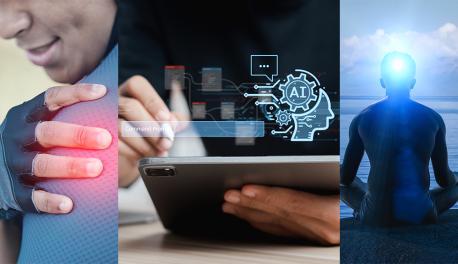
Chronic pain affects millions of Americans and too often leads to dependence on opioids for relief. But what if doctors could predict, before writing a prescription, whether a patient would respond better to non-drug therapies like meditation?
This episode explores groundbreaking research at Worcester Polytechnic Institute (WPI) that combines neuroscience, data science, and artificial intelligence to personalize pain treatment with guests Benjamin Nephew, assistant research professor, biology and biotechnology, and Emmanuel Agu, Harold L. Jurist ’61 and Heather E. Jurist Dean’s Professor of Computer Science.
The study “Integrative Mindfulness-based Predictive Approach for Chronic low back pain Treatment" or IMPACT is funded by the National Institutes of Health (NIH) HEAL (Helping to End Addiction Long-term) initiative. In addition to Nephew and Agu, WPI researchers include Jean King (Principal Investigator), the Peterson Family Dean of Arts and Sciences at WPI, Carolina Ruiz, the WPI Associate Dean of Arts and Sciences and Harold L. Jurist ’61 and Heather E. Jurist Dean’s Professor of Computer Science, Angela Incollingo Rodriguez, assistant professor of psychological and cognitive sciences, Zheyang Wu, professor, mathematical sciences.
Transcript
Colleen: Cold acid rain thundering deep in my brain. An incessant refrain I try in vain to be purged from its shame. Pain. What a way to start a podcast. Huh? Those are the lyrics to the song you just heard. Unfortunately for hundreds of millions of people living with chronic pain, those words ring all too true and even more troubling. Many turn to opioids for relief. Here’s the good news. There are non-pharmacological alternatives like mindfulness practices, and researchers at Worcester Polytechnic Institute are leading an NIH National Institutes of Health study to understand. Who will respond best to those approaches using neuroscience and artificial intelligence? I’m Colleen Wamback, and on this episode of the WPI Podcast, we’re exploring how this innovative research could change how we treat pain and help save lives.
My first guess is Professor Benjamin Nephew.
Professor Nephew: I am Ben Nephew, faculty in Biology and biotechnology. I’m a research assistant professor and I study behavioral neuroscience and mental health, and most relevant today, chronic pain and mindfulness interventions for chronic pain.
Colleen: Can you start by describing the goal of this NIH funded study and what makes it different from other pain management research?
Professor Nephew: Sure. The overall objective is to identify predictors of responders to mindfulness, mindfulness intervention for chronic low back pain specifically, and a lot of the previous related work has focused on identifying predictors of pain itself rather than interventions and treatments for pain. So we want to know who responds to mindfulness for chronic pain and who doesn’t respond to mindfulness for chronic pain.
Colleen: Okay, and when you say mindfulness, we’re talking about meditation, that realm?
Professor Nephew: It’s technically a mindfulness based stress reduction protocol, which is. Somewhat specific. It’s customized for chronic pain. It’s an eight week course and they meet weekly for 90 minutes. And after that there’s some follow up sessions for the intervention, but that’s mostly for data collection. So the whole clinical trial that’s involved in this is six months of data collection. But the mindfulness intervention is meditation focused, but it’s also activity and how to better take care of yourself and manage your chronic pain. So it’s a real all-encompassing type of lifestyle change, hopefully to improve your management of your own chronic pain.
Colleen: I’m glad you noted that. It is monitored, it is guided, so it’s not just telling someone go off and try it and then report back. This is really involving the experts to introduce what meditation can do?
Professor Nephew: Correct. So it’s run by trained clinicians either at UMass Medical School or at Boston Medical Center, and they run these hour and a half sessions weekly sessions. So it’s typically done in groups of 10 to 15 or 16, there’s this healthy group component, which is a real benefit of the intervention. So you get social support from the group and sharing your experience and learning from one another during the intervention.
Colleen: Okay, great. Thank you for explaining that. So what inspired the idea of combining neuroscience and artificial intelligence to guide pain treatment decisions.
Professor Nephew: Mindfulness has been effective for treating depression, anxiety, and other disorders, and it’s being applied to more and more conditions, and a lot of chronic pain management is behavior change. If you are on medication for your chronic pain, it’s taking it reliably and consistently showing up at your appointments, getting healthy amounts of sleep. Eating right and incorporating activity in your daily life as well as maintaining social interactions and support is very important. And the behavior change aspect was recognized. A major part of the motivation really was trying to find alternatives to opiates to see if we could avoid the risk of addiction and related adverse consequences with opiate use. That was one of the main objectives of the Heal Initiative at NIH, and this is what our work funded through.
Colleen: There have been studies to show that mindfulness can help treat pain. This is taking it to another level.
Professor Nephew: Yeah. We’re fortunate to work with the individuals who actually conducted those studies that support the use of mindfulness for treating chronic low back pain and the reason why it’s able to be covered by insurance. So that’s Natalia Marone at Boston Medical Center. She’s also been involved in pragmatic clinical trials to see if it can be applied in a general practice setting, so rather than going to a specialist, can you reach people early on as soon as they go through GP to get them into mindfulness interventions for chronic pain? So with this, what we wanna know is it worked really well for some people and it’s unclear who those individuals are. And through the use of machine learning with comprehensive data sets, you are able to identify who responds and who doesn’t respond by how much their pain decreases over the course of the treatment and following the treatment. So that’s what we’re doing right now. We’re doing a very high quality, comprehensive data collection over the course of six months. Analyzing those data with machine learning. And seeing whose pain drops. These prior studies of mindfulness or chronic pain have shown on a scale of zero to 10, it’ll drop by two, three or four points over the course of the intervention or even more because people incorporate it into their life and improvement even beyond the eight week mindfulness course.
Colleen: That’s incredible. So from a neuroscience perspective, what happens in the brain when someone experiences chronic pain?
Professor Nephew: Yeah, so that’s a great question. Chronic pain is just another type of chronic stress. It adversely affects the structure and function of multiple brain regions that are involved in memory, cognition, the control, general daily activity, sleep, cardiovascular function, digestion, and responses to all sorts of stimuli, including social stimuli. When you’re in chronic pain, you’re probably more likely to interpret social stimuli negatively than if you weren’t, for example. When you have chronic pain, it changes the brain, both structure and function chronically over time, and this adversely affects your health and your behavior. And so we’re hoping to change that with it as mindfulness intervention.
Colleen: We’re talking about chronic pain, not just someone. Who has twisted an ankle? Can you explain what chronic pain means?
Professor Nephew: So chronic pain is defined as experiencing pain for 12 weeks or longer, and that’s a substantial amount of pain to a certain degree and individuals often experience chronic pain for much longer than the three months.
Colleen: How do non-pharmacological interventions like meditation alter the brain activity compared to opioids?
Professor Nephew: The biggest difference is that meditation is not addictive in a harmful way. Opioids block the sensation of pain and also strongly stimulate the reward system. This is the problem with them in terms of being addictive, they’re very rewarding. Some people are highly sensitive to this. They develop an addiction as a result, and then you have related adverse consequences. So mindfulness, in our cases, mindfulness based stress reduction changes how you respond to pain stimuli. So you’re taught to be aware of the pain. But not let it control your life and your taught methods to focus on positive aspects of your life and how to successfully manage that pain and not really obsess on it and let it adversely impact your daily activities.
Colleen: Is it the definition of mind over matter?
Professor Nephew: Yeah, to some degree for sure. I came into this as a skeptic for sure, so I’m more of a background of neurochemical interventions and those type of things. It’s really impressive to see what mindfulness can do to both the brain and behavior. To some degree, it’s really individual based on each participant in a mindfulness class, and it works different ways, and that’s one of the main advantages.
Some people. Just focus less on the pain. Some are able to lessen their sensation of the pain and others are just more likely to do the things they need to do to take care of their pain, whether it’s taking other pain medicationsbecause some individuals are on pain meds, some aren’t. And yeah, so it’s, it really depends on the individual in terms of how it works. But overall, it’s behavior change too, lessen the impact of pain on your life and improve how you deal with it. Okay, so personalized medicine at the end of the day of how you’re able to adapt it is. And some people are better at this than others and more likely to make that change and. The other aspect is that at certain pain levels, it may work well for low pain levels or it may work for high pain levels, and that really depends on the person and potentially the type of pain.
Colleen: What is it like working across disciplines with neuro scientists, data scientists and clinicians to bridge the brain science and patient care? There’s a big team involved.
Professor Nephew: It is. It’s a big diverse team for sure. So it’s exciting and challenging as well. You have to translate between fields. You have to coordinate objectives between the different participants and researchers, and often mediate compromises. What the data scientists want is often not what is going to be feasible from a clinical standpoint. And so you have to come to some sort of conclusion in terms of what data you’re going to get, how you’re going to get it. In what you’re going to do with it. And it’s also, I think one of the most interesting aspects of it is helping to interpret from both sides of the equation interpret what’s happening from the clinical side in terms of how the intervention is going, as well as what the collect data mean in getting the clinical input on how that’s going to be applied.
Colleen: How are hospitals and healthcare providers involved in this study and how might this research influence clinical decision making in the future?
Professor Nephew: Yeah, in terms of nuts and bolts, clinician researchers at UMass and Boston Medical Center are recruiting participants for mindfulness classes for chronic low back pain. For the clinical trial, we hope to identify predictors or characteristics of individuals that respond, and these predictors could inform both clinician and patient decision making. And so if we can increase the awareness of mindfulness and its effectiveness for individuals that do respond, we could inform uptake of these types of interventions and popularity for what we know is effective for many individual.
Colleen: As you’re recruiting, you need to get a certain amount of participants to get a good data set and with the machine learning you’re going to be able to identify factors from various people, backgrounds, pain levels, correct, to see who may respond better to this mindfulness than others. It’s really about getting the biggest data set to make those informed decisions, correct?
Professor Nephew: Yeah. So we’re, we are recruiting from Boston and the Greater Worcester region and hope to get a very diverse participant population. And through our analyses we determine that. 350 individuals right around there is enough, including individuals that may not complete the entire trial, is a large enough sample size to do our analyses. And so that’s the goal over the whole five year course of the project is to recruit 350 individuals. And yeah, we do hope to get to look at subgroup differences in response.
Colleen: So why is this kind of research important in the context of the opioid crisis? Almost everybody has heard horror stories with this crisis.
Professor Nephew: Correct. So while there’s been some recent progress in this area, thousands still die each year from opiate overdose. We know this is still a massive issue, but what is rarely mentioned is that many thousands more still face a lifetime struggle with addiction. And it has increased importance through decreasing addiction as well as overdose deaths. So it’s, it really underscores the importance of finding alternatives to opiates. Opiates are very effective for chronic pain, and that’s part of the problem.
Colleen: Yeah, because researchers want to help doctors treat a patient. But when you look down the road and see how. Just taking an opioid for pain can turn into, for far too many people a lifetime of addiction and struggle. It’s just not worth the risk.
Professor Nephew: Yeah. There there’s also predictive work being done on people that are high risk for this, we’re not involved in that. But this is another application of machine learning to try and identify individuals that are high risk for developing addiction and steering them away from an opiate based intervention.
Colleen: What are some of the challenges in shifting both patients and doctors towards this non-drug based pain management?
Professor Nephew: So many are skeptical of the EFF efficacy of complementary intervention. Other issues involved are that it is an eight week commitment. That’s what’s shown to be most effective. There’s variations of that, but at least in in terms of chronic pain the evidence shows an eight week intervention and. Others are not interested in that in terms of their ability to commit to that based on their impression of how effective it will be. It’s also unclear who might benefit the most from this. And so if you just recruit everyone into this, the average effect may not be as great. If you focus on individuals that you know were most likely to respond, and that’s where we come in.
Colleen: You have a lot of work ahead of you, but if successful, how might this study change how chronic pain is treated nationwide or even globally?
Professor Nephew: Clinicians can be provided with strong data informed findings, and eventually tools, perhaps apps, a future objective and goal to identify who will benefit the most from mindfulness for chronic low back pain. So you could have an app, you could put in patient information, and it could say, this person’s highly likely to respond to mindfulness, and it is a good fit.
Colleen: We’re going to get into the possibility of designing an app, and even how you collect this data on a Fitbit later on in this podcast. But what is your hope for this eventually, and what are the next steps in this research study?
Professor Nephew: The first phase of our study is complete, and that was recruiting 50 subjects, getting everything rolling, showing that the trial is feasible, and the data collection is feasible. Now we’re ramping up for the second phase. We’re recruiting an additional 300 individuals. So that’s the nuts and bolts where we’re at right now. And what we hope to get is high quality data. And what I specifically mean by that is individuals wearing their Fitbit for the course of the six months, filling out all their surveys, staying in the intervention for the full eight weeks, and then successful machine learning analysis and to some degree we already have a lot of the tools established over the course of these first two years we’ve been practicing and developing with other data sets that are very similar to what we’re collecting just from previous trials. Some from our own investigators, from Dr. Marone. And so we’ve done a lot of the groundwork for those analyses and now we just need to collect the data. Modify and revise those analyses and accurately identify predictors. And key goal is getting as accurate as possible. So if we can say that low scores of depression, predict response, or high depression scores predict response to mindfulness, we want to be able to say that with 85, 90, 90 5% accuracy. Yeah, that’s part of the work to be done.
Colleen: Before we wrap up, I’m wondering if you can talk a little bit about having a STEM institution. WPI lead this research. You would think it would be a medical school leading it with input from data scientists, engineers, et cetera. That’s not the case here, right?
Professor Nephew: So technically, yes. WPI is lead institution and that’s pretty rare. As you’ve noted for this type of clinical project. I think there’s an appreciation for the value of AI and machine learning in analyzing complex clinical data. And our clinical partners at UMass and Boston Medical Center are very appreciative of that and excited to, to take part. It’s really a strong collaboration between the three institutions and a strong appreciation for the value and the power of the analysis that we can do to improve clinical decision making and that. The key to that being as effective as possible is really the clinical input. If we were just doing this with clinical data on our own, without obviously the quality of the clinical data provided by clinical teams, but also the interpretation and how this is gonna be applied in the, in the clinic itself.
Colleen: Sure. It really is the power of multidisciplinary work. Final question. This is going back to you. How does it feel to know that you’re working on something that could be this impactful? Yes. Play on words there, because the grant is impact, but this really could be impactful in life changing.
Professor Nephew: It’s very exciting personally, for sure. So I started off in basic research and relatively recently got involved in clinical research. I always had a desire to move translationally, but it’s often very hard to do that and difficult to find opportunities for that. So this has been tremendous. This is a proven intervention, and so it’s exciting to be part of something that can improve individual’s life, and especially those with chronic pain, which is such a challenging problem.
Colleen: I wish you the best of luck, and it sounds like you’re well on your way to success. With the help of many others.
Professor Nephew: Very true. Thank you very much.
Colleen: Coming up, we’ll talk about the data, how it’s collected, and how it can be used to inform decisions and ultimately build new technologies.
<music>
Colleen: Understanding how the brain responds to pain and mindfulness opens powerful new doors for treatment. But turning that information into a reliable and easy to use tool to identify who might benefit the most from therapies is a critical next step. That’s where WPI Professor Emmanuel Agu and his team come in. Professor AGU leads the data science portion of this NIH funded study. His team applies advanced machine learning and AI techniques to create prediction models and devices.
Professor Agu: My name is Emmanuel Agu. I’m a professor in the computer science department with affiliations with data science AI program. My research is around applying AI to healthcare. I get really into things like using the smartphone. For data collection using smartphone sensors to figure out. How people are doing out in the real world to reduce errors in treatment.
Colleen: How many apps do you have on your phone that are monitoring you?
Professor Agu: I have probably, I’d say two or three. Mostly the ones that I developed I’ve been testing. So we develop it and we are the first testers to figure out issues that it’s having and then we correct it. Then we go back and forth trying to fix cases that are not working well and things like that.
Colleen: Are you more hesitant to put some apps on your phone with all of that knowledge of how the data can be used?
Professor Agu: The funny thing is I’m not concerned. I get coffee every day at six 30 if you want to know that that’s fine. Dunkin Donuts wants to send a coupon around those times. Go for it. But I can see how some people would not want that. And I think it’s fine for people to have that choice. And the way we approach it in our research is we assume there’ll be some type of informed consent where the person using the app is told how the app would be used what data is collected and in any kind of risks to their privacy, and then they’ll have the chance to opt in whereby the patient has to, after learning about what app is collecting, how it’s working. And the risks make a decision. Do I want to be part of this or not?
Colleen: You’ve been working in machine learning for more than two decades. Time flies when you’re having fun. What excites you about applying AI to a challenge like chronic pain management?
Professor Agu: Traditionally doctors have used things like statistics where they basically try to find correlations between say the pain. And one variable at a time. But in many cases there are many factors that contribute to the pain. So machine learning is able to combine multiple factors in not so obvious ways to make more accurate predictions. So it’s just a better tool, a tool that fits this problem more.
Colleen: How exactly can machine learning help doctors predict when a patient will respond to mindfulness and when they won’t? That’s the crux of it.
Professor Agu: Yeah, that’s the crux of it. So I say a patient has some kind of pain, maybe it’s chronic, lower back pain, and the doctor is trying to contemplate what should I prescribe for this patient? Should I give them an opioid? Should I give them meditation? Then that patient will be asked to visit the clinic. So they visit the clinic and they’re made to fill out questionnaires that contain questions we found to be predictive in our analysis. And also they’ll be given a Fitbit to take home for a week or two. So we collect their data outside the clinic. Now what’s going to happen is that when they come back after two weeks, we’re going to take both their questionnaire responses and their Fitbit data, and we’re going to basically run it through the AI model. And the AI model will just say, Hey. Based on these responses and this Fitbit data, this person is a great candidate for meditation, or maybe this person will not respond to meditation. So in that way, the doctor would have pretty much a very good sense of who is going to work on, and then they can then prescribe confidently who should get meditation and who should get opioid.
Okay. Yeah, and it takes out the frustration. It takes out the long trial and error process. So the model has been described as interpretable. What does that mean, and why is it so important for doctors and patients to understand why the model makes its recommendations? Yeah, so machine learning can tell the doctor, say after the two weeks of for the baseline questions and the Fitbit data with high accuracy, what patient is going to work on. But the doctors also have received sometimes. 20 years, 30 years of medical training. So they want to understand what factors did the model based this decision on? What was its thought process. So they want to see if the factors on which the model based. This response also lines up with their decades of medical training. And if it does, it might be for them, a light bulb moment. They say, oh yeah, okay, this is, this sounds exactly like. What I think it should be. So they’re more likely to use the recommendation of the model if they also know the factors and the thought process that the model used to arrive at those decisions.
Colleen: So it’s keeping the human in the loop. We’ve heard that term human in the loop. Human in the loop.
Professor Agu: Yes, that’s what it is here. It’s essentially the machine learning output goes to the human, and the human can then. Maybe either take it or leave it. It doesn’t go directly to start taking action or making prescriptions. Yeah. So human is in the loop.
Colleen: To underscore for listeners who are fearful that AI will take over jobs, will eliminate specialists in the medical field, that’s not what this is doing. It’s just another diagnostic tool for a doctor, correct?
Professor Agu: Yes. At this point in time, AI is really just augmenting the doctor. So it is just giving the doctor maybe an extra data point or decision. Say like a second opinion.
Colleen: You mentioned Fitbit. Again, this project combines data with wearables and that data is things like sleep patterns and activity with the self-reported information about pain and mood. So what makes this kind of multimodal? That’s a mouthful.
Professor Agu: Multimodal data is so powerful for machine learning. I think it goes to the heart of the pain. Pain is complex. Pain shows up for different people in different ways. Some people, when they have pain, they can’t sleep at night. For some people, when they’re in pain, they limp a lot more. For some people, it’s going to show up more in their emotion. They just seem to be in a bad mood more often. There are many factors that influence pain, and also there are many ways in which pain shows up in different people. So capturing data from different aspects of the person’s lives or their behaviors, you have a better shot at catching the different types of pain that would show up in the different types of people.
So that’s why essentially multimodal just means collecting different types of data from different types of people. And then based on that, you would have a more robust model that it doesn’t miss some types of people, some types of pain.
Colleen: So if I’m putting it in somewhat of a realistic example, let’s say I’m in pain and I am saying I had an awful night’s sleep. I was tossing and turning, and I’m reporting that for a doctor to look at. But the Fitbit I’m wearing shows, no, Colleen, you got about eight hours of sleep. You might’ve been tossing and turning, but you were asleep. So it’s matching that data or to help the doctor understand it’s not just Colleen saying it was an awful night’s sleep. Maybe it really wasn’t because the Fitbit was saying I did get enough sleep, or vice versa, I could say. I slept like a baby, and the Fitbit is saying, no, you were waking up. Your body was reacting differently. Am I on the right track with that as you’re getting this different multimodal information for predictive models?
Professor Agu: I would place the data in two categories, so there’s questions that would ask the patient at baseline. So for those questions, their responses can be subjective. Yeah, some people might just exaggerate and say, oh, my leg hurts life crazy. And for the same pain level, another person would say, ah, it’s all right. The verbal responses or responsive patients to questions are subjective. It’s colored by their own personal biases or personal style, but for the objective, if the Fitbit says he got eight hours of sleep. You can’t argue with that. So it gives you real data that you can use to compliment the, the, the responses. Now the other thing is that kind of going to your point about if I slept well, if I didn’t sleep well, now we’re looking at a large number of variables and a large number of questions. And each of these variables or questions by themselves are what you would call weak predictors. And that is, there are many things that could cause you to have bad sleep. It could be pain related or it could be other stuff. So if you just go and say, I didn’t sleep well, so I have pain, you’re going to get it wrong. The model gets it wrong a lot of times. But the power is that with machine learning, it combines the fact that you didn’t sleep well with other predictive factors. So let’s say if you have one factor that’s off, that could be a mistake. You have two things that we know are predictive of pain. Are going off, then that’s even more predictive, and then three or four or five things simultaneously are going wrong and they’re all predictive of pain, then the more factors we have, the more we can conclude that yes, this is probably pain. So that’s why combining multiple factors leads to more accuracy, but also leads to more robust findings or decisions. Yeah.
Colleen: And your Fitbit or your cell phone are equipped with enough sensors to get that data?
Professor Agu: Yeah. Fitbits can analyze things like your step count, your sleep length, duration, and also the quality, the sleep stages that you’re in throughout the night, the activity that you perform in the study. We’re also working with UMass Medical School. They’re also interested in looking at heart rate variability, things to do with the heart and the feedback can collect that data as well. It’s, it’s pretty impressive.
Colleen: Can you walk us through what this will look like practically for a doctor using this tool in their clinic?
Professor Agu: If a patient comes in complaining about pain, maybe like a chronic lower back pain, the doctor at that point is wondering, how would I treat this? Should I. Prescribe a painkiller. Should I prescribe a strong painkiller or can this patient actually be fine with meditation? Knowing fully well that if they have the type of pain that will respond to meditation, that’s much lower risk of getting exposed to the opioids and opioid addiction. So. We’re trying to reduce the exposure of people to these painkillers. So doctors are looking at options they have.
Colleen: Do you foresee doctors continuing to collect Fitbit data on patients while they’re using meditation to determine if that’s working?
Professor Agu: Exactly. We actually have two use cases for the technology. There’s the case where we’re trying to predict even before treatment start, whether it’s going to work at all. Should this person be prescribed meditation in the first place? The second use case is that we’re trying to monitor their progress. Even though the model said initially that it was going to work, we’ll continue to monitor their progress in the real world to make sure that things are going as well as we thought it would go, because they will keep wearing the Fitbit and the Fitbit will keep pushing data to the cloud and we can still keep grabbing the data and analyzing it to basically confirm that it’s going the way we thought it would. So that gives us a chance that even after it is prescribed, if it’s not working, we can quickly say, Hey, this isn’t working like we thought it would and change course. Call them back in, change prescription, get them off meditation and put them on something else.
Colleen: What are some of the biggest technical challenges you and your team are tackling as you build these predictive models?
Professor Agu: The key challenges that we’re facing are actually around the data from two main perspectives in the first place. It’s challenging to actually recruit people into the study, just to get people to come in, do the questionnaires, get the free Fitbit that they can keep and wear it for us every day for months. Now the second part is compliance with the study rules in general. There’ll be a large number of people who are in the study, but they never wore a Fitbit in their lives. They never owned a Fitbit, and we’re asking them to wear a Fitbit every day for the next two months. So they may not be used to it. They may forget to wear the Fitbit, leave it and go to go off to work, or go shopping and leave the Fitbit at home, or they might forget to charge the Fitbit and it just shows up in. Lots of missing data. So those are the two main issues we’re we’re really facing at this point.
Colleen: Your whole research portfolio hits on so many of these different areas with machine learning and predictive models. How does that feel for you to have really made a name for yourself in this field?
Professor Agu: I find it exciting. Actually, way back, my area was in mobile computing in general, and at some point I said to myself, it would be nice to apply to an area that it could have real impact and there’s a chance that it could transform fields.
Colleen: Last question. You have a few kids at home, so if they get hurt, if they say, oh dad, this hurts so much. Do you make them wear a Fitbit?
Professor Agu: Not yet. I think not yet. I think right now they tend to leave their watches at home. The same problem with the patients. So that’s a different, that’s a different issue.
Colleen: But I gave you an idea. How much are you really hurting? Let’s check. Check the data.
Professor Agu (laughing): Let’s check the data.
Colleen: Alright. Thank you so much. I find this whole field fascinating and I really, I don’t know what the future is going to hold. You probably have a better understanding than I do, but I’m just so glad that this research is out there and so much of it is being done right here at WPI and in Worcester, so thank you.
Professor Agu: Thank you so much for having me. It’s been wonderful talking about the research.
Colleen: As we’ve heard, combining neuroscience and artificial intelligence isn’t just a scientific breakthrough. It’s a step toward more compassionate, personalized care. It’s a powerful reminder that the future of medicine lies not in one discipline or one technology. But in collaboration between researchers, doctors, and patients working together to improve lives.
This has been the WPI podcast. To learn more about this NIH funded study and other groundbreaking work at wpi, visit wpi.edu. For more WPI podcasts, you can go to wpi.edu/listen, or find them on Spotify, apple Music and YouTube. Thanks to our audio engineers, Varun Bhat and Afton Detweiler, and thanks to you for listening.
I’m Colleen Wamback.