
New AI tool diagnoses skin disease that often occurs in people who walk barefoot.

Identifying Skin Disease with AI

Dmitry Korkin and researchers in Senegal develop tool to find and explain hidden clues to mycetoma
February 3, 2026
Preview

Dmitry Korkin

Dmitry Korkin

Preview

Kpetchehoue Merveille Santi Zinsou

Kpetchehoue Merveille Santi Zinsou

WPI Professor Dmitry Korkin and researchers in Senegal are using a unique type of artificial intelligence (AI) to develop a tool that could not only help pathologists in tropical regions diagnose skin diseases, but also show those pathologists how AI makes its decisions.

The research involves explainable artificial intelligence (XAI), an approach that draws back the curtain on AI to reveal the processes of machine-learning algorithms. The researchers say their XAI tool can analyze skin specimen images to identify pathogens that cause mycetoma, a disease often found in rural parts of Asia, Africa, and Latin America where medical and technical resources may be limited. 

“AI can feel like a black box holding something that is very difficult to comprehend,” says Korkin, the Harold L. Jurist ’61 and Heather E. Jurist Dean’s Professor of Computer Science. “With XAI, we can build a tool that will help diagnose skin diseases and provide down-to-earth explanations about the entire decision-making process.”

Known as SINDI, for Skin INfectious Diseases Intelligent framework, the XAI tool evolved from the work of Kpetchehoue Merveille Santi Zinsou, a PhD student who arrived at WPI in 2024 for a year in Korkin’s lab under the Partnership for Skills in Applied Sciences, Engineering and Technology. Since leaving WPI, Zinsou has continued to work on SINDI within the Institute of Research for Development at UMMISCO, a research organization in Dakar, Senegal.

Mycetoma causes tumor-like lesions, often on the feet, where breaks in the skin and exposure to contaminated soil or water can provide a pathway for invading pathogens. Farmers, laborers, and people who walk barefoot are especially prone to mycetoma. If not treated, mycetoma can invade deep tissues, cause deformities, and impair the body’s ability to function.

Antibiotics or antifungal medications can be used to treat mycetoma, depending on the cause of the infection, but determining the cause is not always easy. Pathologists typically examine tissues and cells under a microscope to identify abnormal structures called “grains” that aid in diagnosis. 

Beginning Quote Icon of beginning quote
“For patients, any delay in diagnosing the cause of mycetoma can delay proper treatment. Tools that speed up diagnosis can help patients get the help they need so they can recover quickly. Beginning Quote Icon of beginning quote
  • Kpetchehoue Merveille Santi Zinsou
  • Institute of Research for Development at UMMISCO
Preview

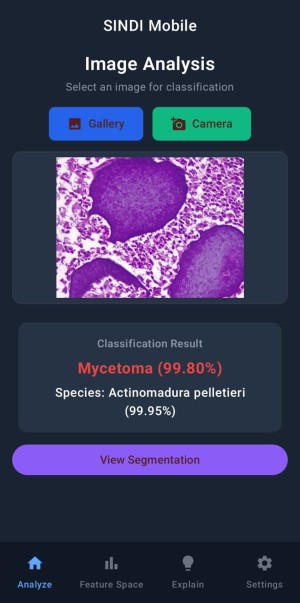
Microscopic image of a cell appears on a mobile app using AI

A mobile version of SINDI displays a microscopic image and diagnosis.

Sometimes, however, grains are not visible in specimens and additional costly, time-consuming tests are needed

“For patients, any delay in diagnosing the cause of mycetoma can delay proper treatment,” Zinsou says. “Tools that speed up diagnosis can help patients get the help they need so they can recover quickly.”

To develop SINDI, the researchers started with a dataset of 7,000 healthy tissue images and 1,324 labeled images of tissue infected by fungal and bacterial pathogens known to often cause mycetoma. Then the researchers developed mathematical algorithms to examine the dataset images. The researchers found that the tools learned to successfully identify infected tissues and pinpoint pathogens, even when no grains were visible.

“We think that the tool can find complex patterns and details, even beyond the lesion areas, that are too tiny for a human expert to detect,” Korkin says. 

The next step was to configure SINDI to show clinicians multiple images that would explain how the tool had identified the disease and the pathogen responsible for a patient’s lesions. 

The research team published their SINDI research on the biology preprint server BioRXiv. In addition to Zinsou and Korkin, authors were Habone Ahmed Mahamoud, Abdou Magib Gaye, and Maodo Ndiaye, all of Cheikh Anta Diop University and National University Hospital of Fann in Senegal; Idy Diop of Cheikh Anta Diop University in Senegal; and Doudou Sow and Cheikh Talibouya Diop, both of the University of Gaston Berger in Senegal.

Zinsou says researchers in Senegal are working with pathologists to begin testing SINDI. After collecting feedback from users, the researchers plan to refine the tool, seek approval from Senegal’s Ministry of Health and Social Action, and deploy SINDI in hospitals.

“We want to ensure that the tool, which users can access through a computer interface or through a mobile app in the near future, is streamlined as much as possible so it can be easily used by doctors in rural clinics to help patients who need treatment,” Zinsou says. 

Keep Up With WPI Research News

Want to learn more about Research at WPI? Subscribe to the monthly newsletter.


Offices and Departments

Profiles