
When Bella Perry visited WPI as a high school senior, her student tour guide talked about the cancer cell research she was working on. Perry was hooked.
“I thought it would be so cool if I could do some meaningful research when I’m an undergrad. I didn’t really know that was a possibility,” says Perry ’28, a biology and biotechnology major who is now doing genetics research in Assistant Professor Karl-Frédéric Vieux’s lab. Her work examines how the expression of specific proteins involved in modifying RNA affects the embryonic development of tiny worms called C. elegans. The goal, Perry says, is that “whatever we find in this research can be applied to human women one day.” (See below for additional details about Vieux and Perry’s work.)

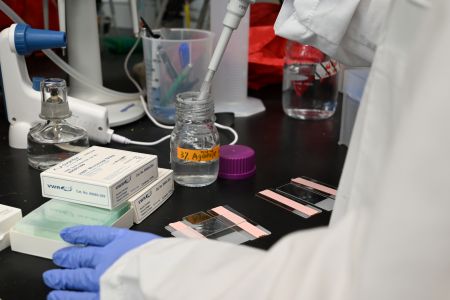
Preparing a slide to view under the microscope
Because she’s long been interested in women’s health, Perry is thrilled to be contributing to research that could eventually benefit women. Now starting her junior year at WPI, she’s in awe when she looks back on the opportunities she’s had to develop her technical skills—and confidence—since A-Term of her first year.
That’s when Perry was accepted into an extracurricular program originally called U-RISE@Wπ, where she could learn about biomedical research as a career and get help finding research opportunities at WPI. She was over the moon to begin volunteering in Vieux’s lab. As someone who learns best by doing, she says, “I knew that if I wanted to make the stuff I was learning in lecture click with me, I needed to do hands-on work. Then I could make that connection in my brain and see the bio actually happening in real life.”
Number crunching
U-RISE@Wπ was funded by a $1.6 million grant from the National Institutes of Health (NIH) in 2024. Perry and 24 other first-year students made up the program’s second cohort, and in spring 2025 she was one of three students selected to continue on and receive additional mentoring, a stipend for summer and academic year research, and tuition assistance for the next three years.
Later that spring, though, the federal government canceled the entire U-RISE program, leaving colleges and universities around the country without funds to cover established undergraduate research training projects, including for Perry and five other WPI student participants chosen to work in biomedical labs.

Kristen Billiar
“But we believed in our program so much that we said, ‘We’re just going to keep doing this.’ And we actually expanded,” says Kristen Billiar, a professor in the Department of Biomedical Engineering and co-principal investigator (PI) on the original U-RISE grant.
Another co-PI, Carissa Olsen, associate professor in the Department of Chemistry and Biochemistry, says, “We were basically in problem-solving mode: What are the most critical parts of this program, and how can we make them work knowing that we’re losing the financial support?”
Billiar, Olsen, and their third co-PI, Elizabeth Ryder (a professor, now retired, in the Department of Biology and Biotechnology), decided the core of the program was mentoring. So they figured out how to continue that without the federal dollars, paring down their planned programming and focusing on facilitating career and research mentoring connections between faculty and students.

Carissa Olsen
WPI’s Office of Undergraduate Studies chipped in some administrative staff support, and the program’s faculty leadership provided funds to help make up for the summer research stipends that Perry’s cohort had been promised. Billiar, Olsen, and Amity Manning—an associate professor in the Department of Biology and Biotechnology who stepped into the co-PI role after Ryder’s retirement—also agreed to lead the program without the salary support they would have received from the grant. And over 45 faculty members in supporting roles agreed to volunteer their time.
But funding for the biggest-ticket item in the original grant, annual tuition support for selected students for each of their last three years at WPI, was not replaced. Still, students already involved in U-RISE wanted to continue working with their faculty mentors, even without any financial support. And in fall 2025, the program—renamed CLIMB@WPI (for Coaching for Leadership, Innovation, and Mentoring in Biomedical Research)—received more applicants than ever before, so faculty agreed to accept larger cohorts going forward.
Team building
The mentoring program is best described through an extended sports analogy. It now accepts 30 first-year students into a “draft year,” which features resume workshops, research seminars, and “scouting lunches” with faculty members looking for undergraduate lab assistants. Participants are also assembled in groups of five with a faculty “coach” who leads informal group discussions and other enrichment activities. At the end of the academic year, draft year participants can apply to continue in the program as a “trainee”—four are selected annually. Trainees meet regularly with a dedicated faculty coach who serves as their advocate until they graduate.
“I love using the term ‘coach.’ The idea is that somebody cares about these students, gets them together, listens to them—but also pushes them a little bit,” Billiar says. “It’s like going to Little League practice. It’s not that fun sometimes, especially if you’re striking out. But you still have to show up. You have to be there. And the coach is the one to motivate everyone to be there on practice days.”


