In its fourth year, Junior Academy at Mass Academy provided two weeks of hands-on academic enrichment and STEM learning for rising 7th, 8th, and 9th grade students from Worcester. Throughout the summer program, students participated in English Language Arts instruction and a variety of engaging, meaningful STEM activities and projects designed to spark curiosity, creativity, and problem-solving skills.
Students explored engineering concepts by designing, building, and testing solar-powered cars, roller coasters, and Automatons. Students also learned about Biotechnology where some students explored "How will using colored dyes affect how plants grow?" Through these experiences, they applied critical thinking and teamwork while discovering how STEM concepts connect to everyday life.
|
Image

Student building a automaton |
Image

Students learning about Biotechnology |
Throughout the two weeks, students visited numerous WPI laboratories and met professors, gaining firsthand exposure to STEM fields and career pathways. Laboratory visits included:
- Architectural Engineering
- Autonomous Vehicle Mobility Unit
- Biomanufacturing Education and Training Center (BETC)
- Biomedical Engineering
- Chemical Engineering
- Mechanical and Materials Engineering
- Physics
- Robotics
|
Image

Student testing a virtual autonomous vehicle |
Image

Students learning about Biomedical Engineering |
Students also explored mobile game development with MassDigi's Summer Innovation Program (SIP). Students also learned about veterinary medicine and engaged in an activity called "They Ate What?!", where students worked collaboratively to examine X-rays and determine what objects animals had swallowed, ranging from socks to wristwatches. Additional activities included coding with Wipple.
Ninth-grade students participated in advanced STEM experiences, including exploring the impacts and implications of social media and artificial intelligence with Professor Richard Lopez. Students conducted chemistry experiments with Professor Raul Orduna-Picon and engaged in robotics activities led by Dee Wilhelm from the Robotics Resource Center. Students were challenged to design, build, and test their own robots while applying engineering principles in a fun, collaborative environment.
|
Image

Students present a skit on AI safety |
Image

A student conducting a Chemistry experiment |
Image

A student testing their robot |
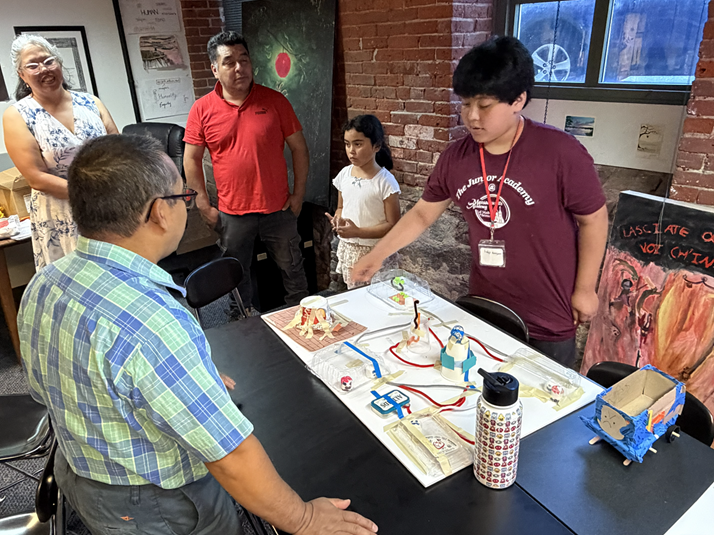
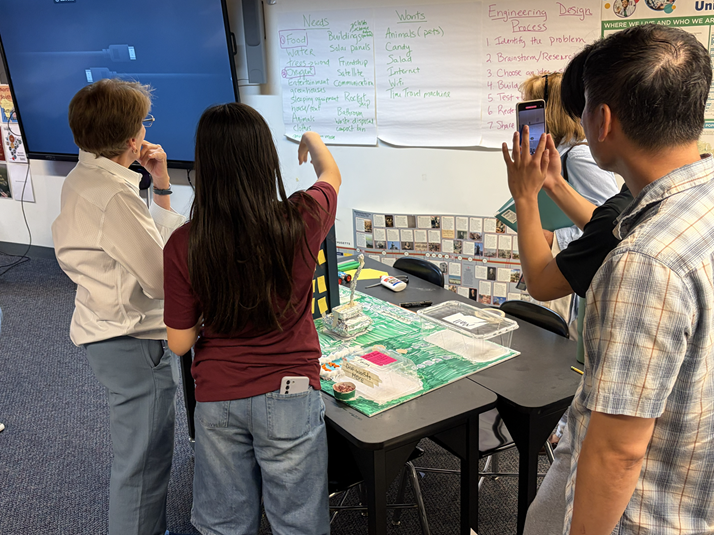
A new addition to Junior Academy this summer was the opportunity for rising 7th and 8th grade students to showcase their learning by presenting their final STEM projects to family members. These presentations allowed students to demonstrate their creativity, communication skills, and knowledge gained throughout the program.

Students presenting their final projects to their families |

Students presenting on their projects to their families |
An important component of Junior Academy is developing a growth mindset. Students reflected on their learning through the prompt, "I used to think..., Now I think...". Their responses highlighted how their understanding of STEM expanded throughout the program:
"I used to think STEM was just about atoms, cells, and things like that. Now I think there is much more to STEM, including building things that help us every day."
"I used to think STEM would be fun but also boring. Now I think you can use STEM in almost anything."
"I used to think math was just about equations. Now I think math connects to everything we do."
Junior Academy is designed to strengthen the STEM pipeline to Mass Academy and WPI by providing students with an enriching experience that helps them to be more confident, curious, and engaged in their learning and realize that science, technology, engineering, and mathematics are not only accessible to them, but they are fun, rewarding, and open doors for their future.
Topics


People


