It’s never too late to finish what you started. Proof of that adage will be on display at this week’s undergraduate Commencement ceremony. That’s when Kerry Lynn will complete an academic journey at Worcester Polytechnic Institute that started in 1972. He’ll walk across the stage to receive his bachelor’s degree 50 years after he first planned. While Lynn entered the university in the Class of 1976, life’s journey made him part of the Class of 2026.

“I’ve set graduation goals in the past—graduating alongside my children and so on—but work always intervened,” says Lynn. “Last year, though, I decided it was now or never, and 'never' wasn't an option. I was really determined to finish on the 50th anniversary of my original target.”
Since 1972, Lynn’s path has shifted to include a five-decade career and family responsibilities. While juggling it all, he kept chipping away on his WPI degree in computer science. He’d never given up on the goal.
“Now that I’m graduating, I hope this accomplishment might inspire even one other person, maybe a fellow student, that there is great value in persistence,” adds Lynn. “I feel persistence is underrated.”
1972–2025
Lynn’s original major was mechanical engineering. He grew up in Connecticut and spent a lot of time around the machine shop his dad, an industrial engineer, had co-founded. In high school, Lynn started to get interested in computers. He was drawn to WPI by its academic program’s focus on project work. “It’s a place where you can chart your own course,” says Lynn.

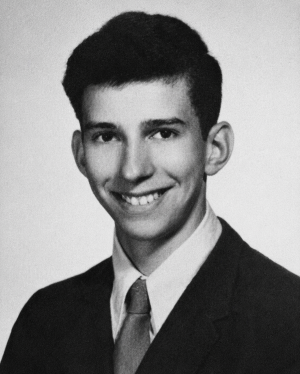
1972 high school yearbook photo - Kerry Lynn
He arrived on campus shortly after faculty approved the WPI Plan in 1970, a bold shift in engineering education that emphasized project-based learning and applying theory to real-world challenges.
Lynn left WPI during his second year while still exploring his career path, but his growing interest in computers quickly led him into the emerging tech industry. He worked hands-on with early microcomputers in Connecticut and moved back to Massachusetts in 1982 to resume part-time study at WPI in computer science. As a member of the Boston Computer Society, he attended a 1984 presentation by Apple co-founder Steve Jobs unveiling the Macintosh computer. “That night in Boston was transformative for me,” Lynn says. He and others formed a Macintosh developers’ group on the spot, which Lynn co-led until moving to California in 1987 to join Apple. During his ten years at Apple, he helped develop one of the world’s first wireless local area networks and eventually became an engineering manager in the PowerBooks division.
After returning to New England in 2000, Lynn resumed classes at WPI while balancing family life and a career that included roles at Cisco, Verizon Labs, and Oracle. His work contributed to Wi-Fi and internet protocol standards, and he earned 10 patents, including two for wireless network security methods.

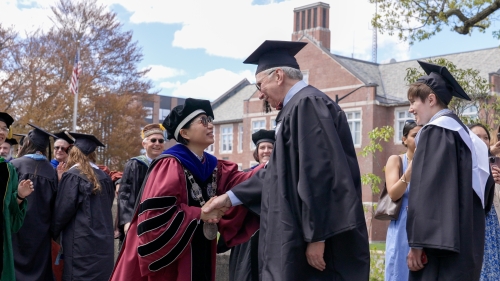
WPI President Grace Wang congratulates Kerry Lynn during Class of 2026 Earle Bridge Crossing
While in midcareer, he completed a now-discontinued graduation requirement from the original WPI Plan—the competency examination. The requirement culminated in an oral examination conducted by faculty members to determine if a student was well-prepared to enter their chosen profession. Lynn thinks he could be the last person at WPI to graduate under the original version of the WPI Plan, with its competency exam requirement.
“During my career, I often didn’t have time to take courses,” says Lynn, who explains the off-and-on approach to completing his required course load. “Graduating has always been at the top of my bucket list, however, so I kept returning to it.”
The final academic year

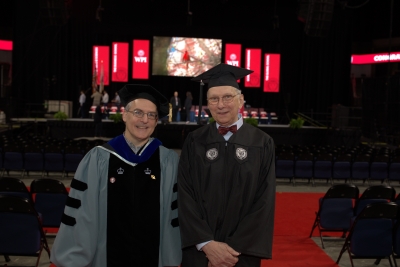
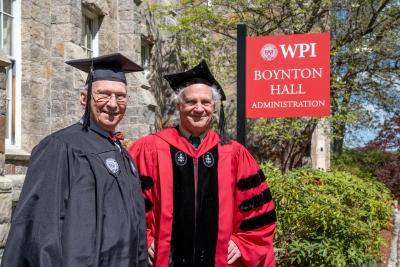
Professor George Heineman and Kerry Lynn at 2026 Undergraduate Commencement
In fall 2025, after a layoff accelerated his retirement from full-time work, Lynn decided it was time to make one final push to complete the degree he began decades earlier. While volunteering with Fab Foundation, a nonprofit focused on providing access to and education about digital fabrication tools and technology that supports innovation and creation, he reached out to George Heineman, associate professor of computer science, to explain his goal. “One doesn’t receive such an email every day,” says Heineman, who worked with the registrar and researched old university catalogs with Lynn to determine that he needed to complete a required humanities and arts inquiry seminar (HUA) and a Major Qualifying Project (MQP) to graduate.
Heineman became Lynn’s MQP advisor and noted the uniqueness of the project: “As Kerry was writing his MQP report, he found that he had to cite his own work that he did with standards organizations from decades ago. Likely no other undergraduate MQP has had to do the same thing.”