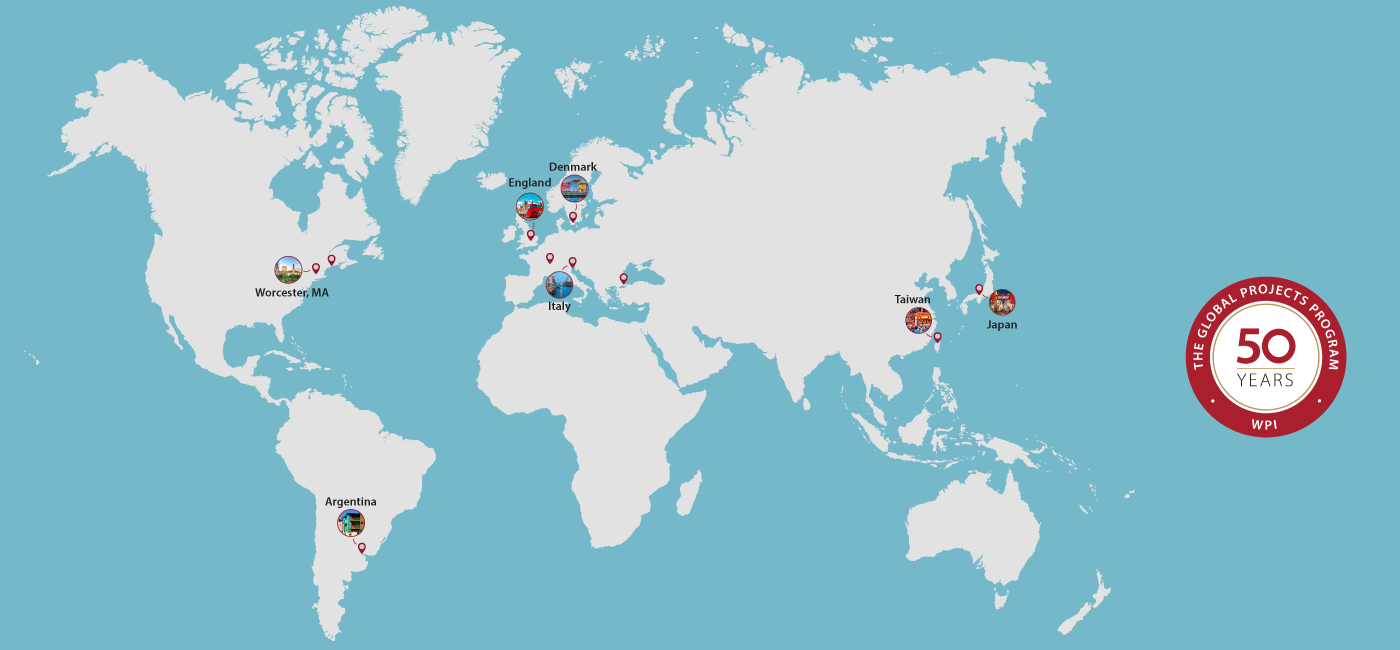
Nearly 150 students are taking advantage of the summer break to work on projects in a dozen project centers through WPI’s Global Projects Program. While many students complete their Interactive Qualifying Project (IQP), Major Qualifying Project (MQP), or the Humanities and Arts (HUA) Requirement during the typical academic year, the opportunity for summer project work offers flexibility for students’ schedules. Off-campus options for the HUA requirement through HUA project centers are offered abroad during summer terms; many students choose this immersive experience that is the equivalent of three HUA courses to learn about the culture, language, and surroundings of a new location.
This year, the Taiwan Project Center ran during E-Term 1, marking the second summer of the HUA center there. IQPs began in Taiwan in 2020 (with a pivot to remote for the first two years because of the pandemic). With the Taiwan HUA center beginning right after the D-Term IQPs, students have the option to remain in Taiwan after their IQP to complete the additional HUA project, and some do just that.
The HUA project experience is different from other student projects, says Jennifer Rudolph, who acts as an advisor at the Taiwan Project Center and a co-director with Wen-Hua Du. “The IQP is a team-based sponsored project at the intersection of technology and society on which the students work full time,” she says. “HUA centers are different. The students are there to learn about the history and culture of the place. They are not working on a project for an external sponsor. They are taking three experiential courses, and they are learning for themselves. Just as important, they are led by a faculty member who is an expert on the place, whether that be the HUA center in Taiwan, Japan, Morocco, London, or Argentina.”
The courses students take at the Taiwan Project Center offer a deep dive into Taiwan’s culture. “One focuses on Taiwan’s fascinating syncretic approach to religion and its world-famous food scene by examining the ecosystem surrounding temples and night markets,” says Rudolph. “A second course focuses on public monuments and memory and the changes that have taken place in Taiwan the last few hundred years, with an emphasis on the 20th and 21st centuries. And the third course is an individual project that each student chooses.” Some classroom time creates a foundation of knowledge, but the majority of the learning takes place through student reflections on day trips in Taipei and northern Taiwan and a five-day excursion to Tainan and Kaohsiung in southern Taiwan.
This year, students, who also learn more about Taiwan through a partnership with a “buddy” from Soochow University, are working on individual projects including an examination of Atayal (one of Taiwan’s Austronesian indigenous groups) identity through weaving, the geopolitics of the Taiwan Strait, computer input methods for the Chinese language, and how young people’s interests in folk beliefs are reflected in video games and movies. And for students who take Chinese language courses for the HUA Requirement, attending the Taiwan center earns the student a Chinese Studies minor.
As the students learn about Taiwan, experience it with a local student, and make their way around an unfamiliar location with a complicated mix of cultures and experiences, they gain valuable global perspective, says Rudolph. “The experience provides the students with a comparative lens that allows for better understanding of their own histories and cultures as well,” she says. Rudolph plans to run the center again next year. Applications will open in late fall through eProjects.
In addition to Taiwan, students are also completing projects in these project centers:
HUA
Buenos Aires, Argentina, with center director Aarti Madan (Humanities and Arts) and advisor Lina Munoz-Marquez (HUA)
Kyoto, Japan, with center director Adrien Stoloff (HUA)
London, England, with center director Esther Boucher-Yip (HUA)
IQP
Acadia National Park, Maine, with center director Frederick Bianchi (HUA) and advisor Courtney Kurlanska (Department of Integrative and Global Studies)
Copenhagen, Denmark, with advisor Greg Lewin (Robotics Engineering)
Istanbul, Turkey, with center director Koksal Mus (Electrical and Computer Engineering) and advisor Bengisu Tulu (The Business School)
London, England, with center director Laureen Elgert (DIGS) and advisor Dominic Golding (DIGS)
Lyon, France, with advisors Lindsay Davis (HUA) and Gbetonmasse Somasse (Social Science and Policy Studies)
Venice, Italy, with advisors Grant Burrier (DIGS) and Natalie Farny (Biology and Biotechnology)
Worcester, Mass., with center director Laura Roberts (DIGS)
MQP
Istanbul, Turkey, with center director Koksal Mus and advisor Bengisu Tulu