Degrees Offered
Under our Program, we offer three degrees: Environmental & Sustainability Studies; Policy Studies; and Economics. The Policy Studies Degree has four options for concentration.

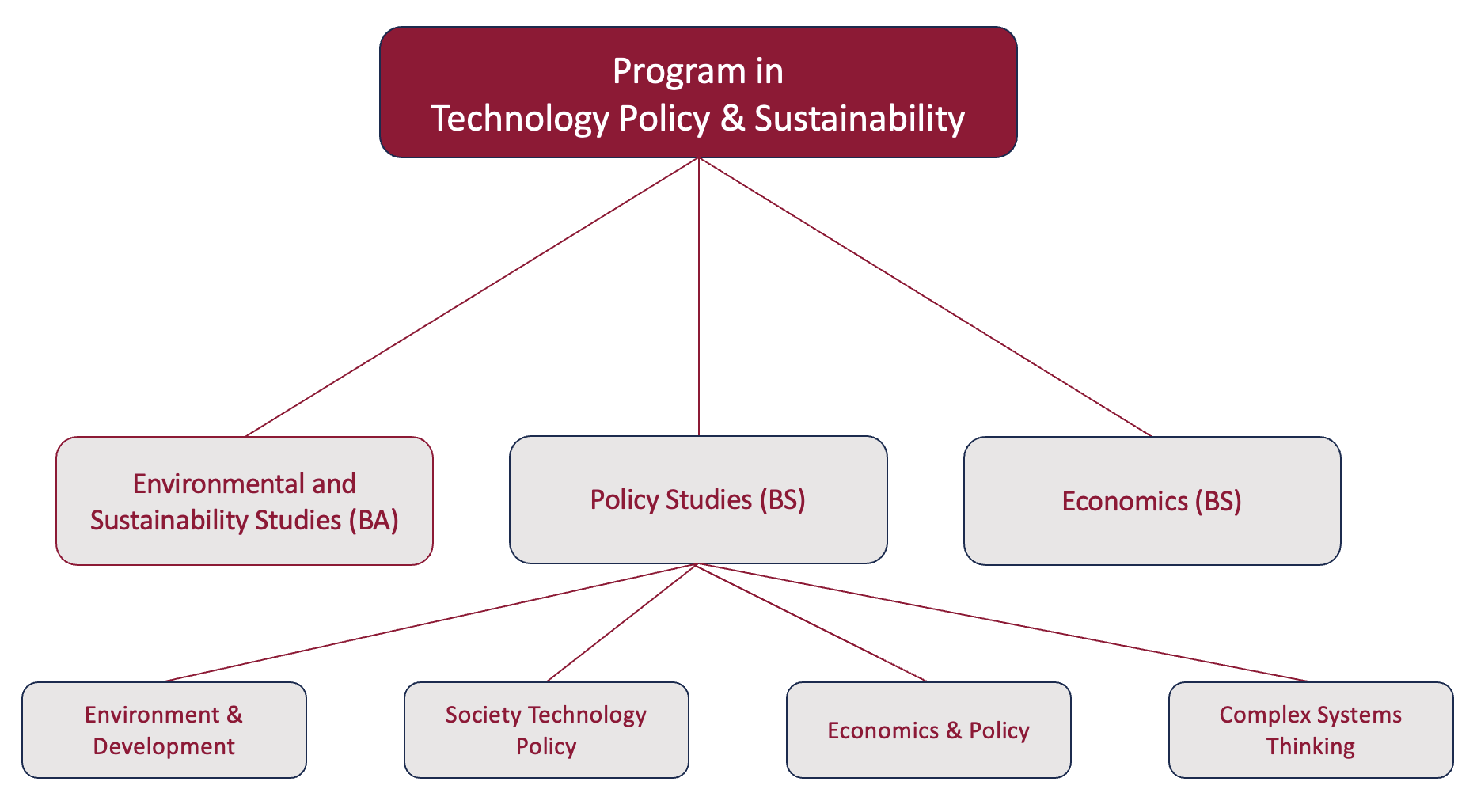
TPS Bachelor’s/Master’s Program: Ambitious undergraduate students majoring in TPS can also earn their Master's in Science & Technology for Innovation in Global Development (MS) through WPI's 5-year Bachelor’s/Master’s program.
TPS Minors: See SSPS Undergraduate Degrees for more information about TSP-related minors, such as Global Public Health and Economics.
TPS Degrees at a Glance

Environmental & Sustainability Studies (BA)
The need for sustainable solutions and drastic policy change has never been greater as human action continues to cause dire environmental consequences worldwide. Through the Environmental & Sustainability Studies specialization, students will develop solutions to society’s most pressing challenges by engaging in transformative project-based work, such as the implementation of water sanitation systems, sustainable planning, or the management of biodiversity.

Policy Studies (BS)
Policy development and change are crucial channels for addressing complex social problems, but how can we ensure that policy interventions lead to meaningful and sustainable outcomes? The Policy Studies degree will allow students to understand the technology-science-policy interface through mixed methods to evaluate social problems and potential policy interventions for challenges related to technology, environment, science, migration, climate change, environmental justice and more.

Economics
Students working toward their degree in economics complete traditional coursework in micro- and macroeconomics, theory, and applied topics, such as development economics, environmental economics, and information economics and policy.

Email: cbrown2@wpi.edu
Phone: +1 (508) 8315000 x5163
Dr. Crystal Brown earned her Ph.D. in Political Science with a focus in comparative politics, international relations, and public policy. She also has a Master of Public Administration (MPA) from Pennsylvania State University and a certificate in Data Analytics from Harvard University. ...
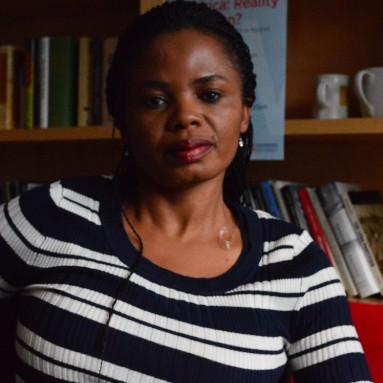
Email: pagupusi@wpi.edu
Phone: +1 (508) 8315000 x6225
Patricia C. Agupusi (Ph.D.) is an Assistant Professor of Social Science at the School of Social Science and Policy Studies at Worcester Polytechnic Institute (WPI), Massachusetts, US. Her research interests include state capacity, political violence, and the political economy of development and inequality. ...

Email: lelgert@wpi.edu
Phone: +1 (508) 8315000 x5452
I joined WPI in 2011 as a scholar and teacher with training in public health, environmental policy, and international development studies. My research and teaching interests focused on the environment-development nexus, where tensions between sustainability and livelihoods often lead to contentious policy debates. ...

Email: aismael@wpi.edu
Phone: +1 (508) 8315000 x6234

Email: krueger@wpi.edu
Phone: +1 (508) 8315000 x5110
Robert Krueger is Professor of Human Geography where his work examines a deceptively simple question: how can knowledge, technology, and institutions contribute to development that genuinely improves people's lives? ...

Email: opavlov@wpi.edu
Phone: +1 (508) 8315000 x5234
Professor Pavlov earned a BS degree in Physics/Computer Science and a PhD in Economics from University of Southern California and an MBA from Cornell University. He has taught at WPI since 2002. He has been to many universities in the US, Russia and Western Europe, but he thinks WPI is like no other university. The project-based approach at WPI allows him to involve students in research projects. He values the opportunity to include students in his research through IQPs and MQPs.
...

Email: mjradz@wpi.edu
Phone: +1 (508) 8315000 x5767
Professor Radzicki is an economist and simulation scientist who directs WPI’s Complex Systems Laboratory as well as the university’s Program in Technology, Policy, and Sustainability. ...

Email: drosbach@wpi.edu
Phone: +1 (508) 8315000 x5826
The overarching goal of my teaching and research is to contribute to an interdisciplinary understanding of environmental governance and policy. More specifically, I focus on the building of individual, organizational and institutional capacities to participate in collaborative efforts to address complex social and environmental sustainability problems through the application of science and technology. ...

Email: saeed@wpi.edu
Phone: +1 (508) 8315000 x5563
Khalid Saeed is widely recognized for his work on the interface of economics and system dynamics. He has published two books and numerous articles on a variety of methodological, developmental and management agendas including sustainable agriculture, poverty alleviation, political instability, supply chain management and system dynamics modeling. His current focus is on operationalization of economic policy so it can be implemented through available managerial roles. ...

Email: adksmith@wpi.edu
Phone: +1 (508) 8315000 x6543
See my personal website (https://followthe6.com) for a description of my work to incorporate Behavioral Economics into Personal Finance.
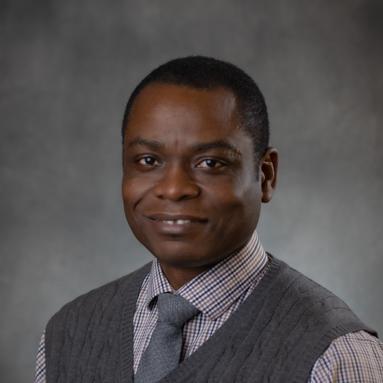
Email: gbsomasse@wpi.edu
Phone: +1 (508) 8315000 x5417
Dr. Gbetonmasse Somasse is an economist and applied econometrician with field experience as a development practitioner. He is an Associate Professor of Teaching in the Department of Social Science and Policy Studies. Prior to joining WPI, he was an instructor at Clark University. He also served as senior economist statistician at the Central Bank of West African States and a consultant for the UN Economic Commission for Africa and the United Nations Development Program. ...

Email: eastoddard@wpi.edu
Phone: +1 (508) 8315000 x4871
Prof Stoddard is a human-environment geographer who is interested in the intersection of nature, society, and justice, particularly in the context of climate change. She looks at the ways in which we can design for climate resilience, in terms of infrastructure, location specific practices, and through community resilience. Stoddard also looks at the vulnerability and resilience of food systems to disasters (climate, disease outbreaks, etc.), and the impacts for humans, animals, and ecosystems. ...