
When Lauren Mathews, co-director of the Hawaii Project Center and associate professor in the Department of Biology and Biotechnology, thought of Hawaii as a new project center location, she knew the location’s emphasis on community connections and shared responsibility for people and land would resonate with students.
She was right.
“Hawaii is a U.S.-based project center, but it is fundamentally different from anywhere else in the United States,” says Mathews. With a 7-week term and close work with community organizations, students working on Interactive Qualifying Projects (IQPs) or Major Qualifying Projects (MQPs) have the opportunity to see Hawaii through the lens of more than a short-trip tourist. That immersion means they become familiar with the Hawaiian language and the culture of environmental conservation and stewardship so integral to Hawaiian culture.
Respect for and protection of the earth is woven through every part of Hawaiian culture, says Mathews, and that leaves a lasting impression on students. “Hawaii is a very relational place,” says co-director Zoe Eddy, an assistant professor of teaching in the Department of Integrative and Global Studies (DIGS) and a co-advisor with Carly Thorp, a professor of practice in the Department of Mathematical Sciences, in Hawaii this term. “In Hawaii, kuleana is a reciprocal responsibility with the community and the land. Reciprocity shapes our work in Hawaii. Our community partners care deeply about our students.”
Sam Van Saun ’28 is in Hawaii this term and says the community connections are central to student work. “I look forward to the final community presentation to the town of Hauʻula,” says Van Saun, an electrical and computer engineering major and fire protection engineering master’s student. “I am excited to share the deliverables we have developed throughout the term and to see how they can make a meaningful, practical difference in the community’s daily life.” And, he says, with the interdisciplinary nature of the work, he’s adding professional skills while delivering work that is valuable to the community. “I am also hoping to use this experience to advance my knowledge of the practical skills of engineering and science.”
As teams build on the work being done at the Hawaii Project Center each year, the momentum leads to long-term, lasting impact. “We now have ongoing relationships with a number of organizations,” says Mathews, “and that leads to cumulative improvement.”
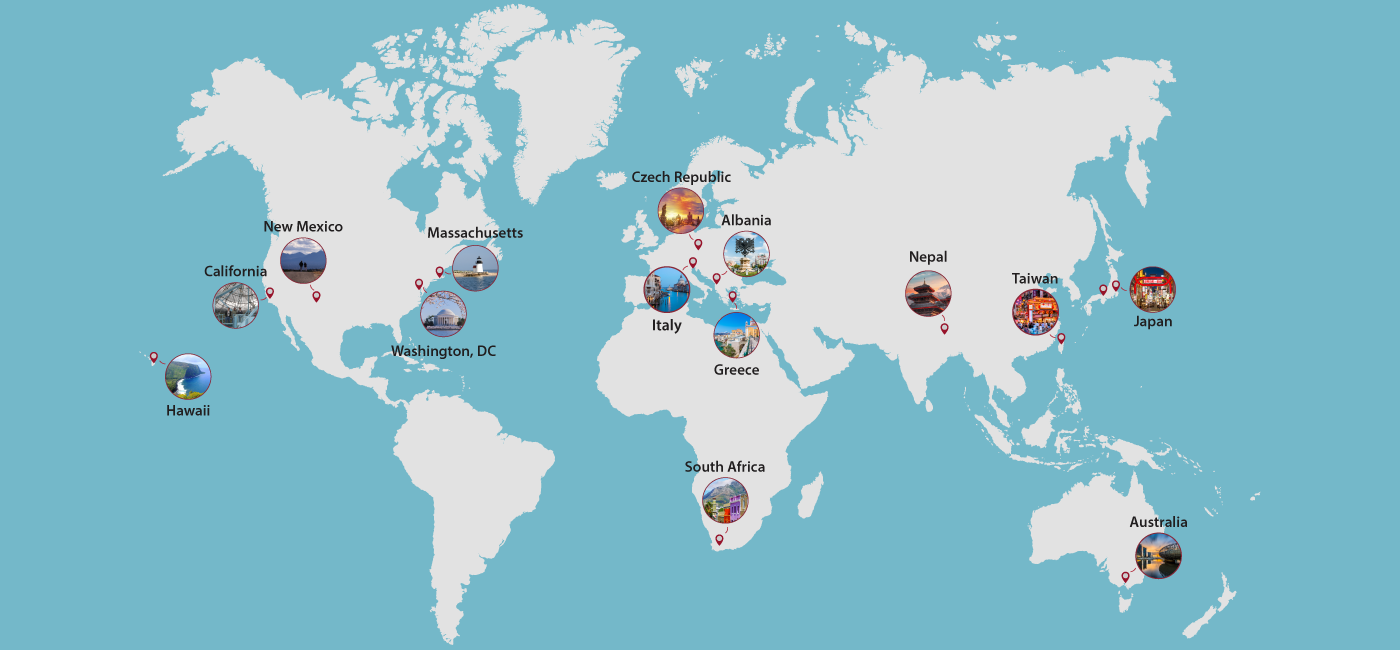
In addition to the 24 students in Hawaii, nearly 275 students are working in these project centers in B-Term ’26.
Cape Town, South Africa, with advisors Alejandro Manga (The Global School—TGS) and Alexandrina Agloro (TGS)
Kathmandu, Nepal, with advisors Peter Hansen (Humanities and Arts) and Clare Gillis (TGS)
Kyoto, Japan, with advisors Alex Sphar (DIGS) and Lorraine Higgins (DIGS)
Melbourne, Australia, with advisors Sarah Molinari (DIGS) and Tahar El-Korchi
(Civil, Environmental, and Architectural Engineering)
Nantucket, Mass., with advisors Seth Tuler (DIGS) and Melissa Butler (DIGS)
Prague, Czech Republic, with advisors Michele Femc-Bagwell (TGS) and Mallory Bagwell (TGS)
Santa Fe, N.M., with advisor Katherine Foo (DIGS)
Syros, Greece, with advisor Robert Hersh (TGS)
Taipei, Taiwan, with advisors Hansong Pu (TGS) and Joseph Sarkis (The Business School)
Albania, with advisors Erica Brozovsky (HUA) and Melissa Belz (DIGS)
Venice, Italy, with advisors Douglas Creed (DIGS) and Ulrike Brisson (TGS)
Washington, D.C., with advisor Adrienne Hall-Phillips (TBS)
MQP
Kyoto, Japan, with center director Adam Powell (Mechanical and Materials Engineering)
Silicon Valley, Calif., with center director Mark Claypool (Computer Science)
Tokyo, Japan, with center director Adam Powell (MME)
Topics

People


