For 25 years, the Namibia Project Center has been a home base for students’ Interactive Qualifying Project (IQP) experiences. In that time, the project center has kept pace with a changing and evolving country.
Alexander Smith, associate professor in the Department of Social Science and Policy Studies (SSPS), has co-directed the center since 2020 but his involvement expands to a total of 15 years. “Namibia is a young and developing economy,” says Smith. “We’ve had a presence and been participants in Namibia’s fascinating development.”
In the project center’s beginning, healthcare, electricity, or employment opportunities dominated the project opportunities; current projects emphasize educational opportunities and entrepreneurship such as modernizing schools in remote locations or support for startups and small business.
“Namibia is such an interesting place,” says Tsitsi Masvawure, assistant professor in The Global School, now in her third term co-directing the Namibia project center. She notes Namibia’s vastly different ecologies—from desert to plains to ocean—are different from what many students have experienced. The well-established sponsor relationships provide continuity and make the project work meaningful and immediately effective, so students see real-time results. “Many of our sponsors have small staff and limited budgets and so the student work is a vital part of what the sponsors do,” says Masvawure.
Amanda Wittman, assistant teaching professor in The Global School, is co-advising in Namibia with Erica Brozovsky, adjunct teaching professor in the Department of Humanities and Arts (HUA), and explains the complexities that students must consider for all project work.
“All of the projects have a technical focus nested within a social and public question or concern. For example, you can’t understand the state of education without a strong understanding of past colonial histories that shape it,” Wittman says, “or design fire safety protocols without understanding urban planning and governmental housing policies.”
This term, student projects include:
- Investigating how starting a Robotics Lego League may support the broader Namibian STEM pipeline
- Creating a data-driven impact documentary for a long-standing after-school program
- Utilizing interviews and design sprints to determine whether generative AI can support networks of teachers who work with out-of-school Namibians
- Interviewing community teachers in the northern riverine region to gather data that will help them design a mobile boat classroom
- Gathering data on fire safety protocols in informal settlements
- Developing an app for the Namibian mining industry to visualize data
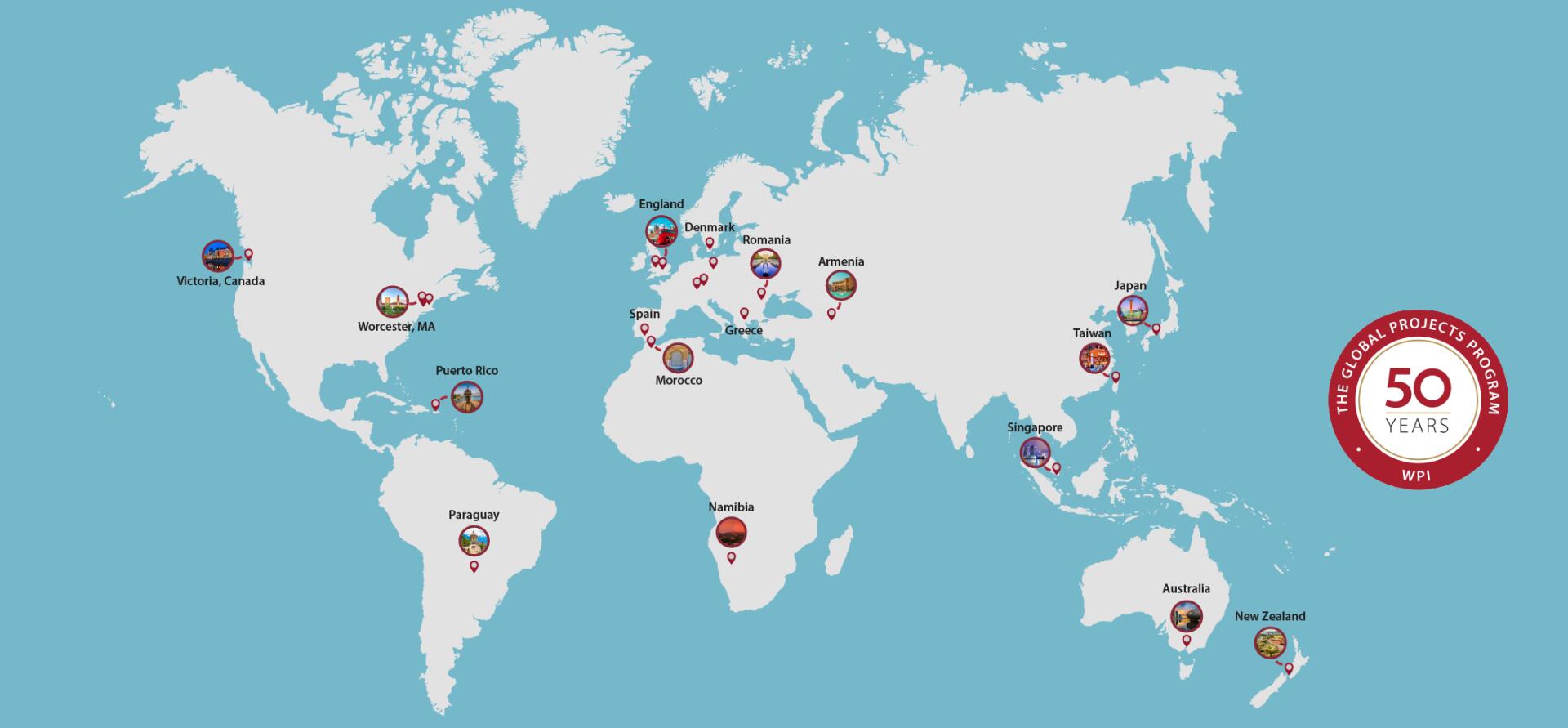
Through WPI’s Global Projects Program, students have many opportunities to complete any of the projects required for graduation including the IQP, Humanities and Arts Requirement, or Major Qualifying Project—at an off-campus project center.
This term, more than 400 students will be completing projects at the following project centers.
Asunción, Paraguay, with advisor Kira Kovnat (The Global School)
Berlin, Germany, with advisors Kent Rissmiller (DIGS) and Beth Eddy (The Global School)
Bucharest, Romania, with advisors Michele Femc-Bagwell (The Global School) and Mallory Bagwell (The Global School)
Cádiz, Spain, with advisors Svetlana Nikitina (HUA) and Brajendra Mishra (Mechanical and Materials Engineering)
Copenhagen, Denmark, with advisors Francesca Bernardi (Mathematical Sciences) and Jeff Solomon (The Global School)
Farm Stay Project Center (Massachusetts), with advisor Lisa Stoddard (DIGS)
Kobe, Japan, with advisor Alex Sphar (DIGS)
Lausanne, Switzerland, with advisors Ingrid Shockey (DIGS) and Alejandro Manga (The Global School)
London, England, with advisors Patricia Agupusi (SSPS) and Nima Kordzadeh (The Business School)
Melbourne, Australia, with advisors Lorraine Higgins (DIGS) and Marc Trudeau (The Global School)
Rabat, Morocco, with advisors Ulrike Brisson (The Global School) and Mark Boyer (The Global School)
San Juan, Puerto Rico, with advisors Sarah Molinari (DIGS) and Martin Cobian (The Global School)
Singapore, with advisor Peter Hansen (HUA)
Taipei, Taiwan, with advisors Hsinhan Hung (HUA) and Greg Snoddy (The Global School)
Thessaloniki, Greece, with advisors Bob Kinicki (The Global School) and Melissa Butler (DIGS)
Victoria, Canada, with advisor Melissa Belz (DIGS)
Water Resource Outreach Center (Massachusetts), with advisor Corey Dehner (DIGS)
Wellington, New Zealand, with advisor Holly Ault (The Global School)
Windhoek, Namibia, with advisors Amanda Wittman (DIGS) and Erica Brozovsky (HUA)
Worcester Community Project Center (Massachusetts), with advisor Corey Dehner (DIGS)
Worcester, England, with advisors Althea Danielski (HUA) and Linda Looft (The Global School)
Yerevan, Armenia, with advisor Aaron Sakulich (Civil, Environmental, and Architectural Engineering)
Topics

People
See my personal website (https://followthe6.com) for a description of my work to incorporate Behavioral Economics into Personal Finance.